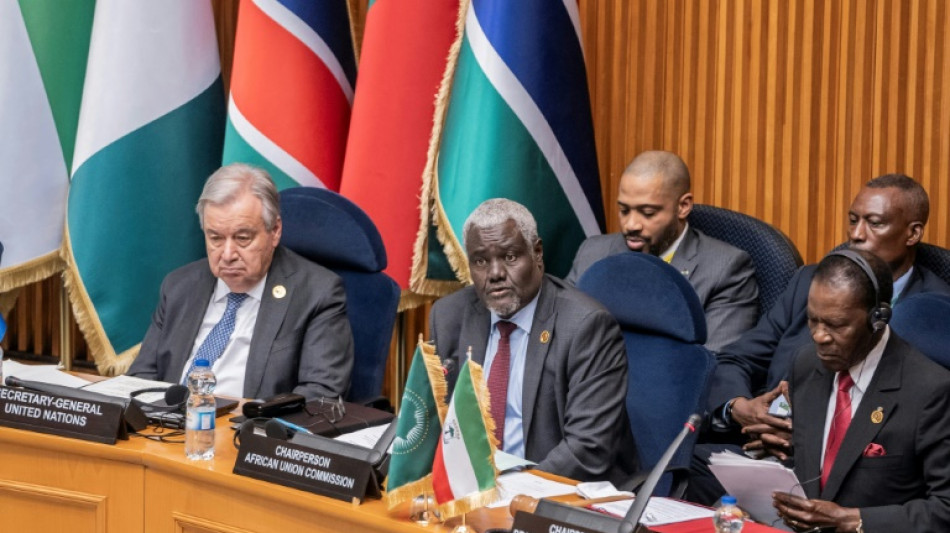
African Union summit opens, overshadowed by DR Congo conflict / Photo: Amanuel Sileshi - AFP

 Malaysia Sues Google for $146m Over Harmful Content

 Black Wind Turbine Blades Reduce Bird Deaths by 74% in Spain Study

 Brazil’s Landless Movement Partners with China to Build Affordable Tractors for Family Farms

 Raheem Sterling Receives Suspended Sentence After Lamborghini Crash

 Luxembourg Pay Rise Delayed as Regional and World Headlines Develop

 Audience to Choose the Set List at Luxembourg's First FAMIL Jukebox Night

 Twickenham Grounds Team Prepares Pitch for Six Matches in Three Days

 Black Friday Discounts Cut Prices on Two Top-Rated Wiper Blades

 Arizona Gun Regulation Battle Intensifies Under New Democratic Legislative Majority

The escalating conflict in Democratic Republic of Congo will dominate an African Union summit opening Saturday, with the DRC president absent after Rwandan-backed forces seized a second major city on his territory.
The 55-nation body meets in the Ethiopian capital Addis Ababa as Africa faces devastating conflicts in the DRC and Sudan -- as well as US President Donald Trump's cuts to US development aid, which have hit the continent hard.
The African leaders represent around 1.5 billion people in a body long criticised for sluggishness, inefficiency and toothless statements.
With the spectre of a regional conflagration rising in eastern DRC, and international bodies increasingly sounding the alarm, the AU has been criticised for its timid approach and observers have demanded more decisive action.
East and southern African leaders on February 8 called for an "immediate and unconditional" ceasefire within five days, but fresh fighting erupted on Tuesday.
Outgoing AU chair Moussa Faki Mahamat told AFP on Friday that "the ceasefire must be observed", adding there was a "general mobilisation" among African nations to stop the clashes.
A meeting of the AU's Peace and Security Council dedicated to the conflict ran late into the night on Friday.
UN Secretary-General Antonio Guterres is scheduled to address the full summit on Saturday.
- DRC president absent -
Neither Rwandan President Paul Kagame nor his Congolese counterpart Felix Tshisekedi attended Friday's meeting.
A government source told AFP Tshisekedi would not attend the summit over the weekend either, saying: "He must closely follow the situation on the ground in DRC."
Tshisekedi, speaking at the Munich Security Conference on Friday, urged nations to "blacklist" Rwanda, condemning Kigali's "expansionist ambitions".
Having captured the key provincial capital of Goma last month, the Rwandan-backed armed group M23 pushed south.
It took a vital airport before marching virtually unchecked into another key city, Bukavu, on Friday, security and humanitarian sources said.
Rwanda has not admitted backing M23 but has accused extremist Hutu groups in DR Congo of threatening its security.
Observers have branded the AU ineffective in the DRC crisis.
"The AU has no power in this conflict and is playing the spectator," Thierry Vircoulon, of the French International Relations Institute (IFRI), told AFP.
International Crisis Group's Great Lakes project director Richard Moncrieff was also pessimistic about what the AU could achieve.
"Kagame has clearly calculated that his best approach is to push forward, and he does have some support," he told AFP.
"Some African leaders have trouble defending Congo because they don't defend themselves."
- New AU chair -
Angolan President Joao Lourenco, heavily involved for several years in futile mediation between Tshisekedi and Kagame, will take over the rotating presidency of the AU at the weekend -- a ceremonial role that changes hands annually.
There will also be a new chairman -- the AU's top job, managing operations and policies for four years -- which is chosen by vote on Sunday.
Three candidates are vying to replace Chad's Moussa Faki Mahamat, who has reached the two-term limit.
They are Djibouti's Foreign Minister Mahmoud Ali Youssouf, Kenyan opposition veteran Raila Odinga and Madagascar's ex-foreign minister Richard Randriamandrato.
The position was reserved for an East African this time.
Candidates need the backing of two-thirds of member states with the right to vote, excluding countries suspended following coups, including Gabon, Mali and Niger.
The United Arab Emirates on the sidelines of the summit on Friday pledged more than $200 million of further humanitarian aid to Sudan, stricken by civil war.
Meanwhile, the summit's ostensible theme -- the question of reparations from western nations over slavery -- remains on the table.
E.Borba--PC

