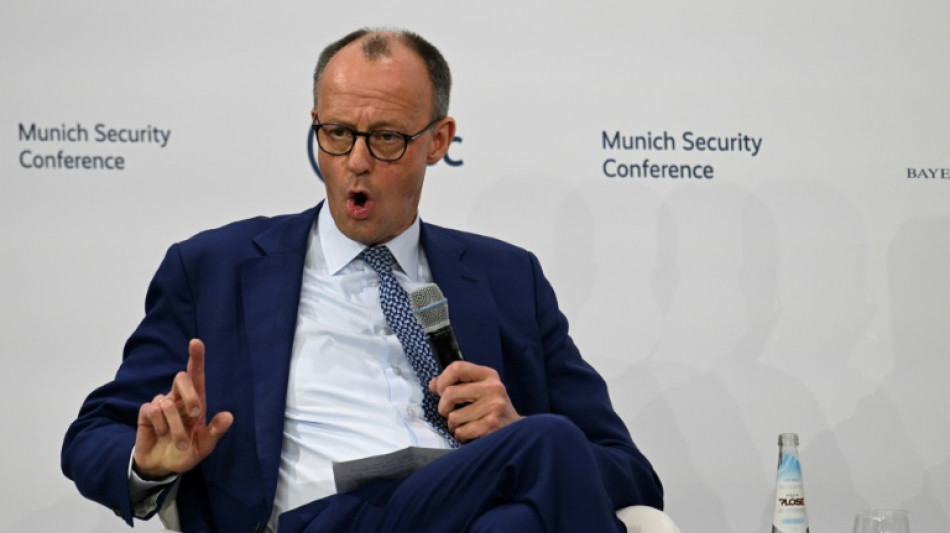
German election favourite Merz sets out foreign policy plans / Photo: THOMAS KIENZLE - AFP

 Malaysia Sues Google for $146m Over Harmful Content

 Black Wind Turbine Blades Reduce Bird Deaths by 74% in Spain Study

 Brazil’s Landless Movement Partners with China to Build Affordable Tractors for Family Farms

 Raheem Sterling Receives Suspended Sentence After Lamborghini Crash

 Luxembourg Pay Rise Delayed as Regional and World Headlines Develop

 Audience to Choose the Set List at Luxembourg's First FAMIL Jukebox Night

 Twickenham Grounds Team Prepares Pitch for Six Matches in Three Days

 Black Friday Discounts Cut Prices on Two Top-Rated Wiper Blades

 Arizona Gun Regulation Battle Intensifies Under New Democratic Legislative Majority

Germany's conservative election frontrunner Friedrich Merz pledged a stronger role for Berlin in the EU and muscular support for Ukraine as he outlined his foreign policy vision at the Munich Security Conference.
In what German media dubbed Merz's "diplomatic speed-dating", the CDU leader hoping to be the next chancellor joined speaking panels and met a long list of international policy-makers at the annual event.
Merz, 69, is a committed European and trans-Atlanticist who has argued the EU must be united to deal confidently with US President Donald Trump, whom he has labelled "predictably unpredictable".
He may soon get to try his theories in practice if the polls are right, giving him a strong lead over centre-left Chancellor Olaf Scholz ahead of elections a little over a week away.
In talks with global leaders at the conference, Merz said he was "hearing very often... that there is obviously a lack of German leadership within the European Union".
"I fully agree with all those who are demanding more leadership from Germany and frankly I'm willing to do that because I'm seeing that Germany is in a strategic position in the centre of Europe," Merz said from the main stage.
- In chancellor mode -
Merz's agenda for the conference, which attracts high-level guests from around the globe, was packed out "like a chancellor's", German daily Bild said.
On social media, Merz posted pictures of himself already in chancellor mode, shaking hands with NATO chief Mark Rutte, EU foreign policy boss Kaja Kallas and the Chinese Foreign Minister Wang Yi.
German weekly Der Spiegel said that while Merz was engaged in "diplomatic speed-dating" to prepare the ground for his expected turn of office, Scholz looked like a "lame duck".
Unlike Scholz, who was seemingly snubbed by Vice President JD Vance during the conference -- having met him earlier in the week in Paris -- Merz was granted an audience with the number two man to Trump.
They agreed the Ukraine war must "end as soon as possible", Merz said afterwards, adding that he had impressed upon Vance the need for "close coordination between America and Europe".
However, after Vance then delivered a blistering attack on the EU and its policies on immigration and free speech that stunned many, Merz said the intervention was an "overreach".
Merz was welcomed by others at the conference as if the outcome of the February vote was a foregone conclusion.
The moderator of a panel with Merz and political leaders from Sweden, Denmark and the Czech Republic mistakenly introduced the candidate as "chancellor" before correcting herself.
- Ukraine support -
Merz used the event, sitting alongside heads of state and government, to emphasise what he would do differently to Scholz as chancellor, including on the Ukraine war raging for almost three years.
Whereas Scholz has flatly refused to send long-range missiles to Kyiv, Merz said his intent "remains to deliver, within a European coordinated framework, more weapons to Ukraine".
He also sketched out his position vis-a-vis Germany's most signficant ally, the United States, after Trump shocked allies by starting direct talks with Russian President Vladimir Putin to end the conflict in Ukraine.
Trump said Kyiv's desire to join NATO was impractical, but Merz affirmed his backing for Ukrainian accession to the military alliance.
"There is an agreement within NATO that Ukraine gets the perspective of becoming a member... I don't agree with anybody who is putting NATO membership off the table," Merz said.
Merz has also sketched out plans to bolster ties with European allies, notably Paris and Warsaw, which he says deteriorated badly under Scholz, and backed calls to spend more on defence.
But in the midst of the election campaign, Merz did not commit to a spending target or say where the money for more arms would come from.
"From 2027 on, we have to spend much more money from the regular budget... and the question is open where this money comes from," he said. "I'm open to have any debate on resources."
M.A.Vaz--PC

