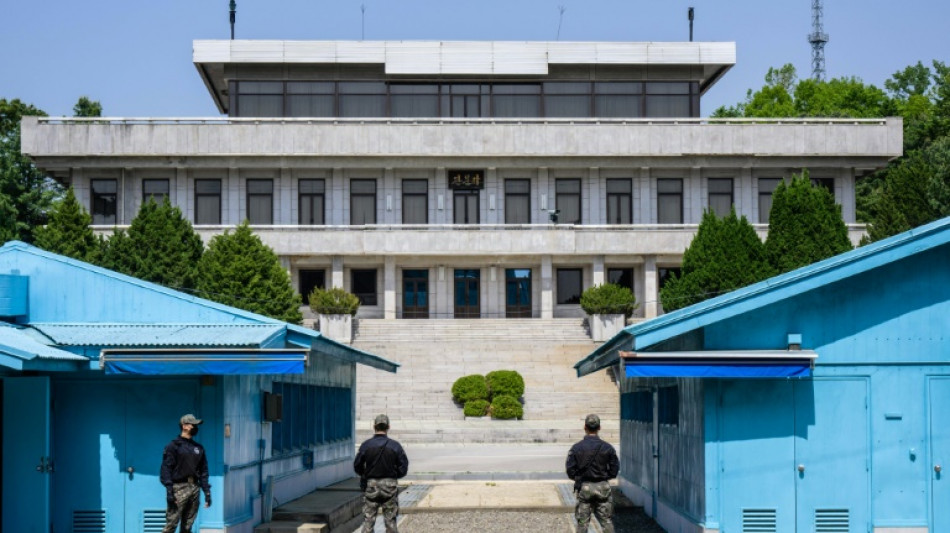
South Korean blockbuster 'JSA' strikes a chord 25 years on / Photo: Anthony WALLACE - AFP/File

 Malaysia Sues Google for $146m Over Harmful Content

 Black Wind Turbine Blades Reduce Bird Deaths by 74% in Spain Study

 Brazil’s Landless Movement Partners with China to Build Affordable Tractors for Family Farms

 Raheem Sterling Receives Suspended Sentence After Lamborghini Crash

 Luxembourg Pay Rise Delayed as Regional and World Headlines Develop

 Audience to Choose the Set List at Luxembourg's First FAMIL Jukebox Night

 Twickenham Grounds Team Prepares Pitch for Six Matches in Three Days

 Black Friday Discounts Cut Prices on Two Top-Rated Wiper Blades

 Arizona Gun Regulation Battle Intensifies Under New Democratic Legislative Majority
Twenty-five years ago, director Park Chan-wook risked jail to make a movie about friendship between North and South Korean soldiers, striking box office gold and beginning his actors' ascent to global stardom.
Relations between the two Koreas have since plunged, with Pyongyang renouncing its long-held goal of unification and last week destroying a venue that traditionally hosted reunions of families separated by decades of divisions.
Park said his smash hit "Joint Security Area" still strikes a chord a quarter of a century later.
"It is a sad reality that this movie's themes still resonate with the younger generation," he told reporters in Seoul this month.
"I hope that by the 50th anniversary, we will be able to discuss it as just a story from the past."
The film is widely regarded as a masterpiece of South Korean cinema and its cast members have gone on to wider success, including "Squid Game" actor Lee Byung-hun and Song Kang-ho from Oscar-winning "Parasite".
But when he set out to make it, Park -- best known today for action thriller "Oldboy" and mystery romance "Decision to Leave" -- was far from a prominent director. His first two feature films flopped.
Desperate for success, Park delved into one of the most sensitive topics: the decades-long division of the Korean peninsula.
At the time, Park feared that his tale of inter-Korean bonding could fall foul of laws banning the "glorification" of the communist-run North.
"We prepared ourselves" for the prospect of being jailed, he told reporters.
- Smash hit -
But history was on his side.
Three months before the film's September 2000 release, then-South Korean president Kim Dae-jung held a historic summit with his North Korean counterpart Kim Jong Il in Pyongyang.
Against the backdrop of that reconciliation, "Joint Security Area" swept almost all domestic film awards that year. It was also nominated for best film at the Berlin film festival and became South Korea's highest-grossing movie up to then.
Actor Lee, now one of South Korea's biggest stars, said he was so thrilled by its success that he watched it 40 times in the cinemas to see the audience reactions.
Local media even reported that Kim Jong Il -- a known film buff -- had seen it.
The film is set in the eponymous Joint Security Area, located inside the Demilitarized Zone, the 250-kilometre (155-mile)-long strip of land that divides the Korean peninsula.
It is among the most heavily fortified areas on the planet -- and the only place where soldiers from the North and South stand face to face.
The tragic film tells the story of secret friendships that form after two North Korean troops assist a South Korean soldier who accidentally steps on a landmine, leading them to bond over South Korean pop music and chocolate desserts.
- Breaking barriers -
"Before 'Joint Security Area', portraying North Korean soldiers in South Korean cinema was somewhat considered taboo," Nam Dong-chul, a film critic and chief programmer at the Busan International Film Festival, told AFP.
"This film broke that barrier by depicting ordinary and relatable North Korean soldiers," he said.
"At the same time, it was a successful and well-crafted blockbuster, marking a significant advancement in the history of Korean cinema."
South Korea has since established itself as a global cultural powerhouse.
Some credit "Joint Security Area" with laying the groundwork.
The film was a "driving force behind the creation of films in the Korean cinema industry that combine the director's artistic vision with commercial viability," said Jerry Kyoungboum Ko, head of film business for CJ ENM, the South Korean studio that distributed the movie.
The real-life JSA has since been a site of both reconciliation and tragedy.
North Korean leader Kim Jong Un met with then-South Korean president Moon Jae-in there in 2018.
The following year, Kim also shook hands with US President Donald Trump across the division line.
But it also saw North Korean soldiers open fire during a defection by one of their comrades in 2017.
And in 2023, troops were re-armed on both sides of the JSA, breaking an inter-Korean military pact signed during more optimistic times.
Park said he is often asked when the film is shown abroad if it was shot at the real-life JSA, also known as Panmunjom.
"I would always respond by saying that if we could have filmed at the actual location, this film might not have been necessary at all."
J.Oliveira--PC

