UN nuclear chief to view contaminated Fukushima soil / Photo: Atish PATEL - AFP/File

 UK fears grow over AI giant Palantir's health service deal

 Empty nets in Latin America as fish flee El Nino

 Meidroth blasts White Sox through, Phillies survive in MLB playoffs

 'Catastrophic': Swiss glaciers lose fifth of mass in five years

 California roller coaster shut after brain damage claims

 Panama ministers push for reopening of huge open-pit copper mine
 Bohm's blast keeps Phillies alive in MLB playoffs
 US judge accepts Paramount's Warner Bros. buyout settlement

 Global stocks mixed as markets weigh higher oil prices, bond yields

 Marsh hails improvements after Australia win final one-day international

 Hegseth says US cut number of generals, admirals by 20%

 Kanye West's Russian concerts have been cancelled, organisers say

 First Hollywood, now Fat Bear Week: nepobaby wins Alaska contest

 Barcelona lay down marker in Women's Champions League, Arsenal slip up

 US pushes against overproduction with eye on China at G20 meeting

 Swiss FA withdraws support for FIFA chief Infantino
 Man City's meteoric rise clouded by financial scandal

 Polish activists open first abortion pill locker in Warsaw

 NHL Avalanche ink Bednar to four-year coaching deal

 Polish activists opens first abortion pill locker in Warsaw

 Turkey says news site closed for 'LGBTQ propaganda'

 Oil companies close in on Venezuela despite hurdles

 Turkey freezes ex-minister's assets as fund scandal grows

 Guardiola backs Man City after bombshell guilty verdicts
 G20 trade ministers open talks under strain of Trump tariffs
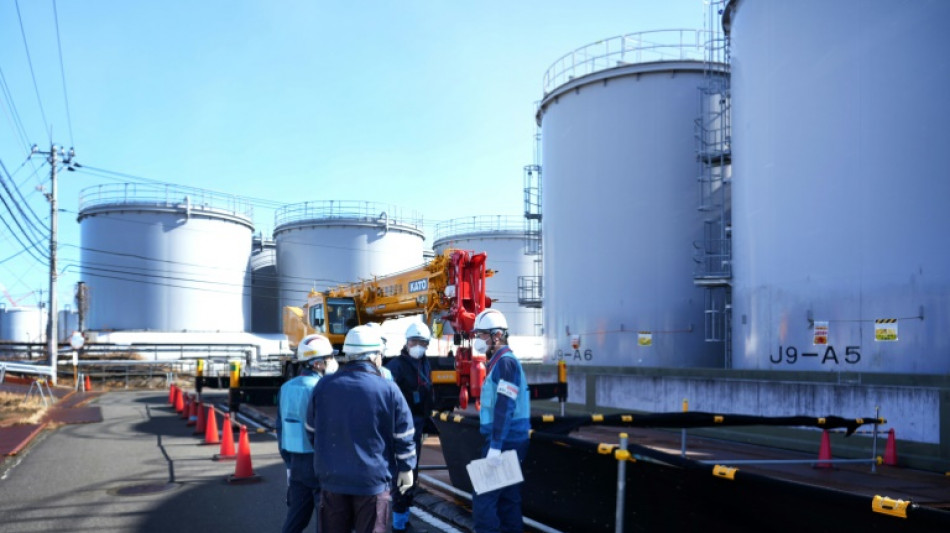
The UN nuclear watchdog chief will make his first visit this week to storage facilities for vast quantities of soil contaminated in the 2011 Fukushima disaster.
Japan's government must decide what to do with the soil -- enough to fill 10 baseball stadiums -- scraped from the wider Fukushima region as part of efforts to remove harmful radiation.
That is on top of the monster task of decommissioning the Fukushima Daiichi plant, which went into meltdown after being hit by a tsunami in the worst nuclear disaster since Chernobyl.
Rafael Grossi, head of the International Atomic Energy Agency (IAEA), will tour the plant on Wednesday. He will also be shown some of the 13 million cubic metres of soil and 300,000 cubic meters of ash from incinerated organic material.
For comparison, the capacity of the Tokyo Dome arena, where pop superstar Taylor Swift performed last year, is 1.24 million cubic metres.
Japan plans to recycle roughly 75 percent of the removed soil -- the portion found to have low radioactivity levels.
If this material is confirmed safe, authorities want to use it for building road and railway embankments among other projects.
The remaining soil will be disposed of outside the Fukushima region ahead of a 2045 deadline.
The central government has said it intends to confirm the disposal site this year, with Fukushima's regional governor reportedly urging it to come up with a plan quickly.
In September, the IAEA published its final report on the recycling and disposal of the soil, saying that Japan's approach was consistent with UN safety standards.
- Decades-long clean-up -
The Fukushima plant on Japan's northeast coast was hit by a huge earthquake-triggered tsunami in March 2011 that killed 18,000 people.
Although almost all areas of Fukushima region have gradually been declared safe for residents, many evacuees have been reluctant to return as they are worried about persistent radiation or fully resettled elsewhere.
Stripping topsoil from the land was "very effective" to decontaminate areas close to waterways, said Olivier Evrard, research director at France's Atomic Energy Commission (CEA).
"However, it also has many disadvantages. It had an enormous cost, it generated a massive amount of waste and still poses fertility issues" for agriculture, said Evrard, an expert on the Fukushima decommissioning process.
It stands in contrast to the decision to fence off a large area after the 1986 Chernobyl disaster and more or less "leave it to wildlife", he told AFP.
"You can imagine it's not very simple to find willing takers" for the soil, he cautioned, saying that another option would be to wait for radioactivity levels to decrease naturally.
The IAEA has been monitoring the decades-long clean-up process of the region and the plant itself.
But the most dangerous part -- removing around 880 tonnes of radioactive fuel and rubble from the reactors -- has only just begun, with one tiny sample removed by a robotic claw so far.
Plant operator TEPCO in August 2023 began discharging 1.3 million tonnes of collected groundwater, seawater and rainwater, along with water used for cooling the reactors, into the sea.
The water release has been endorsed by the IAEA, and TEPCO says all radioactive elements have been filtered out except for tritium, levels of which are within safe limits.
But countries including China and Russia have criticised the release and banned Japanese seafood imports over safety concerns.
During Grossi's visit -- his fifth to Japan in the role -- experts from the IAEA and countries including China and South Korea will take fresh seawater and fish samples.
This is "to further increase the transparency" of the water release process, an official from Japan's energy agency said.
China in September said it would "gradually resume" importing seafood from Japan but this has yet to begin.
E.Ramalho--PC