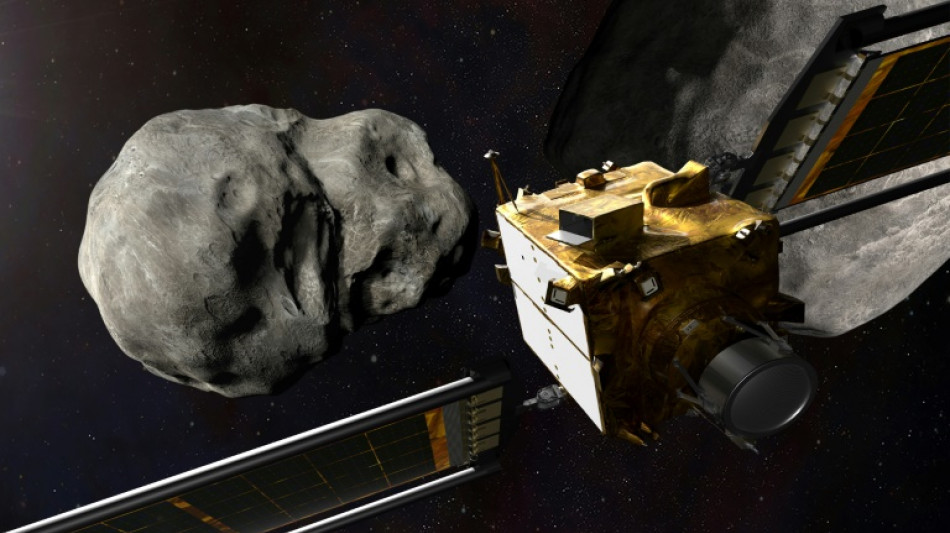
Do look up: How Earth can defend itself against asteroid / Photo: Handout - NASA/AFP/File

 California roller coaster shut after brain damage claims

 Panama ministers push for reopening of huge open-pit copper mine

 Bohm's blast keeps Phillies alive in MLB playoffs
 US judge accepts Paramount's Warner Bros. buyout settlement

 Global stocks mixed as markets weigh higher oil prices, bond yields

 Marsh hails improvements after Australia win final one-day international

 Hegseth says US cut number of generals, admirals by 20%

 Kanye West's Russian concerts have been cancelled, organisers say

 First Hollywood, now Fat Bear Week: nepobaby wins Alaska contest

 Barcelona lay down marker in Women's Champions League, Arsenal slip up

 US pushes against overproduction with eye on China at G20 meeting

 Swiss FA withdraws support for FIFA chief Infantino

 Man City's meteoric rise clouded by financial scandal

 Polish activists open first abortion pill locker in Warsaw

 NHL Avalanche ink Bednar to four-year coaching deal

 Polish activists opens first abortion pill locker in Warsaw

 Turkey says news site closed for 'LGBTQ propaganda'

 Oil companies close in on Venezuela despite hurdles

 Turkey freezes ex-minister's assets as fund scandal grows

 Guardiola backs Man City after bombshell guilty verdicts

 G20 trade ministers open talks under strain of Trump tariffs

 France in talks with UK to end 2025 migrant accord: ministry

 Europe's surging inflation spreads gloom in stock markets

 Truth commission demands compensation for Sweden's Sami people
 Japan win marathon penalty shootout to set up South Korea gold-medal clash

There is a very small chance that an asteroid capable of taking out an entire city could strike Earth in less than eight years. But even if this asteroid is hurtling our way, humanity is now able to defend itself against such a threat, experts say.
The odds that the recently discovered asteroid will hit Earth on December 22, 2032 have now risen to 3.1 percent, NASA said on Tuesday, the highest probability for an impact by such a large space rock in modern forecasting.
"Don't panic," Richard Moissl, head of the European Space Agency's planetary defence office, told AFP.
As astronomers gather more data, the odds of a direct hit are widely expected to edge upwards before rapidly dropping down to zero.
However, even in the unlikely event that the probability does keep rising up to 100 percent, "we are not defenceless", Moissl emphasised.
Here are some of the ways that humanity could deflect or destroy the asteroid known as 2024 YR4.
- Smash a spacecraft into it -
Only one planetary defence strategy has been tried out on an actual asteroid.
In 2022, NASA's Double Asteroid Redirection Test (DART) deliberately smashed a spacecraft into the 160-metre-wide Dimorphos asteroid, successfully altering its orbit around a larger space rock.
An advantage of this plan is that we could hit the 2024 YR4 asteroid with multiple spacecrafts, observing how each one changed its trajectory, Bruce Betts, chief scientist for the nonprofit Planetary Society, told AFP.
The asteroid discovered in December is estimated to be 40-90 metres wide -- roughly half the size of Dimorphos.
"You have to take care not to overdo it," Moissl warned.
If the spacecraft partially destroyed the asteroid, it could send "bits flying off" that still head towards Earth, he said.
If this kind of mishap changed the eventual impact site on Earth -- for example, "from Paris to Moscow" -- that would likely cause major problems back home, Betts added.
- Tractor, ion beams, paint -
A separate idea called a gravity tractor involves a large spacecraft flying up near the asteroid and -- without touching it -- using its gravitational pull to tug it away from Earth.
Another non-contact plan would put a spacecraft near the asteroid armed with thrusters that would exert a "constant stream of ions" to shove the asteroid off course, Moissl said.
Scientists have also considered spray painting one side of the asteroid white, increasing its reflectiveness so it slowly changes trajectory.
These subtler strategies would require reaching the asteroid sooner than for some more severe options.
- The nuclear option -
Or we could also just blow it up with a nuclear bomb.
Rather than drilling a nuclear weapon deep into an asteroid -- as depicted in the 1998 sci-fi action movie "Armageddon" -- this would likely involving detonating a bomb nearby.
Last year, US researchers testing out this theory on a marble-sized mock asteroid in the lab found that the x-rays from a nuclear blast would vaporise its surface and send it shooting off in the opposite direction.
Even setting aside the ethical, political and legal issues of sending nukes into space, this is considered more of a last-ditch plan for kilometres-wide asteroids like the one that killed off the dinosaurs.
And again, there is a risk that a nuclear explosion could still send unpredictable chunks hurtling towards Earth.
- Lasers -
Along less dangerous but similar lines, another idea is to shoot laser beams from a spacecraft to vaporise the side of an asteroid, pushing it away.
Lab experiments suggest this plan is viable, but it is not one of the "top techniques" being looked at, Betts said.
- If all else fails -
If necessary, deflecting this asteroid is "doable, but it depends on the speed at which we move as a planet", Moissl said.
While experts and space agencies will make their recommendations, ultimately the decision on how to tackle the asteroid will be made by world leaders.
If all else fails, we will have a good idea of the strike zone of the asteroid -- which is not a "planet killer" and at most could threaten a city, Moissl said.
This means that preparing for impact, potentially including evacuation if the area is populated, will be the last line of defence.
"Seven and a half years is a long time to prepare," Moissl said, re-emphasising that there is a roughly 97 percent chance the asteroid will miss Earth.
C.Amaral--PC