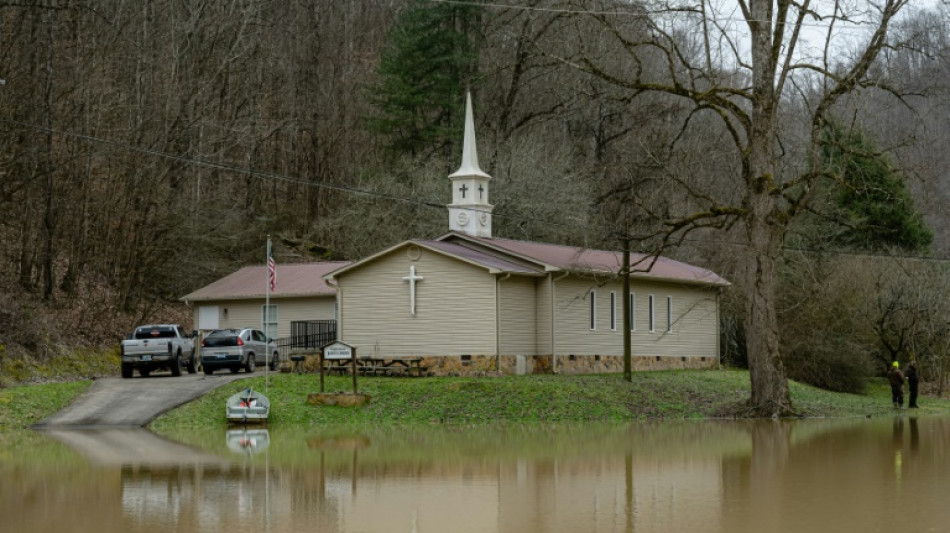
Proposed 'weather control' bans surge across US states / Photo: Jon Cherry - GETTY IMAGES NORTH AMERICA/AFP

 US pushes against overproduction with eye on China at G20 meeting

 Swiss FA withdraws support for FIFA chief Infantino
 Man City's meteoric rise clouded by financial scandal

 Polish activists open first abortion pill locker in Warsaw

 NHL Avalanche ink Bednar to four-year coaching deal

 Polish activists opens first abortion pill locker in Warsaw

 Turkey says news site closed for 'LGBTQ propaganda'
 Oil companies close in on Venezuela despite hurdles
 Turkey freezes ex-minister's assets as fund scandal grows
 Guardiola backs Man City after bombshell guilty verdicts
 G20 trade ministers open talks under strain of Trump tariffs

 France in talks with UK to end 2025 migrant accord: ministry

 Europe's surging inflation spreads gloom in stock markets

 Truth commission demands compensation for Sweden's Sami people

 Japan win marathon penalty shootout to set up South Korea gold-medal clash
 Djokovic grinds out opening-round win at China Open
 Northern Ireland police probe blockade of disputed parade

 UK PM Burnham reopens divisive debate on rejoining EU

 Man City future in doubt after guilty verdict
 'Do something,' begs Iranian woman after death sentence over protests

 China extends 52-year unbeaten record as Games organisers say sorry
 In Manchester, people say City scandal is 'shame for football'
 Stocks lacklustre as inflation data weighs on sentiment
 Israel-bound plane rerouted, pilots wounded in reported fight

 Truth commission on Sweden's Sami people seeks redress

Fake stories that atmospheric experiments are triggering natural disasters have led to US states pushing blanket bans on weather modification, which experts say may jeopardize current local scientific programs and hinder future research.
From recent deadly flooding in Kentucky to the Florida and North Carolina monster hurricanes of 2024, Americans have amplified increasingly conspiratorial explanations for extreme weather events -- even blaming manufactured clouds blocking sunlight for the devastation.
In response, lawmakers are moving to criminalize legitimate scientific experiments in the atmosphere.
In Kentucky, Republican John Hodgson told AFP he introduced a bill because his constituents "do not want to allow any government attempts to modify the solar radiation or weather."
But no such government program played a role in the state's weather whiplash.
"None of this is government control," said Shane Holinde, a meteorologist at the Kentucky Climate Center.
"It is all Mother Nature," he told AFP of the "rollercoaster of a month."
The severe weather events claimed 23 lives across the state, according to Democratic Governor Andy Beshear.
The actions in Kentucky and other states highlight how misinformation has become entrenched in political discourse, driving legislative efforts in response to conspiracy theories.
Tennessee is the first and only state to have passed such a law, despite witness testimony citing chemtrails -- a conspiracy that purports toxic chemicals are being sprayed from aircraft.
Kentucky bill co-sponsor, Republican Steve Rawlings, also alluded to them, telling local media his efforts address constituents' concerns of "streaks in the skies."
The efforts reflect general confusion over beneficial, small-scale activities, such as targeted cloud seeding programs in the arid West and large-scale geoengineering projects that are still decades away from possible implementation.
For example, the text targets stratospheric aerosol injection -- a futuristic technique that the wider public knows little about.
Scientists hope the method might allow them to shift the total energy balance between the Earth and the Sun and reduce some of the most blatant effects of climate change, including supercharged floods and storms, but it is currently only at a research stage.
The Kentucky legislation mirrors bills advancing in Florida and Arizona since the start of the year.
Edward Parson, environmental law professor at UCLA, said such bills often seek "to prohibit something that is not happening."
He warned that as more states consider these laws, people will be misled to believe they are "a sensible, legitimate" issue.
- Blanket bans -
As global warming makes weather extremes more likely, each new natural disaster brings further pushback against "weather control" from an increasingly loud crowd, including prominent political figures such as Republican Congresswoman Marjorie Taylor Greene.
Blanket bans also run the risk of hindering projects shown to benefit farmers by managing hyper-local precipitation and reducing crop losses from hail.
"These state legislations feel a little bit like a knee-jerk reaction," said Deborah Sivas, environmental law professor at Stanford University, while cautioning regulation around larger geoengineering experiments may prove necessary on an international scale.
"There is a bigger conversation to be had about if you can do things to manipulate weather patterns" over the ocean or other large shared areas, she said.
Dana Willbanks of Columbia University's Climate Science Legal Defense Fund is tracking science-silencing initiatives nationwide.
She pointed to a surge of climate-skeptic discourse and censorship at all levels of government since the start of the second Trump administration, down to city councils and school boards.
"We are going to start seeing more and more outrageous bills" like bans on weather control, she said.
F.Carias--PC