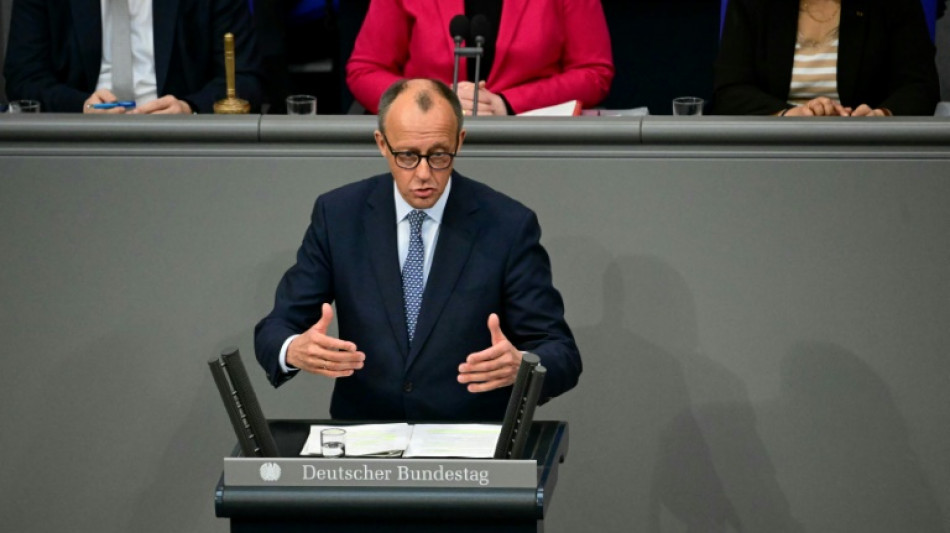
Germany's Merz urges MPs to back spending bonanza in fiery debate / Photo: Lilith von Borstel - AFP

 South Korea break China hearts to reach Asian Games football final

 Eala storms into Asian Games semi-finals to thrill adoring fans

 Turkey freezes ex-minister's assets as fund crisis grows

 What we know about the North Korean POW dispute

 Most equities rise after oil price plunge, US data in focus
 Polar oceans transformed as warming melts ice habitats: research

 Lost shark becomes viral star in South Korea

 Dangote to launch $16bn refinery in Kenya

 North Korean leader 'extremely obese': Seoul spy agency
 Yankees and pope-backed White Sox start MLB playoffs with wins

 Malaysia's ex-PM Mahathir in hospital for observation

 'No limits': Marathon world record holder Sawe chasing history

 Countdown begins to biggest-ever Rugby World Cup

 Bangladesh women lose ground after quota reform

 Vietnam admits 'differing opinions' on Hanoi development

 Stocks temper gains as oil pares heavy losses, US data in focus
 New Zealand denies breaching climate commitments to EU
 Albert becomes youngest US scorer in 4-2 win over Chile

 Pirate island's plunging population shows Greece's demographic decline

 With elections ahead, Latvia's Russian-speakers reject Moscow's help

 Brazil football clubs face massive sponsorship blow from betting ban

 ChatGPT maker wants to be the App Store for AI as safety concerns grow

 Women fight fires and sexism in Indonesian Borneo

 Forsling's OT blast lifts Florida over Carolina in NHL opener

 Hurricane Polo sweeps over Mexico's Pacific coast, heads inland
Germany's likely next leader Friedrich Merz said Thursday urgent action was needed to boost the country's under-resourced military and ailing economy, as he defended plans for a spending bonanza during a fiery parliamentary debate.
Merz's conservatives and the centre-left Social Democrats (SPD) -- in talks to form a coalition after February's general election -- unveiled the plans for vast extra outlays last week, and are now racing to push them through the current legislature.
"In view of the alarming security situation in Europe in every respect and the growing economic challenges in our country, far-reaching decisions... cannot be postponed any longer," Merz told lawmakers at the start of the debate.
When it came to the armed forces in particular, "any further delay" in boosting spending "would be irresponsible", he said. "We must now take action to significantly increase our defence capabilities, and we must do so quickly."
Fraying Europe-US ties under President Donald Trump have fuelled calls for Germany, long dependent on the US security umbrella, to quickly boost military funding, while infrastructure spending is seen as a route to pull Europe's top economy out of stagnation.
Merz's plans envisage exempting defence spending from the country's strict debt rules when it exceeds one percent of GDP and setting up a 500-billion-euro ($545-billion) fund for infrastructure investments.
While the plans have won praise from German allies abroad, who grew weary of inaction under outgoing Chancellor Olaf Scholz, Merz faces a desperate scramble to push them through parliament.
- 'History is knocking' -
As the measures involve a change to the constitutionally enshrined "debt brake", which limits government borrowing, they require a two-thirds majority in parliament.
This means that Merz's CDU/CSU bloc and SPD want to get them passed before a new parliament convenes later this month in which far-right and far-left parties, who have expressed scepticism about extra defence spending, will be in a position to block the measures.
Stressing that action needed to be taken quickly, SPD parliamentary leader Lars Klingbeil told MPs: "When history knocks at our door, then we must open it -- we don't know if we will have a second chance".
But there are hurdles ahead, particularly after the Greens -- whose votes are needed to reach the two-thirds mark -- threatened to torpedo the plans, complaining they were rushed and did not do enough for climate protection.
Green lawmaker Irene Mihalic criticised the attempt to force through major changes to the constitution "with the old majorities" in parliament, rather than waiting for the new parliament to convene.
Such a manoeuvre "shows complete ignorance of the reality in our country and of this parliament, and I fear it damages trust in politics as a whole," she said during the debate.
- Legal challenges -
Parliament is convening for two special sessions to debate the measures, on Thursday and also next Tuesday -- when a vote on the proposals is also to take place.
Merz's plans also face another threat with both the far-right Alternative for Germany (AfD) -- which came second in the election -- and the far-left Die Linke party having filed legal challenges at the constitutional court, arguing there will be insufficient time for consultations.
If Merz fails to get his plans through, observers fear he would lose momentum and his future government could face the same paralysis that beset Scholz's ill-fated, three-party coalition, whose November collapse precipitated last month's election.
The pressure has only increased on him in recent weeks as Trump has become increasingly hostile towards Ukraine and made overtures to Russia.
Still, the incoming government would have options to boost spending if the current parliament fails to pass the plans next week, analysts said.
Once Merz becomes chancellor -- likely in late April -- he could suspend the debt brake by invoking an emergency, as the previous government did during the pandemic, although this would only be a stopgap.
Merz's conservative bloc and the SPD are also due to begin full-fledged negotiations on forming a coalition Thursday after concluding exploratory talks at the weekend.
The fate of the spending plans could have a bearing on these talks, noted Der Spiegel news outlet.
A failure to push them through parliament "would possibly also put an end to the coalition negotiations", it said.
A.Santos--PC