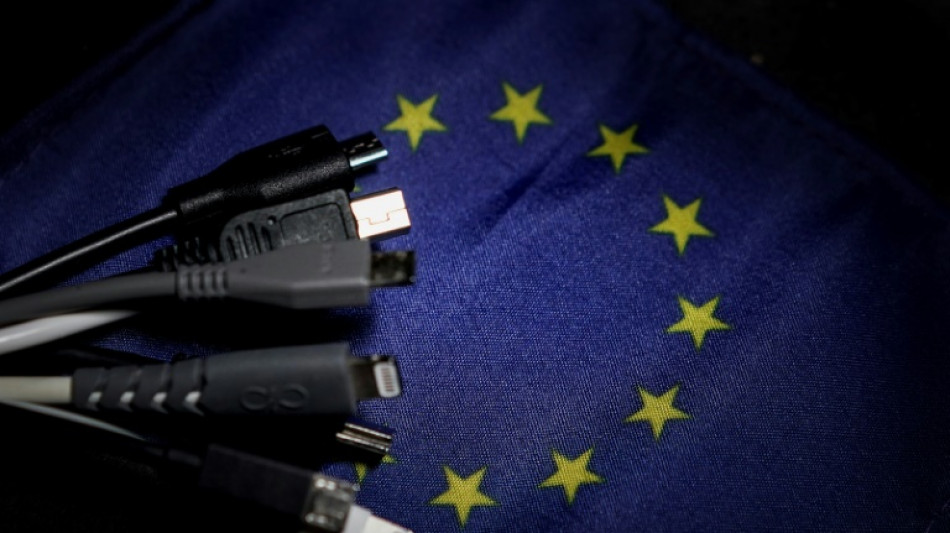
EU agrees single charger standard, in blow to Apple / Photo: Kenzo TRIBOUILLARD - AFP/File

 UEFA's legal move 'massive escalation' in bitter Infantino feud
 MEXC Launches Earn Plus With Limited-Time Event Offering Up to 800% APR Booster

 Norway's new King Haakon VIII, popular face of shaken monarchy

 Stocks rise ahead of Fed chair's policy speech

 Norway's new King Haakon VII, popular face of shaken monarchy

 Last-wicket duo take England to 290 all out in 2nd Test against Pakistan
 MPSC Drug Inspector Exam Leak: Rutuja Patil Allegedly Paid Rs 50 Lakh for Leaked Paper

 Japan spent record $96 bn in yen interventions: ministry

 Nepal-China floods disaster: Latest developments
 Duplantis needs A-game to fend off Karalis pressure

 Architect Minenhle Makhanya Ordered to Repay R147 Million for Nkandla Upgrades

 Iran says still open to diplomacy as war with US hits six months

 20,000 Salmon Return to Klamath River Following Dam Removal, Yet Recovery Faces Ongoing Challenges

 King Harald, 'symbol' of Norway, dead at 89

 Norway's new King Haakon, popular face of shaken monarchy
 Most stocks rise as attention turns to Warsh speech

 Japanese rugby U-turns on limits on naturalised players

 Norway's King Harald dead at 89

 Climate change hits trout and salmon in UK's prized chalk streams

 Škoda Octavia Marks 30 Years With Nearly 7.9 Million Units Produced

 Nepal seeking to reach survivors in tunnel as risk of new floods rises

 Anger in Austria over business park on former Nazi camp site

 In shadow of Premier League, Serie A flexes financial muscle

 Tanker pays record $5.3 mn to transit Panama Canal: administrator

 Pilgrims seeking peace caught in deadly Nepal-Tibet floods

European officials on Tuesday agreed the text of a proposed EU law imposing a standard charger for smartphones, tablets and laptops sold in the bloc, in a blow to Apple.
EU member states and MEPs believe a standard cable for all devices will cut back on electronic waste, but iPhone juggernaut Apple argues a one-size-fits-all charger would slow innovation and create more pollution.
For most portable devices the requirement for charging via a USB Type-C port will come into effect from late 2024, negotiators said, while laptops will be given more time.
The USB-C rule will also stretch to digital cameras, headphones, headsets, portable speakers and E-readers, they said.
Lawmakers agreed on the common charger based on a proposal that was made by the EU executive -- the European Commission -- in September, but came more than a decade after the European Parliament first pushed for it.
The decision will be formally ratified by European Parliament and among EU member states later this year before entering into effect.
"We have been able to do it in nine months, that means that we can ... move fast when there is a political will," the EU internal market commissioner Thierry Breton said.
"We are able to say to the lobbies, 'sorry, but here it is Europe and we're working for our people'," he said.
The 27-nation union is home to 450 million people, some of the world's richest consumers, and the imposition of the USB-C as standard could affect the entire global market.
"This is a rule which will apply to everyone," said MEP Alex Agius Saliba, who led the negotiations for the European Parliament.
"If Apple ... or anyone wants to market their product, sell their products within our internal market, they have to abide by our rules and their device has to be USB-C," he said.
The rules will also give shoppers the option to opt out of receiving a new charging cable when purchasing an electronic device.
- 'Planning ahead' -
And in order to prepare for the future, the law has provisions to set a standard on wireless charging.
This was "not to end up ... legislating for a technology which is basically dying out, so we are also planning ahead," Saliba said.
Apple, which already uses USB-C connectors on some of its iPads and laptop computers, has insisted any legislation to force a universal charger for all mobiles in the European Union is unwarranted.
"The proposal is vastly disproportionate to any perceived problem," the company said in its response to the commission when the law was being drafted.
Imposing a charger standard, it argued, would stifle innovation and "reduce European consumer choice by removing more affordable older models from the market".
Consumers currently have to decide between phones served by three main chargers: "Lightning" for Apple handsets, the micro-USB widely used on most other mobile phones and the newer USB-C that is increasingly coming into use.
That range is already greatly simplified from 2009, when dozens of different types of chargers were bundled with mobile phones, creating piles of electronic garbage when users changed brands.
In making its proposal last year, the EU said the current situation remained wasteful and that European consumers spent approximately 2.4 billion euros ($2.8 billion) annually on standalone chargers they bought separately.
The European Commission had long defended a voluntary agreement it made with the device industry that was set in place in 2009 and saw a big reduction in cables, but Apple refused to abide by it.
T.Batista--PC