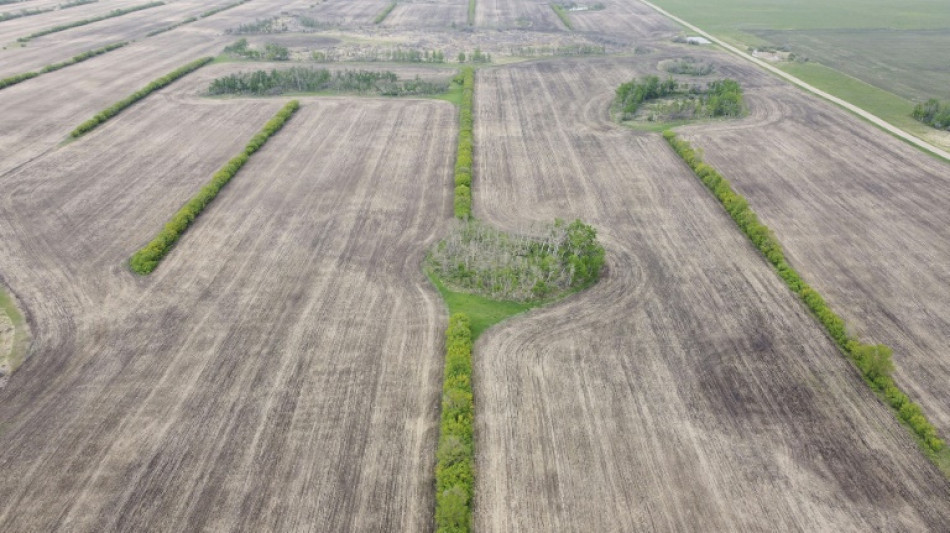
Canada canola farmers squeezed by trade wars on two fronts / Photo: Geoff Robins - AFP/File

 'No limits': Marathon world record holder Sawe chasing history

 Countdown begins to biggest-ever Rugby World Cup

 Bangladesh women lose ground after quota reform
 Vietnam admits 'differing opinions' on Hanoi development

 Stocks temper gains as oil pares heavy losses, US data in focus
 New Zealand denies breaching climate commitments to EU

 Albert becomes youngest US scorer in 4-2 win over Chile
 Pirate island's plunging population shows Greece's demographic decline
 With elections ahead, Latvia's Russian-speakers reject Moscow's help
 Brazil football clubs face massive sponsorship blow from betting ban
 ChatGPT maker wants to be the App Store for AI as safety concerns grow

 Women fight fires and sexism in Indonesian Borneo

 Forsling's OT blast lifts Florida over Carolina in NHL opener

 Hurricane Polo sweeps over Mexico's Pacific coast, heads inland
 Grynspan pulls ahead in race to lead UN: diplomat

 Trump touts AI boss pledge to self-regulate
 Oil down, but stocks lower as bond yields rise

 England break down stubborn Czechs to claim first Nations League win
 UN Security Council extends Haiti anti-gang force by 6 months

 Manchester City guilty of Premier League charges: What comes next?

 Man City chief Soriano slams Premier League 'conspiracy theory'

 Hurricane Polo sweeps over Mexico's Pacific coast

 Man City must be relegated after guilty verdict says club's former chairman

 German far-right aims to lead Saxony-Anhalt govt in December

 Little damage as Hurricane Polo sweeps over Mexico's Pacific coast
To sow or not to sow? Canola farmers in Canada's vast western Prairies region have found themselves in the crossfire of trade wars with both the United States and China.
"We have two economic superpowers of the world having a trade war with us at the same time," Rick White, head of the Canadian Canola Growers Association, told AFP.
"We've had our challenges but nothing of this magnitude. This is the worst of all scenarios," he said, weeks before planting is to begin.
Canada, a major agricultural economy, is among the world's top producers of canola -- an oilseed crop that is used to make cooking oil, animal meal and biodiesel fuel.
But the bulk of canola exports go to just two customers, the United States and China, two countries with which Ottawa is now in standoffs over tariffs.
A few days ago, Beijing announced 100 percent tariffs on canola oil and meal in response to Ottawa's levies on Chinese electric vehicles, which align with those imposed on China by the United States under former president Joe Biden.
Meanwhile, since coming to office in January, US President Donald Trump has threatened widespread tariffs on imports of Canadian goods into the United States.
The price of canola has plunged as a result of the Chinese tariffs, dragging the price of European rapeseed down with it.
- Seeding soon -
All of this must be sorted out in the coming weeks, fumes Jason Johnson, a farmer from Manitoba province in Canada's agricultural heartland.
"We're going to be seeding in about a month and once we do, we can't change crops," he said, while waiting for a call from a seed dealer about possible alternative crops.
China accounts for nearly one third of Canadian canola exports, mainly canola seeds, while the United States is the largest market for canola oil and meal.
Johnson believes it was wrong for Canada to impose tariffs on China.
"We should go back to China and say, 'We'll lift our tariffs if you lift yours,' basically doing a Trump by threatening tariffs and then retracting them," he told AFP.
On his 2,500-acre farm just north of the Canada-US border, he grows canola each year on about 1,000 acres, and feels certain the United States will ramp up tariffs against Canada that will be widespread and hit hard.
Those tariff threats have already sent shockwaves through Canada, as more than 75 percent of its exports go to the United States. A trade war between the two neighbors, with Canada retaliating, would cause significant damage to the Canadian economy.
- 'Engage with China' -
Canola Council of Canada chief executive Chris Davison is urging the Canadian government "to immediately engage with China, with a view to resolving this issue."
Ottawa and Beijing have been at loggerheads for several years, relations having soured after Canada detained a senior Huawei executive on a US warrant in December 2018 and Beijing retaliated by holding two Canadians.
A deal was reached that saw all three detainees released in September 2021, but bad blood remains, with Beijing criticizing Ottawa for aligning itself with Washington's China policies and Canadian authorities regularly accusing China of interference.
As this goes on Canadians wonder if bright yellow fields of canola will be seen in the Prairies this spring.
Johnson says switching from canola to alternative crops at the last minute wouldn't be easy.
Markets for other crops are mostly smaller and if canola farmers switch to cultivating them it would lead to an oversupply and a drop in prices for those agricultural commodities too.
He noted also that Canada has "invested a lot in the last 20 years in infrastructure" to crush canola into oil and meal.
A.F.Rosado--PC