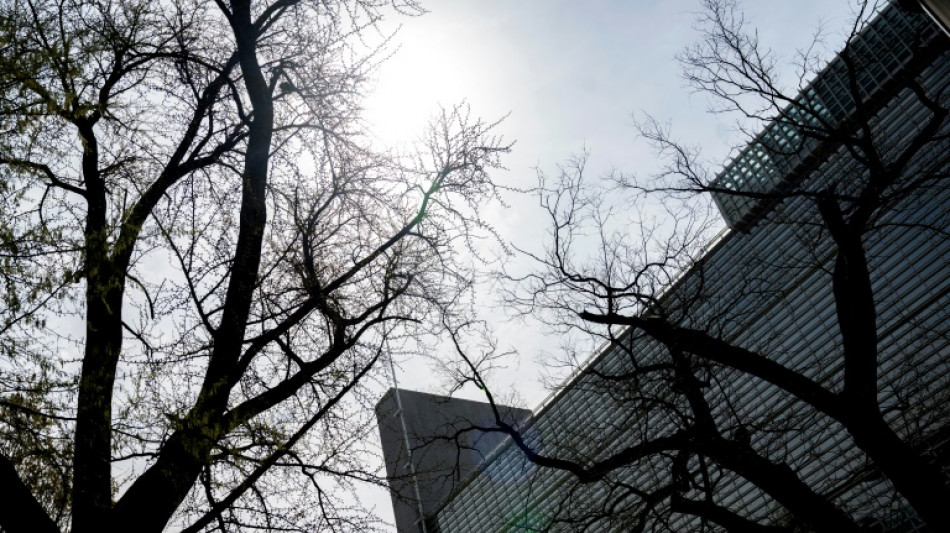
'Stagflation' risk as Ukraine war chokes global growth: World Bank / Photo: Stefani Reynolds - AFP/File

 Putin's party set to retain power after Russia vote hit by cyberattacks, drones

 Germany's Merz under pressure after bruising state election losses

 Messi, Miami frustrated in 2-2 draw with San Diego

 Thousands march in France against 'licence to kill' draft law

 Forest fire threatens tourist town in Colombian Andes

 Torres on target again as PSG beat 10-man Marseille in Ligue 1

 Germany's Merz vows to stay course despite new election defeats

 Carrick demands Man Utd response after 'pathetic' jibes

 Liverpool boss Iraola urges Isak to raise his level

 Evenepoel wins record 4th straight world time-trial title

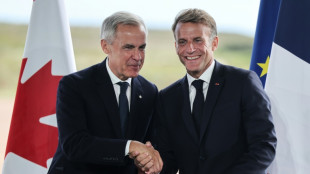 France's Macron, Canada's Carney announce closer ties

 Carrick defends troubled Man Utd after Fulham escape

 Horror movie 'Resident Evil' tops N. American box office

 Germany's Merz vows to stay course despite new vote losses

 Man City outgun Sunderland despite Brobbey hat-trick, Man Utd rescue Fulham draw

 Mourinho blames ref committee for Real Madrid derby defeat

 Maresca craves a 1-0 win after eight-goal Man City thriller
 Atletico Madrid beat Real Madrid in tense derby clash
 Reusser retains world time-trial title

 Man City outgun Sunderland despite Brobbey hat-trick, Liverpool win at Bournemouth

 Top US, Chinese economic officials meet ahead of Trump-Xi summit

 Erdogan's LGBTQ crackdown 'first step of election campaign': activist

 Mass drone barrage on Moscow kills two

 82-year-old dies after beach fight in Greece over sun lounger

 US warns of rapid escalation in Mideast war

The global economy risks falling into a harmful period of 1970s-style "stagflation," sparked chiefly by Russia's invasion of Ukraine, the World Bank warned Tuesday as it slashed its annual growth forecast.
The toxic combination of weak growth and rising prices could trigger widespread suffering in dozens of poorer countries still struggling to recover from the upheaval of the Covid-19 pandemic.
The stark forecast came as the international development lender cut its global growth estimate to 2.9 percent, 1.2 percentage points below the January forecast, due to the severe downturn caused by the war.
"The risk from stagflation is considerable with potentially destabilizing consequences for low and middle income economies," World Bank President David Malpass told reporters.
"For many countries recession will be hard to avoid."
And if risks to the outlook materialize, global growth could slow even more sharply -- triggering a worldwide recession, Malpass warned.
The bank's Global Economic Prospects report said the Ukraine war is compounding the damage from the pandemic and magnifying the slowdown in the global economy, "which is entering what could become a protracted period of feeble growth and elevated inflation."
The slump comes after growth recovered to 5.7 percent in 2021 following the pandemic downturn -- marking the "sharpest deceleration following an initial recovery from global recession in more than 80 years."
The report notes similarities to the 1970s when growth stalled and inflation skyrocketed with supply factors fueling price hikes and following a long period of low interest rates.
But in contrast to that period, the US dollar is strong, and major financial institutions are in solid position.
- Global recession risk -
The Russian invasion and Western sanctions on Moscow have sent grain and oil prices soaring, threatening to worsen hunger in poor countries and causing drivers around the world to face eye-popping prices at the pump.
The World Bank chief stressed the need to increase production to combat rising prices, especially for energy, as short supplies of natural gas and fertilizer are harming food production.
Malpass also said it was "crucial" to avoid export restrictions and subsidies that "magnify the rise in prices and distort markets."
Likewise, the bank warned against trying to resolve the inflation spike with price controls or export restrictions which would only worsen the damage.
Given the widespread uncertainty, the situation could deteriorate further due to a series of "interlinked" risks, including the possibility of further geopolitical tensions, steep interest rates hikes to contain inflation and rising wages, and the potential for Covid-19 to reassert itself, according to the forecast.
The US Federal Reserve has embarked on an aggressive drive to raise borrowing rates to cool demand and combat rising prices, and the World Bank notes that higher rates have played a prominent role in previous financial crises in emerging market and developing economies (EMDEs), straining resources and causing outflows of cash from those countries.
The simultaneous materialization of these risks could result in a much sharper and more prolonged global slowdown.
If faster US rate hikes were to cause "acute financial stress" in EMDEs, the European Union were to face a sudden ban on energy imports, and China were to experience renewed pandemic-related lockdowns, "global growth could fall more sharply in 2022 and nearly halve in 2023 -- declining to 2.1 percent and 1.5 percent, respectively," the report said.
Malpass said that would cause per capita income growth to fall to zero, and "that certainly would qualify as a global recession."
Even without that dire outcome, per capita income in developing economies this year will be nearly five percent below its pre-pandemic trend.
The report cut the US growth estimate by 1.2 points to 2.5 percent, and the forecast for China was lowered 0.8 point to an unusually low 4.3 percent.
Meanwhile the euro area forecast was cut to 2.5 percent, and Japan to 1.7 percent.
Russia's economy is expected to contract this year by 11.3 percent.
L.Henrique--PC