-
 Brazil football clubs face massive sponsorship blow from betting ban
-
West Bank's violent settlers part of a new generation fuelled by ideology

-
 ChatGPT maker wants to be the App Store for AI as safety concerns grow
-
US-led coalition ends mission in Iraq

-
 Women fight fires and sexism in Indonesian Borneo
-
Pope-backed White Sox join Braves with MLB playoff wins

-
 Forsling's OT blast lifts Florida over Carolina in NHL opener
-
NBA close to picking new $12-13bn Vegas team owners: report

-
 Hurricane Polo sweeps over Mexico's Pacific coast, heads inland
-
LA28 Olympics torch relay to visit all 50 states

-
 Grynspan pulls ahead in race to lead UN: diplomat
-
Spain brush aside Croatia in Nations League, England down Czechs

-
 Trump touts AI boss pledge to self-regulate
-
Trump hails 'morally binding' AI self-regulation pledge

-
 Oil down, but stocks lower as bond yields rise
-
Yamal inspires Spain to Croatia romp on World Cup homecoming

-
 England break down stubborn Czechs to claim first Nations League win
-
UN to hold fourth informal poll of secretary-general candidates
-
 UN Security Council extends Haiti anti-gang force by 6 months
-
Who are the Emiratis behind crisis-hit Manchester City?

-
 Manchester City guilty of Premier League charges: What comes next?
-
Singer Angelique Kidjo urges Africans to 'create together'

-
 Man City chief Soriano slams Premier League 'conspiracy theory'
-
Alleged Rihanna mansion shooter mentally fit for trial, says judge

-
 Hurricane Polo sweeps over Mexico's Pacific coast
-
Mystery over UK airbase scare as police find petrol not explosives

-
 Man City must be relegated after guilty verdict says club's former chairman
-
OpenAI unveils low-cost AI model, a day after shelving Astra upgrade

-
 German far-right aims to lead Saxony-Anhalt govt in December
-
Premier League confirms Man City guilty of serious financial breaches

-
 Little damage as Hurricane Polo sweeps over Mexico's Pacific coast
-
Brazil's Lula turns to Bad Bunny tune to criticise Trump ahead of polls

-
 Manchester City guilty of breaking financial rules - Premier League
-
Nigerian dancer eyes world record after seven-day marathon

-
 FIFA boss Infantino blasted as would-be 'emperor' by UEFA's Ceferin
-
Swiss regulator concludes Julius Baer bank probe

-
 Stocks move lower despite oil prices dropping
-
Brazil's patron saint pulled into latest election scrap

-
 AI driving up innovation investment: UN
-
Football overload leaves players near 'breaking point', warns Tebas

-
 UN Security Council extends Haiti mission by 6 months
-
Paris Eiffel Tower says chief to step down after uproar over removing women staff
-
 Man Utd do not deserve medals if Man City stripped of titles: Rooney
-
Amaze Holdings (NYSE: AMZE) Executes Binding LOI to Acquire BullionFX | Alchemy, a Decentralized Gold-Backed Financial Ecosystem for Valued at US$155 Million

-
 Vana Completes Expanded Staking as Part of the Vega Upgrade, Publishes Expanded VANA Token Economics
-
Clashes between French teens, police as school blockades intensify

-
 Spain to cap gas price hikes, extend fuel discounts
-
Stocks move sideways despite oil moving lower
-
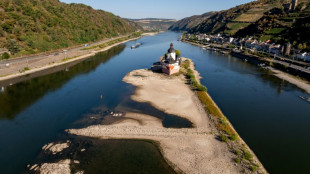 'We just need rain': Germany's Rhine river hits new low
-
African leaders to gather in Egypt for business summit

World's glacier mass shrank again in 2024, UN says
All 19 of the world's glacier regions experienced a net loss of mass in 2024 for the third consecutive year, the United Nations said Friday, warning that saving the planet's glaciers was now a matter of "survival".
Five of the last six years have seen the most rapid glacier retreat on record, the UN's World Meteorological Organization said on the inaugural World Day for Glaciers.
"Preservation of glaciers is a not just an environmental, economic and societal necessity: it's a matter of survival," said WMO chief Celeste Saulo.
Beyond the continental ice sheets of Greenland and Antarctica, more than 275,000 glaciers worldwide cover approximately 700,000 square kilometres (270,000 square miles), the WMO said.
But they are rapidly shrinking due to climate change.
"The 2024 hydrological year marked the third year in a row in which all 19 glacier regions experienced a net mass loss," the WMO said.
Together, they lost 450 billion tonnes of mass, the agency said, citing new data from the Swiss-based World Glacier Monitoring Service (WGMS).
It was the fourth-worst year on record, with the worst being in 2023.
- Huge loss over 50 years -
"From 2022-2024, we saw the largest three-year loss of glaciers on record," Saulo said.
Glacier mass loss last year was relatively moderate in regions such as the Canadian Arctic and the peripheral glaciers of Greenland, but glaciers in Scandinavia, Norway's Svalbard archipelago and North Asia experienced their worst year on record.
Based on a compilation of worldwide observations, the WGMS estimates that glaciers -- separate from the continental ice sheets in Greenland and Antarctica -- have lost more than 9,000 billion tonnes since records began in 1975.
"This is equivalent to a huge ice block of the size of Germany with a thickness of 25 metres," said WGMS director Michael Zemp.
At current rates of melting, many glaciers in western Canada and the United States, Scandinavia, central Europe, the Caucasus and New Zealand "will not survive the 21st century", the WMO said.
The agency said that together with ice sheets, glaciers store around 70 percent of the world's freshwater resources, with high mountain regions acting like the world's water towers. If they disappear, that would threaten water supplies for millions of people downstream.
- 'Ignoring the problem' -
For the UN, the only possible response is to combat global warming by reducing greenhouse gas emissions.
"We can negotiate many things in the end, but we cannot negotiate physical laws like the melting point of ice," said Stefan Uhlenbrook, the WMO's water and cryosphere director.
He declined to comment on the return to office of US President Donald Trump, a climate change sceptic who has pulled the United States out of the landmark 2015 Paris climate accords.
However, Uhlenbrook said that "ignoring the problem" of climate change "is maybe convenient for a short period of time", but "that will not help us to get closer to a solution".
For the inaugural World Day for Glaciers, the WGMS named a US glacier as its first Glacier of the Year.
The South Cascade Glacier in Washington state has been monitored continuously since the 1950s and provides one of the longest uninterrupted records of glaciological mass balance in the western hemisphere.
The US Geological Survey, the government body that studies the natural environment, has measurements there going back to 1958, while WGMS's records there began even earlier, in 1952.
M.Gameiro--PC