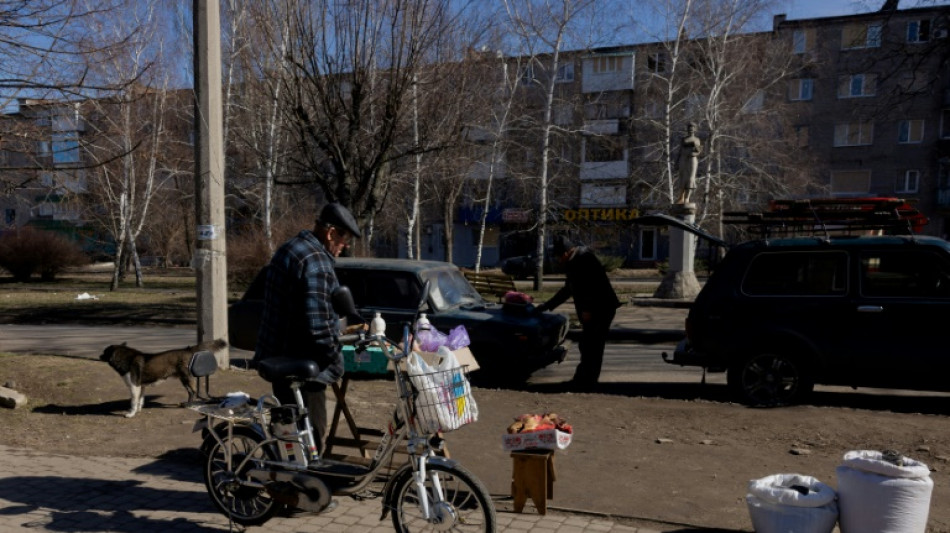
Russian drones and glide bombs stretch Ukraine front / Photo: Tetiana DZHAFAROVA - AFP

 Brazil football clubs face massive sponsorship blow from betting ban
 ChatGPT maker wants to be the App Store for AI as safety concerns grow

 Women fight fires and sexism in Indonesian Borneo

 Forsling's OT blast lifts Florida over Carolina in NHL opener

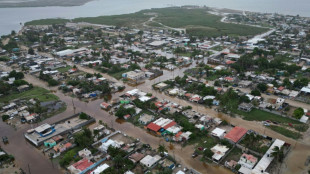 Hurricane Polo sweeps over Mexico's Pacific coast, heads inland
 Grynspan pulls ahead in race to lead UN: diplomat

 Trump touts AI boss pledge to self-regulate

 Oil down, but stocks lower as bond yields rise

 England break down stubborn Czechs to claim first Nations League win

 UN Security Council extends Haiti anti-gang force by 6 months

 Manchester City guilty of Premier League charges: What comes next?

 Man City chief Soriano slams Premier League 'conspiracy theory'

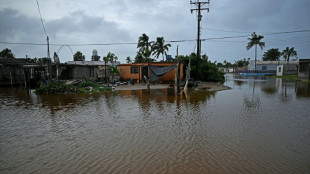 Hurricane Polo sweeps over Mexico's Pacific coast
 Man City must be relegated after guilty verdict says club's former chairman

 German far-right aims to lead Saxony-Anhalt govt in December

 Little damage as Hurricane Polo sweeps over Mexico's Pacific coast

 Manchester City guilty of breaking financial rules - Premier League

 FIFA boss Infantino blasted as would-be 'emperor' by UEFA's Ceferin

 Stocks move lower despite oil prices dropping

 AI driving up innovation investment: UN

 UN Security Council extends Haiti mission by 6 months

 Man Utd do not deserve medals if Man City stripped of titles: Rooney

 Vana Completes Expanded Staking as Part of the Vega Upgrade, Publishes Expanded VANA Token Economics
 Spain to cap gas price hikes, extend fuel discounts

 'We just need rain': Germany's Rhine river hits new low

Living in the gutted-out eastern Ukrainian city of Kostyantynivka, Maryna has learned to recognise the sound of the devastating Russian glide bombs that have pounded her city for months.
Equipped with wings to help them glide over dozens of kilometres, the bombs are part of an arsenal developed by Russia to let it hit deeper into Ukrainian territory and stretch the front line.
Maryna recalled to AFP just one of the recent strikes.
"Six people didn't get back up. There was blood everywhere," she said.
Overhead, the threat of a fresh attack is constant.
In a recent visit to the city, AFP reporters saw Russian planes flying over frequently and a dozen strikes in the area in less than half an hour.
Each drop triggered a blast, seeming to unfold in slow motion, followed by a high column of black smoke.
Kostyantynivka used to be relatively sheltered, lying a dozen kilometres (7 miles) from the front line.
But Russian forces are now pounding the city with the cheaply made bombs.
Usually made from Soviet stocks and modernised with satellite control systems, each can carry up to a tonne of explosives.
The glide bombs themselves are mostly impossible to intercept for the Ukrainian airforce, whose only option is to try to shoot down the planes.
Throughout the three-year war, Russia has used them to devastating effect -- razing cities like Chasiv Yar to the ground and obliterating Ukrainian defensive positions across the front line.
- Attacks increased tenfold -
Selling produce from his farm on a folding table on the side of a damaged road, Maryna's husband Volodymyr said the explosions had crippled his business.
"My cow is producing less milk because of the blasts, and my pigs are having miscarriages one after the other," he said.
He also has fewer clients, as most civilians have fled.
Attacks increased tenfold in February, according to governor Vadym Filashkin, who is urging residents to evacuate.
Children and their guardians were ordered to leave the city in autumn 2024.
The eastern districts of the town, closer to the front, also face relentless drone attacks.
"I can hear them buzzing as soon as I leave the house," said Volodymyr, who barely escaped alive when his home was hit in a drone attack.
He recently counted 108 drones in one week.
"When you hear them, you raise your arms and wait," he said, explaining how he signalled to Russian drone operators that he was a civilian.
Ukraine, too, has used drones extensively throughout the conflict -- for frontline hits and reconnaissance for long-range strikes deep inside Russian territory.
A few kilometres from the front line, Ronin and Archie, two young Ukrainian soldiers, were training on first-person view (FPV) drones, which are piloted remotely by operators donning virtual reality-like goggles.
The relatively cheap drones are ever-present at the front, leading both sides to develop various electronic warfare tools to neutralise them.
To overcome jamming, both have developed fibre optic drones equipped with thin cables tethered to the operator, rendering them immune to radio or signal interference.
"The enemy has many more than we do. And they often use them successfully," 21-year-old Ronin said.
"We are more exposed and we spend more time holding our positions," Archie, 24, said.
- 'More exposed' -
The fibre optic drones can reach up to 20 kilometres.
Soldiers often resort to shotguns, whose multiple pellets are useful to shoot down the nimble drones.
The threat also complicates the provision of medical aid to wounded soldiers.
Cameras on drones can spot the ambulances -- now forced to work at night -- sent to collect wounded soldiers.
In a stabilisation point -- an emergency shelter to treat soldiers close to the front -- an anaesthetist who goes by "Frenchie" said the drones had expanded the danger zone.
"In 2022, being two kilometres from the line, it felt like we were on vacation," said the 31-year-old doctor, before running to attend to a soldier whose leg had been torn by a drone blast.
"I want to believe and believe in God, because we have no one else," Volodymyr said.
"Even if they have to negotiate for years, let them stop bombing people," Maryna said.
A.Magalhes--PC