Georgia cracks down on pro-EU protests with crippling fines / Photo: Vano SHLAMOV - AFP

 Brazil football clubs face massive sponsorship blow from betting ban
 ChatGPT maker wants to be the App Store for AI as safety concerns grow
 Women fight fires and sexism in Indonesian Borneo

 Forsling's OT blast lifts Florida over Carolina in NHL opener

 Hurricane Polo sweeps over Mexico's Pacific coast, heads inland
 Grynspan pulls ahead in race to lead UN: diplomat

 Trump touts AI boss pledge to self-regulate
 Oil down, but stocks lower as bond yields rise
 England break down stubborn Czechs to claim first Nations League win
 UN Security Council extends Haiti anti-gang force by 6 months

 Manchester City guilty of Premier League charges: What comes next?
 Man City chief Soriano slams Premier League 'conspiracy theory'
 Hurricane Polo sweeps over Mexico's Pacific coast
 Man City must be relegated after guilty verdict says club's former chairman

 German far-right aims to lead Saxony-Anhalt govt in December
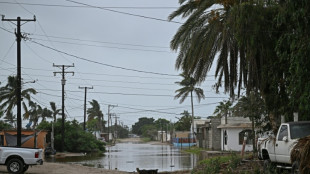 Little damage as Hurricane Polo sweeps over Mexico's Pacific coast
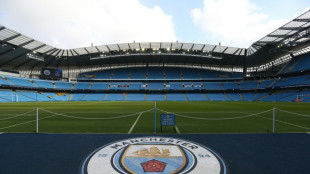 Manchester City guilty of breaking financial rules - Premier League
 FIFA boss Infantino blasted as would-be 'emperor' by UEFA's Ceferin

 Stocks move lower despite oil prices dropping
 AI driving up innovation investment: UN

 UN Security Council extends Haiti mission by 6 months
 Man Utd do not deserve medals if Man City stripped of titles: Rooney

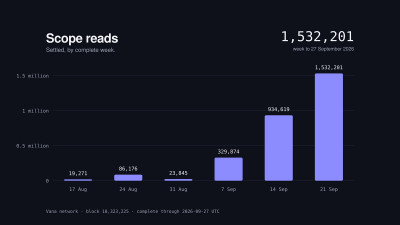 Vana Completes Expanded Staking as Part of the Vega Upgrade, Publishes Expanded VANA Token Economics
 Spain to cap gas price hikes, extend fuel discounts
 'We just need rain': Germany's Rhine river hits new low
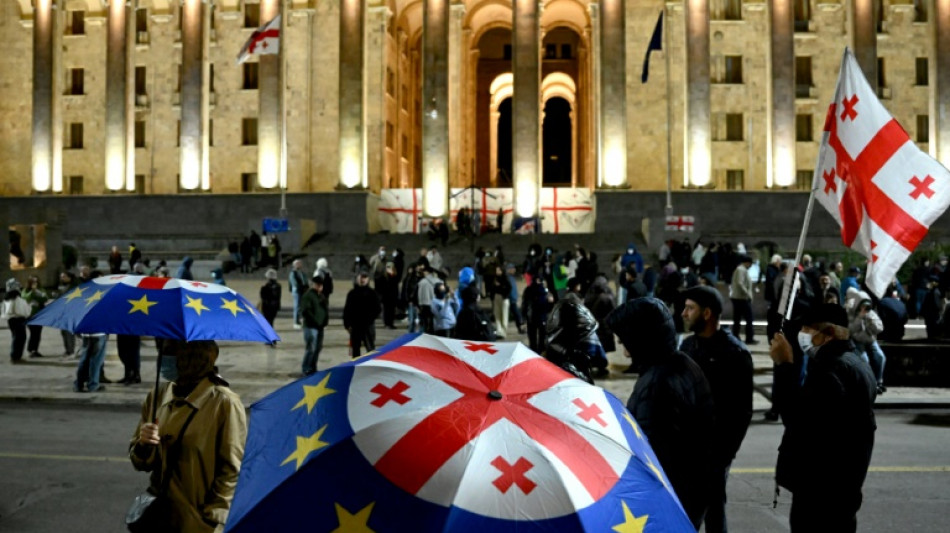
Nadim Khmaladze has been joining thousands of fellow Georgians on the streets every evening since November, when Tbilisi's increasingly repressive government shelved EU membership talks.
The 60-year-old rights activist said he was "ready to face police violence" when he first joined the anti-government rallies in Tbilisi, but he never imagined that standing on the street for a few hours could cost him more than 22 months' salary.
Three months into the protests, he received a summons: a total of 45,000 lari (around $16,000) in fines for briefly blocking traffic along Tbilisi's central avenue.
"The government is using Russian-style methods to abolish freedom of assembly in Georgia," he told AFP.
Khmaladze is one of thousands of Georgian protesters facing crippling fines for taking to the streets.
Prominent writer Mikheil Tsikhelashvili, who returned to Georgia last year from emigration in Portugal to fight against the ruling Georgian Dream party's "pro-Russian policies," has been attending protests daily.
He says he and his girlfriend were each fined the equivalent of $1,850, in what he called a "financial terror aimed at extinguishing popular anger."
"I took the case to court," he said, adding however that he had "little hope in Georgia's justice system, which is fully controlled by the ruling party."
- Unprecedented protests -
Braving bitter frost, protesters continue to rally daily in Tbilisi and cities across the Black Sea nation, in what has become an unprecedented protest movement against Georgian Dream's perceived democratic backsliding and growing rapprochement with Moscow.
The mass protests first erupted following disputed parliamentary elections in October, which the opposition rejected as rigged in favour of Georgian Dream.
The movement intensified after Prime Minister Irakli Kobakhidze's November 28 announcement that his cabinet would not seek to open EU membership talks with Brussels until 2028 -- a move that shocked many.
Georgia is an official candidate for membership in the 27-nation bloc, a bid supported by more than 80 percent of the population, according to opinion polls, and enshrined in the country's constitution.
During the protests' initial phase, security forces used tear gas and water cannons to disperse demonstrators and made hundreds of arrests.
Georgia's top human rights official, ombudsman Levan Ioseliani, and Amnesty International have accused police of "torturing" detainees -- a charge the government denies.
Authorities have since resorted to harsh financial penalties and increased surveillance, deploying facial recognition technology to identify protesters and issue hefty fines.
- 'Slowly strangling' -
"After the bare violence proved ineffective, the government turned to intimidation -- televised police raids on activists' homes and anonymous threats over the phone," Salome Khvadagiani, the director of Liberty Institute rights group, told AFP.
"When that too failed to suppress the protest, the government moved to slowly strangling them -- financially," she added.
In December, fines for blocking roads were increased tenfold, to 5,000 laris ($1,850), leaving thousands facing "absolutely disproportionate financial sanctions" or, alternatively, 15 days in prison.
In January alone, the total amount of fines surpassed $6.5 million in the country of four million people, where the average monthly salary is some $740, according to the For Georgia opposition party.
The interior ministry said it only issues fines "when the number of demonstrators doesn't justify blocking the road" and a rally can be held without disrupting traffic.
To enforce these measures, authorities have expanded surveillance capabilities, including the deployment of facial recognition technology.
Rights groups said the government has drastically increased the number of high-resolution surveillance cameras in the streets of Tbilisi.
The widespread use of "facial recognition and remote biometric recognition technologies facilitates discriminatory targeted surveillance," said GYLA rights watchdog. "These practices undermine fundamental rights."
- 'We will never back down' -
In 2021, Amnesty International, along with several other international rights groups, called for "an outright ban on uses of facial recognition and remote biometric recognition technologies that enable mass surveillance and discriminatory targeted surveillance."
Khvadagiani of the Liberty Institute said the "campaign of mass and disproportional financial sanction has caused protests turnout to dwindle significantly over the last month."
But demonstrators are now "adapting to the situation" she said, filing court complaints that have overwhelmed the judicial system, "significantly delaying the enforcement of financial sanctions or even making them unenforceable."
"The government can't scare us," said Khmaladze, who fought for nearly two years on Ukraine's frontlines against invading Russian troops.
"We are taking to the streets for Georgia's democracy and will never back down," he said.
F.Carias--PC