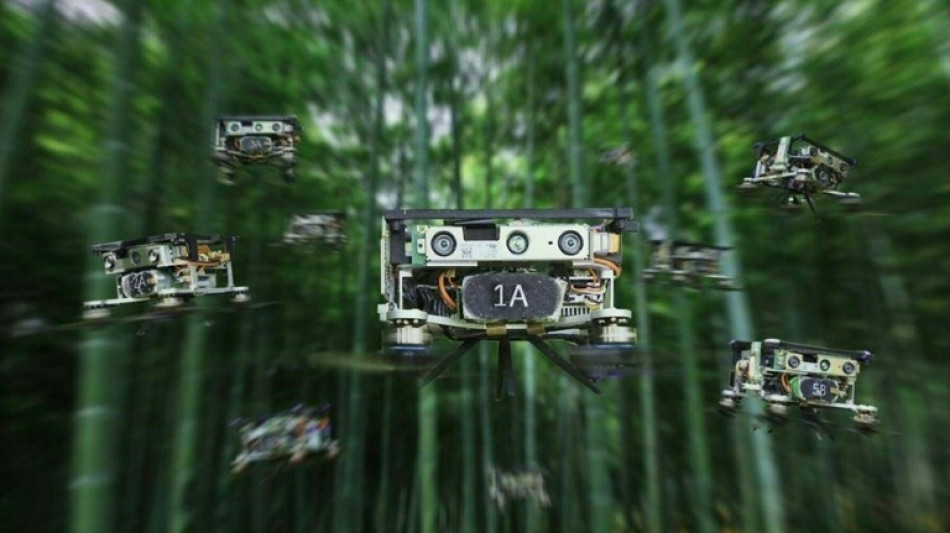
China's drone carrier hints at 'swarm' ambitions for Pacific / Photo: Handout - Yuman Gao and Rui Jin/AFP

 Putin's party set to retain power after Russia vote hit by cyberattacks, drones

 Germany's Merz under pressure after bruising state election losses

 Messi, Miami frustrated in 2-2 draw with San Diego

 Thousands march in France against 'licence to kill' draft law

 Forest fire threatens tourist town in Colombian Andes

 Torres on target again as PSG beat 10-man Marseille in Ligue 1

 Germany's Merz vows to stay course despite new election defeats

 Carrick demands Man Utd response after 'pathetic' jibes

 Liverpool boss Iraola urges Isak to raise his level

 Evenepoel wins record 4th straight world time-trial title

 France's Macron, Canada's Carney announce closer ties

 Carrick defends troubled Man Utd after Fulham escape

 Horror movie 'Resident Evil' tops N. American box office

 Germany's Merz vows to stay course despite new vote losses

 Man City outgun Sunderland despite Brobbey hat-trick, Man Utd rescue Fulham draw

 Mourinho blames ref committee for Real Madrid derby defeat

 Maresca craves a 1-0 win after eight-goal Man City thriller

 Atletico Madrid beat Real Madrid in tense derby clash

 Reusser retains world time-trial title

 Man City outgun Sunderland despite Brobbey hat-trick, Liverpool win at Bournemouth

 Top US, Chinese economic officials meet ahead of Trump-Xi summit

 Erdogan's LGBTQ crackdown 'first step of election campaign': activist

 Mass drone barrage on Moscow kills two

 82-year-old dies after beach fight in Greece over sun lounger

 US warns of rapid escalation in Mideast war

Officially it is just a research vessel, but China's newly unveiled drone carrier is a clear sign Beijing is rushing to deploy an autonomous swarm of unmanned devices in its push for military supremacy in the Pacific Ocean.
State media last month showed the launching of the Zhu Hai Yun -- "Zhu Hai Cloud" -- capable of transporting an unspecified number of flying drones as well as surface and submarine craft, and operating autonomously thanks to artificial intelligence.
The 89-metre (292-foot) ship would be operational by year-end with a top speed of 18 knots, vastly increasing China's surveillance potential of the vast Pacific area it considers its zone of influence.
"The vessel is not only an unprecedented precision tool at the frontier of marine science, but also a platform for marine disaster prevention and mitigation, seabed precision mapping, marine environment monitoring, and maritime search and rescue," Chen Dake, lab director at the firm that built the carrier, told China Daily.
Armies worldwide see drone squadrons as key players in combat, able to overwhelm defence systems by sheer numbers and without putting soldiers' lives at risk, such as with more expensive jets or tanks.
"It's probably a first-of-its-kind development but other navies across the world, including the US Navy, are experimenting with remote warfare capabilities in the maritime domain," said US Army Lieutenant Colonel Paul Lushenko, who is also an international relations specialist at Cornell University in New York.
Even if the vessel's actual capabilities remain to be seen, Beijing is broadcasting its intent to cement territorial claims in the region, as seen with the security partnership agreed last month with the Solomon Islands northeast of Australia.
"It's definitely imposing, provocative, escalatory and aggressive," Lushenko told AFP.
- Collective intelligence -
Building fleets of autonomous and relatively inexpensive drones would greatly augment China's ability to enforce so-called anti-access and area denial (A2-AD) in the Pacific, with the aim of weakening decades of US influence.
Unlike traditional aircraft carriers or destroyers carrying hundreds of troops, the drone carrier could itself navigate for longer periods while sending out devices that create a surveillance "net," potentially able to fire missiles as well.
The Zhu Hai Yun could also improve China's mapping of the seafloor, providing a covert advantage for its submarines.
"These are capabilities that are likely to be critical in any future conflicts that China wages, including over the island of Taiwan," strategists Joseph Trevithick and Oliver Parken wrote on the influential War Zone site.
Beijing has made no secret of its desire to wrest control of Taiwan, and military experts say it is closely watching the West's response to the Russian invasion of Ukraine to gauge how and when it might make its move.
And last month, Chinese researchers published a drone swarm experiment allegedly showing 10 devices autonomously navigating a dense patch of bamboo forest, without crashing into the trees or each other.
"The ultimate goal is something that has a collective intelligence," said Jean-Marc Rickli, head of risks at the Geneva Centre for Security Policy.
"The analogy is a bit like a school of fish. They create forms in the water that are not the decision of any single fish, but the result of their collective intelligence," he told AFP.
- Game-changer -
It would be a big technological advance from current weapons, which can be programmed and semi-autonomous but must have human operators to react to unexpected challenges.
A fleet of self-navigating drones could in theory incapacitate defence systems or advancing forces by sheer numbers, saturating combat zones on land or at sea until an opponent's arsenal is depleted.
"A conventional attack becomes impossible when you're facing dozens, hundreds or thousands of devices that are much cheaper to develop and operate than heavy conventional weapons," Rickli said.
Noting this profound shift in modern warfare, a RAND Corporation study from 2020 found that while unmanned vehicles need significant improvements in onboard processing, "the overall computing capability required will be modest by modern standards -- certainly less than that of a contemporary smartphone."
"A squadron of approximately 900 personnel, properly equipped and trained, could launch and recover 300 L-CAATs every six hours, for a total of 1,200 sorties per day," it said, referring to low-cost attributable aircraft technology -- meaning devices so cheap an army can afford to lose them.
"We do have indications that China is making rapid capabilities development," Lushenko said of Beijing's new drone carrier.
"What we lack is empirical data to suggest that China's one-party state can actually employ the ship in an integrated fashion in conflict."
Ferreira--PC