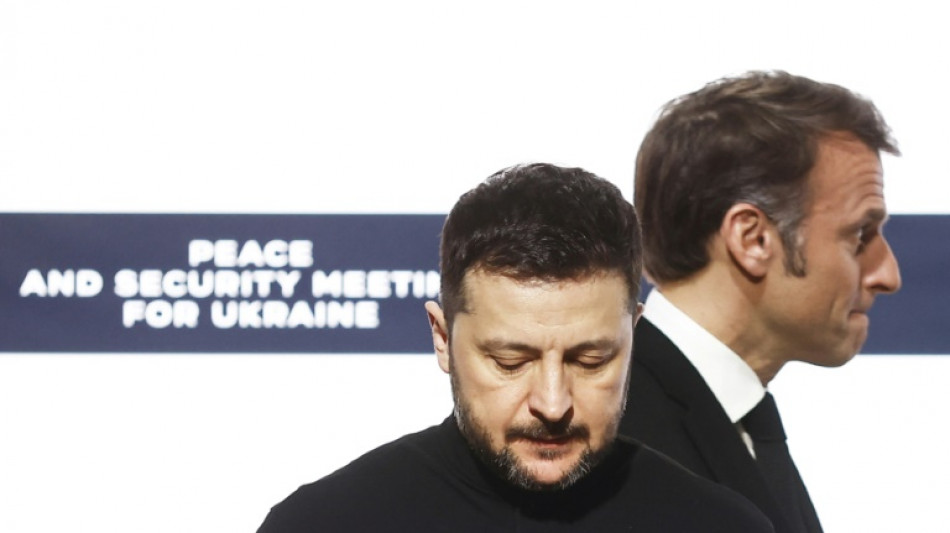
Paris summit rejects Russia sanctions relief, sketches Ukraine force / Photo: Yoan VALAT - POOL/AFP

 British Couple Spends £3,500 on Gender-Selective IVF in Egypt to Ensure Daughter

 Games Inbox: Reader Debates GTA 6 PC Release, Graphics, and Monster Hunter Choices

 Karbon-X (OTCQB: KARX) Joins IATA CORSIA EEU Supply Alliance as 2027 Aviation Compliance Demand Accelerates
 US Lawmaker and Colombian Ministry Urge X to Suspend Gustavo Petro’s Account

 Firefighters Respond to Blaze at Will Smith and Jada Pinkett Smith's Los Angeles Estate
European countries agreed at a summit in Paris Thursday to ramp up rather than lift sanctions on Russia over its war against Ukraine, as Britain and France began sketching out plans to send a "reassurance" force after any peace.
President Emmanuel Macron hosted the meeting of Ukraine's European allies and President Volodymyr Zelensky in the latest effort to agree a coordinated policy after Donald Trump shocked Europe by opening direct talks with the Kremlin.
The US claims tentative progress towards a ceasefire to end the three-year conflict sparked by Russia's February 2022 full-scale invasion of its neighbour. But as yet a peace deal appears far off.
The meeting of over two dozen heads of state and government set out to agree what security guarantees Europe can offer Ukraine once there is agreement on a ceasefire, including the possible deployment of military forces by a so-called "coalition of the willing".
"Europe can defend itself. We have to prove it," Zelensky said on social media ahead of the talks.
There appeared to be consensus around the table at the Elysee Palace that sanctions imposed against Russia should not be weakened, and rather intensified, until there is peace.
"There was complete clarity that now is not the time for the lifting of sanctions, quite the contrary -- what we discussed is how we can increase sanctions to support the US initiative to bring Russia to the table from further pressure," British Prime Minister Keir Starmer said alongside Zelensky.
Zelensky added that "everybody understood and understands that today Russia does not want any kind of peace."
In a separate briefing, German Chancellor Olaf Scholz said that lifting sanctions against Russia would be a "grave mistake" and "makes no sense" without a truce.
- 'Reassurance force' -
As well as boosting Ukraine's own armed forces, a key pillar of ensuring security and preventing further Russian invasions could be to deploy European troops to Ukraine, although until now it has been far from clear how this could happen.
Macron said after the summit France and Britain were leading efforts to send a "reassurance force" to Ukraine after any end to the fighting.
"It does not have unanimity today, but we do not need unanimity to do this," he added, saying a Franco-British delegation would head to Ukraine in the coming days for talks.
"There will be a reassurance force with several European countries who will deploy" to Ukraine, he said.
Macron emphasised that members of such a force would not be peacekeepers, deployed on the front line or any kind of substitute for the Ukrainian army.
Also, he said, not all of Ukraine's European allies would be represented in the force, with some states not "having the capacity" and some reluctant due to the "political context".
The Franco-British delegation would begin talks over where such a force could be deployed.
It would have the "character of deterrence against any potential Russian aggression", he said.
Macron added that the summit agreed that he and Starmer would together "co-pilot" Europe's "coalition of action for stable and durable peace".
The UK-France delegation would also discuss the shape of "tomorrow's Ukraine army", Macron said, emphasising the importance of a "strong Ukrainian army, well-equipped for the day after".
Hailing the summit, Starmer said: "This is Europe mobilising together behind the peace process on a scale that we haven't seen for decades, backed by partners from around the world."
- 'Take time' -
Ukraine has offered through the United States a 30-day ceasefire, but Russia has so far failed to respond, with the European allies growing all the more impatient.
Underscoring how far apart the sides remain, Ukraine accused Russia Thursday of violating a US-brokered agreement to refrain from targeting energy infrastructure with an artillery strike that caused a power outage in the city of Kherson.
The Ukrainian army meanwhile rejected Russian claims it had itself targeted energy sites.
Macron spoke by telephone to Trump just ahead of the summit, a French presidential official said.
Speaking in Jamaica, US Secretary of State Marco Rubio said Russia's conditions will be evaluated, and cautioned that a peace deal "won't be simple".
V.Dantas--PC