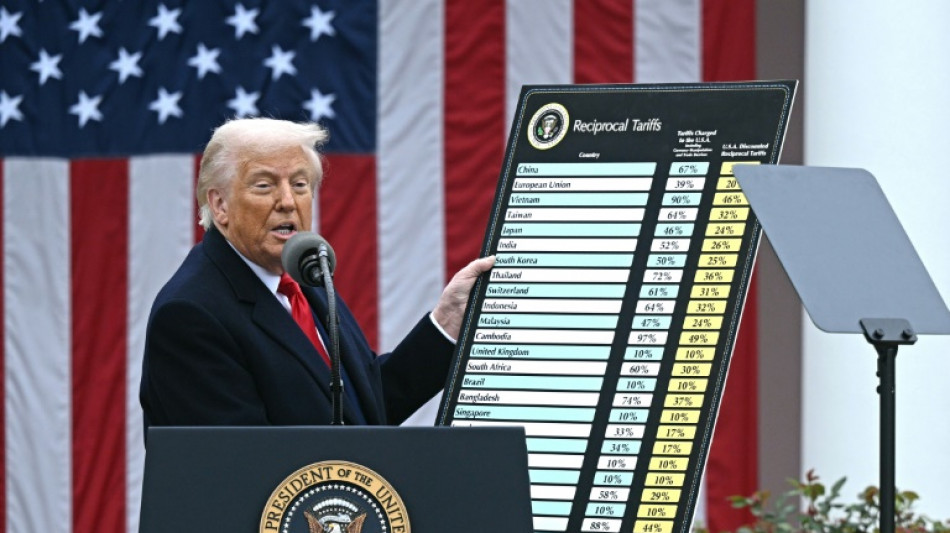
Trump's tariff Big Bang puts global economy under threat / Photo: Brendan SMIALOWSKI - AFP/File

 Stocks move lower despite oil prices dropping

 AI driving up innovation investment: UN

 UN Security Council extends Haiti mission by 6 months
 Man Utd do not deserve medals if Man City stripped of titles: Rooney

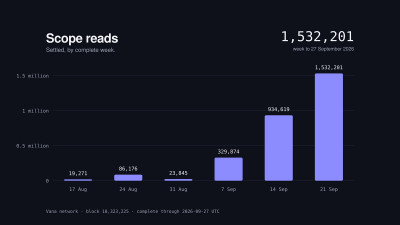 Vana Completes Expanded Staking as Part of the Vega Upgrade, Publishes Expanded VANA Token Economics
 Spain to cap gas price hikes, extend fuel discounts
 'We just need rain': Germany's Rhine river hits new low
 Yemen health system at 'breaking point': WHO

 Ireland undecided on second Israel match: coach

 France's Le Pen defiant after top ally hit by antisemitism claims

 Tom Cruise trades stunts for satire as toxic tycoon 'Digger'

 MEXC Unveils "WE SEE YOU" Brand Visual Refresh, Putting People Behind Every Trade in Focus

 Thai capital cleans up after deadly floods

 NATO, EU allies rally to Estonia after 'sabotage' blamed on Russia

 Families demand justice for Cameroon's 'nightmare' wave of murdered women
 Tebas says Man City should face 'most severe' sanctions if guilty of rule breaches
 Pochettino calls Man City success 'a period of deception'

 Settler attack on West Bank village injures Israeli forces, drawing rare rebuke

 Mystery over UK airbase scare after reports no explosives found
 Spanish govt races to adopt housing law under protest pressure

 Estonia slams Russian 'sabotage' after arson attack on defence company
 Slovenia sees surge in '.si' sites after Trump hypes 'super intelligence'
 'Like a dream' for An as Games organisers 'sorry' for latest mix-up
 Tokyo suffers longest streak of rainy days on record

 Indonesia charges train driver over crash that killed 16 women
It took just one 50-minute speech by US President Donald Trump to undermine global economic stability and raise the prospect of a recession, with China's countermeasures only amplifying the risk of a debilitating tit-for-tat trade war.
The Wednesday White House event, billed by Trump as "Liberation Day", unveiled levies on dozens of countries including all major US trading partners.
These included the imposition of 20 percent levies on the European Union, 24 percent on Japan and an additional 34 percent on goods from China -- bringing the new added tariff rate there to 54 percent.
- What have been the first effects? -
Trump's sparked staggering selloffs on global stock markets as investors pulled out of shares of companies which will be strongly impacted by the measures.
The S&P 500 index, which regroups the 500 largest US companies, saw $2.5 trillion in value zapped on Thursday as it sank 4.8 percent in its worst daily loss since the Covid pandemic.
It fell by another five percent in morning trading on Friday.
Shares in certain auto manufacturers have taken a big hit as separate tariffs of 25 percent on car imports into the United States went into effect on Thursday.
Stellantis, which owns the Chrysler, Dodge and Jeep brands, will pause production in certain of its Canadian and Mexican factories.
Nissan went back on its plan to phase out production of its Rogue SUV in South Carolina, and will no longer sell two models of its luxury brand Infiniti that are made in Mexico.
Volkswagen will pass on the cost of the tariffs to consumers by adding an "import fee" to cars it imports into the United States from Europe and Mexico.
Shares in apparel firms also took big hits as they depend heavily on imported goods.
- Will this provoke a recession? -
"No one wins from a trade war, with the US economy set to be adversely impacted as much as, if not more, than Europe," said analysts at Barclays bank.
A spike in inflation from the tariffs and a drop in consumption by US consumers could choke off growth, in the United States and elsewhere.
More and more economists and analysts are talking about the possibility of the US economy falling into recession.
The OECD's March forecasts already forecast a recession for Mexico this year and next. It also sharply lowered its outlook for the Canadian economy.
IMF chief Kristalina Georgieva on Thursday said new US tariffs "clearly represent a significant risk to the global outlook".
The IMF had until now expected the global economy to expand by 3.3 percent this year and next.
"It's a major shock for the global economy," said Antoine Bouet, head of the French economic think tank CEPII.
He expects the tariffs could shave 0.8 percent off global economic output by 2040.
- Will global trade contact? -
The first signals are worrying, particularly in Asia, which has become the globe's manufacturing centre.
While China had dominated, the tariffs imposed by Trump during his first stint in the White House encouraged companies to move some manufacturing to countries such as Vietnam, Cambodia and Bangladesh.
Economists at ratings agency Fitch said Trump's "Liberation Day" measures take US tariffs back to levels last seen in 1909 and would likely sharply affect the economy.
In a sign of fear of a sharp slowdown in trade, the price of transporting shipping containers from China to the United States has tanked since Thursday.
The World Trade Organization said Thursday it estimated that the Trump tariffs would cut global trade by around one percent.
But it said things could get worse if a tit-for-tat trade war began, and on Friday China announced retaliatory tariffs on US goods of 34 percent.
- Is it the end of free trade? -
The "Liberation Day" tariffs took the average US tariff rate from 4.99 percent to 27.17 percent, CEPII calculated.
The measures are a fresh bump for the global economy that has faced shocks in recent years from the Covid-19 pandemic and the Russian invasion of Ukraine.
But former WTO chief Pascal Lamy sought to put the situation into context.
"Thirteen percent of global imports are affected by Trump's follies," he told AFP.
"There's no reason the other 87 percent become contaminated."
He said that he expects if the US economy closes up other countries would open theirs.
Numerous nations have sought recently to breathe new life into trade deal talks in the hopes of compensating for lost business in the United States.
Japan, South Korea and China called Sunday for their negotiations for a comprehensive trilateral free-trade agreement to be speeded up, and agreed to create "a predictable trade and investment environment".
J.Oliveira--PC