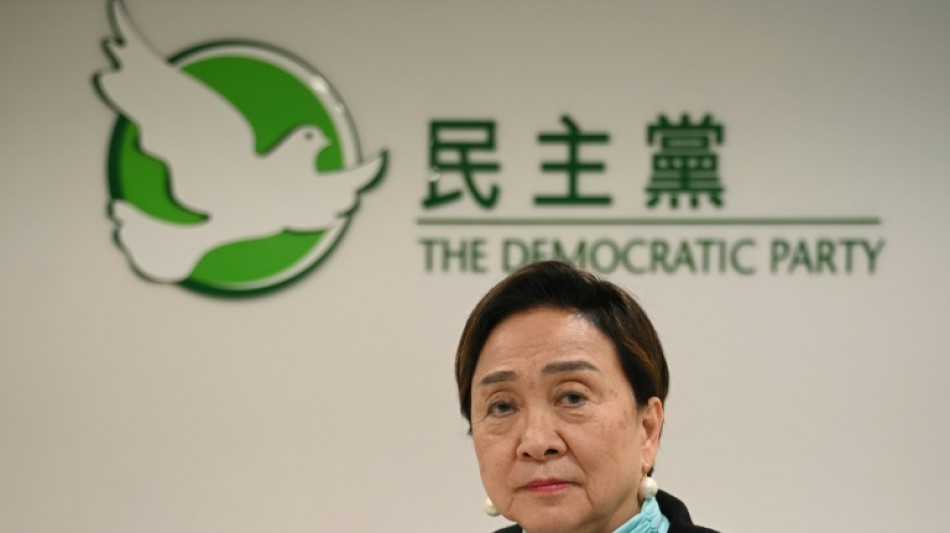
End of the line for Hong Kong's Democratic Party / Photo: Peter PARKS - AFP

 Slovenia sees surge in '.si' sites after Trump hypes 'super intelligence'
 'Like a dream' for An as Games organisers 'sorry' for latest mix-up
 Tokyo suffers longest streak of rainy days on record

 Indonesia charges train driver over crash that killed 16 women

 Ruthless An makes history to retain Asian Games badminton crown
 Australian central bank lifts key interest rate to 15-year high
 Polo makes landfall in Mexico as Category 3 hurricane

 South Korea team latest to be bussed to wrong Asian Games venue

 Bears thrash Eagles 27-7 as third-string QB Keenum shines
 All Blacks name veteran Taylor captain as Mo'unga seizes 10 jersey

 Race against time as Asian Games cricket quarter-finals washed out

 India turns to corals and seagrass to shield against rising seas

 Manchester City's Premier League charges: What comes next?

 Brazil's cellphone crime: a security nightmare in every pocket

 Russia pummels Kyiv in latest deadly attack

 Akkodis and Biolevate Partner to Accelerate AI-Powered Scientific, Regulatory and Technical Documentation in Highly Regulated Industries

 NFL Giants obtain QB McCarthy from Vikings

 Deal for evicted Spanish pensioner as PM seeks new housing law

 Clippers apologize, warn fans of 'challenges' after Leonard scandal

 Turkish comedian convicted for Erdogan 'insult' freed pending appeal
 Trump announces 'biggest' US steel plant in battleground Iowa

 Olise wonder strike gives Zidane's France win in Belgium
 US stocks fall, bond yields rise as Middle East war drags on

 Trump denies offering to sell arms to China's Xi
 Wemby ready for NBA Spurs to move rivals in climb to top

Under heavy skies, the minibus carrying Hong Kong politician Emily Lau rattles along a winding mountain road to Stanley Prison for a visit she finds all too familiar.
Lau is the former chair of the Democratic Party, once the city's stalwart opposition force but now seatless and preparing to dissolve as some of its veterans languish in jail.
The party and its campaign for freer elections have withered under Beijing's years-long national security crackdown.
After 2019 protests paralysed the financial hub, Beijing moved to further restrict elections and imprison democracy campaigners.
Lau listed off five party comrades behind bars, including her predecessor Albert Ho, who could be jailed for life on national security charges.
Ho is "very, very patriotic", she said ahead of her visit to Stanley Pirson. "Look at his fate".
The remaining members of the city's main democracy party will meet on Sunday to discuss and possibly vote on shutting down, following procedures that began in February.
At the time, party chair Lo Kin-hei cited the "political environment", but refused to say if there had been pressure from Beijing to dissolve.
- Universal suffrage -
Hong Kong's Democratic Party was founded in 1994, three years before the British colony was handed over to China.
Its top concern was determining how the city would eventually elect its own leader and lawmakers through universal suffrage as promised in China's "One Country, Two Systems" model.
Lee Wing-tat, a founding member, was among those inspired to enter politics by Beijing's pledge of "Hong Kong people ruling Hong Kong".
"When I got older I found out those slogans were fake, but it's hard to blame a young man in his twenties for being idealistic," said Lee, who now lives in the United Kingdom.
The party's manifesto supported the 1997 handover and acknowledged Hong Kong as part of China, a tone set by heavyweights Szeto Wah and Martin Lee.
Interviewees recalled the two leaders as yin and yang: Szeto a po-faced strategist with patriotic roots, Lee a suave barrister dubbed the city's "Father of Democracy".
The party's moderate line meant that, for a time, it was "relatively easy" to communicate with Beijing, according to founding member Sin Chung-kai.
In 2010, the party decided to send three members, including Emily Lau, to meet with Beijing's representatives in Hong Kong to discuss electoral reform.
"That was the first time and the only time that Beijing decided to negotiate with us," Lau recalled.
"We said to the liaison officers, 'Well, you must continue to talk to us.'
"They never did."
- 'Break the rules' -
The 2010 meeting was divisive.
Critics accused the Democratic Party of selling out at a time when smaller, more radical groups were emerging in the opposition camp.
Within the party, younger members called for a more assertive stance, recalled Ted Hui, who won his first seat in 2011.
Hui saw a need to "break the rules of the game" in order to secure real democratic reform.
One early protest, which ended with him being tossed out of a District Council meeting, gained public sympathy but was considered "impulsive" by party elders.
"The party needed a more comprehensive transformation, so it can move in sync with society," he said.
"We had to up our game."
By the time the massive democracy protests seized Hong Kong in 2019, Hui and other party figures had learned to tread a fine line, playing a peaceful yet defiant role during street clashes.
The party more than doubled its seats at the District Council that year on swelling anti-government sentiment.
But a Beijing-imposed national security law in 2020 was the beginning of the end.
Authorities used that law to jail four Democratic Party ex-lawmakers, saying they were among 47 opposition figures who took part in an informal primary election to subvert state power.
Hui, who moved to Australia, was also accused of breaching the security law and became the target of a police bounty.
- 'Not forgotten' -
The Democratic Party holds no elected seats after its lawmakers resigned en masse in 2020 to protest Beijing's tightened grip.
The wipeout was repeated at District Councils the following year.
Ramon Yuen, a former party treasurer, said members were sometimes treated like outcasts -- restaurants refused to host their banquets.
"Even normal social gatherings could not be held," he said.
Yuen said he was in favour of dissolution and expected most of the 400 party members to agree.
"Hong Kong has discussed (universal suffrage) for so many years, but regrettably we don't know when we'll see it," he said.
Outside Stanley Prison, Lau said she makes regular visits to let jailed democrats know "they have not been forgotten".
The party's end should spur the public to ask hard questions, she added.
"Why do we have to disband? What is going on? That's a question I want Hong Kong people to ask."
N.Esteves--PC