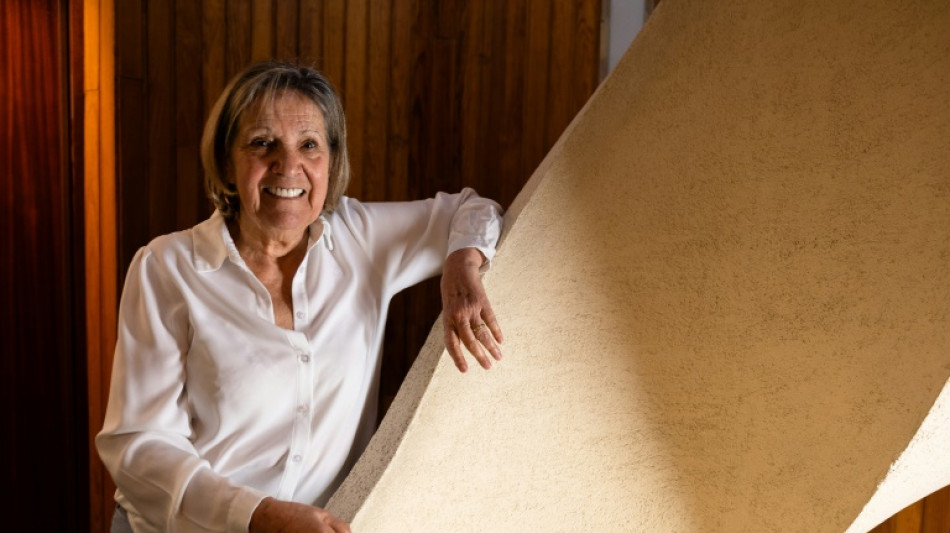
Erased identity: Post-war adoptee seeks German roots / Photo: Xavier GALIANA - AFP

 Slovenia sees surge in '.si' sites after Trump hypes 'super intelligence'

 'Like a dream' for An as Games organisers 'sorry' for latest mix-up

 Tokyo suffers longest streak of rainy days on record

 Indonesia charges train driver over crash that killed 16 women

 Ruthless An makes history to retain Asian Games badminton crown

 Australian central bank lifts key interest rate to 15-year high

 Polo makes landfall in Mexico as Category 3 hurricane

 South Korea team latest to be bussed to wrong Asian Games venue

 Bears thrash Eagles 27-7 as third-string QB Keenum shines
 All Blacks name veteran Taylor captain as Mo'unga seizes 10 jersey
 Race against time as Asian Games cricket quarter-finals washed out

 India turns to corals and seagrass to shield against rising seas

 Manchester City's Premier League charges: What comes next?

 Brazil's cellphone crime: a security nightmare in every pocket

 Russia pummels Kyiv in latest deadly attack

 Akkodis and Biolevate Partner to Accelerate AI-Powered Scientific, Regulatory and Technical Documentation in Highly Regulated Industries

 NFL Giants obtain QB McCarthy from Vikings

 Deal for evicted Spanish pensioner as PM seeks new housing law

 Clippers apologize, warn fans of 'challenges' after Leonard scandal

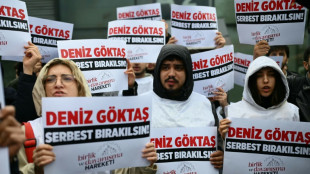 Turkish comedian convicted for Erdogan 'insult' freed pending appeal

 Trump announces 'biggest' US steel plant in battleground Iowa

 Olise wonder strike gives Zidane's France win in Belgium

 US stocks fall, bond yields rise as Middle East war drags on

 Trump denies offering to sell arms to China's Xi

 Wemby ready for NBA Spurs to move rivals in climb to top

Claudine Spire pointed to a group of toddlers in a black-and-white photo. "I thought I recognised myself," she said, indicating a girl with curly hair and a short coat. But it was not her.
As part of the 78-year-old Frenchwoman's relentless search for her roots, Spire found the photo a few days ago in the archives of the French ministry of foreign affairs.
"I felt as a child that I didn't quite belong," she said. "I didn't look like anyone in the family."
Spire is among the post-war children from the French-occupied part of Germany who had German mothers and French soldiers as fathers.
About 1,500 of them were brought to France, presumably illegally, by French authorities between 1946 and 1951 and handed over to adoptive families.
"The French authorities actively sought these children and pressured the mothers to give them up," said Yves Denechere, a historian at the University of Angers. "This was about replenishing the population after the war."
German women expecting a child from a Frenchman were required to report this to the occupying authorities. While still in the maternity ward, many were visited by "research officers" who urged them to part with the child, claiming that their son or daughter would have a better future in France.
The officers brought a form, ready for the mothers to sign: "For personal reasons, I hand over my child to the French authorities," it said. The mothers waived all rights to the child, and stated that they did so willingly.
Claudine Spire's mother, who became pregnant at 19, was pressured by her parents to give up the "child of the enemy".
Claudine was placed in a French children's home in Nordrach in the Black Forest when she was barely one and a half.
The French occupying authorities had set up the home in a former "Lebensborn" institution that had been run by the Nazis to promote the Aryan race.
In selecting children for adoption, the French postwar authorities used racial selection criteria that were eerily similar to those applied by the Third Reich.
"The children sent to France were mainly white, with blond hair, and in good health," said Denechere.
- 'Absolutely disgusting' -
Since about half of the French soldiers stationed in Germany were from North or sub-Saharan Africa, many children did not match the criteria and were either returned to their mothers or placed in German children's homes.
"I was on the list of children who were not to be proposed for adoption," said Spire, whose father came from Morocco.
But adoptive parents were found for her regardless, and she grew up in a loving family.
Only in her early 50s did she feel compelled to search for her roots.
"I knew that I was adopted, but I didn't know the circumstances," she said.
The more she learnt about the past, the more she was shocked.
"It's absolutely disgusting what the French state did back then," Spire said, also condemning postwar Germany for allowing the adoptions to happen.
Spire eventually found her German mother. Their first meeting took place in the entrance hall of a hospital in Offenburg in southwest Germany, just across the border from Strasbourg.
"It was very strange. She hadn't told her husband and daughter anything about me," Spire remembered.
Her mother addressed her as Margarete, her birth name that was changed upon adoption.
"Our origins were erased," Spire states.
These adoptions took place in a legal vacuum, as Germany, having no government, was divided into zones occupied by various Allied countries.
"Those were irregular, illegitimate practices," said Denechere.
Yet been no legal challenges have been brought, the historian added.
"Against whom? And for what exactly?", he said.
In addition such cases would presumably be covered by statutes of limitations by now.
"This part of history is completely unknown to the public," he said.
This is gradually changing thanks in part to a 2022 documentary on the topic and a recent novel by author Anke Feuchter telling the story of a woman in a similar situation as Spire's mother.
With criticism of the practice mounting, many adopted children of the occupation are still looking for their German roots.
Their search, it turns out, has been facilitated by the French authorities' decision to repatriate all documents related to the adoptions in a bid to remove traces of the practices.
Today, those very documents have allowed historians and interested parties to shed light on a dark chapter of German-French post-war history.
This is how Claudine Spire found photos of children in Nordrach who, like her, were adopted.
But she has yet to find any pictures of herself from back then.
A.S.Diogo--PC