Silent killing fields 50 years on from Khmer Rouge atrocities / Photo: TANG CHHIN SOTHY - AFP

 South Korea volleyball team latest to be bussed to wrong Games venue

 Malaysia starts sending Myanmar migrants home

 8.3 mn refugees at risk due to 'severe' funding cuts: UN
 Stocks drop and oil rises as Hormuz hopes fade
 OpenAI cancels release of newest model due to safety concerns

 AI bosses head to White House as safety pressure builds
 Batista sacked as Costa Rica coach after six months
 Flooding, power cuts and evacuations as Hurricane Polo slams Mexico

 NFL Giants obtain QB McCarthy from Vikings

 Deal for evicted Spanish pensioner as PM seeks new housing law

 Clippers apologize, warn fans of 'challenges' after Leonard scandal

 Turkish comedian convicted for Erdogan 'insult' freed pending appeal

 Trump announces 'biggest' US steel plant in battleground Iowa

 Olise wonder strike gives Zidane's France win in Belgium
 US stocks fall, bond yields rise as Middle East war drags on

 Trump denies offering to sell arms to China's Xi
 Wemby ready for NBA Spurs to move rivals in climb to top

 Ukraine to postpone some spending amid delays in aid: PM
 Tuchel says Czech Republic game 'not yet a must-win'
 MaXhosa puts South Africa on the Paris fashion map
 Rose, Scott among 2027 World Golf Hall of Fame finalists
 Brunson says NBA champion Knicks can't get satisfaction

 France puts out largest wildfire since 1949
 Real Madrid's Perez summoned over Barcelona referee payments comments

 Oil takes off again, Wall Street dips after Trump rejects Iran truce offer
Cambodia marked on Thursday the 50th anniversary of the Khmer Rouge's march into Phnom Penh, though survivors of its genocidal rule were forbidden from praying before victims' skulls.
On April 17, 1975, soldiers of the ultra-Maoist Khmer Rouge rolled into the capital astride tanks, toppling the US-backed republican army of Lon Nol and starting a four-year communist government.
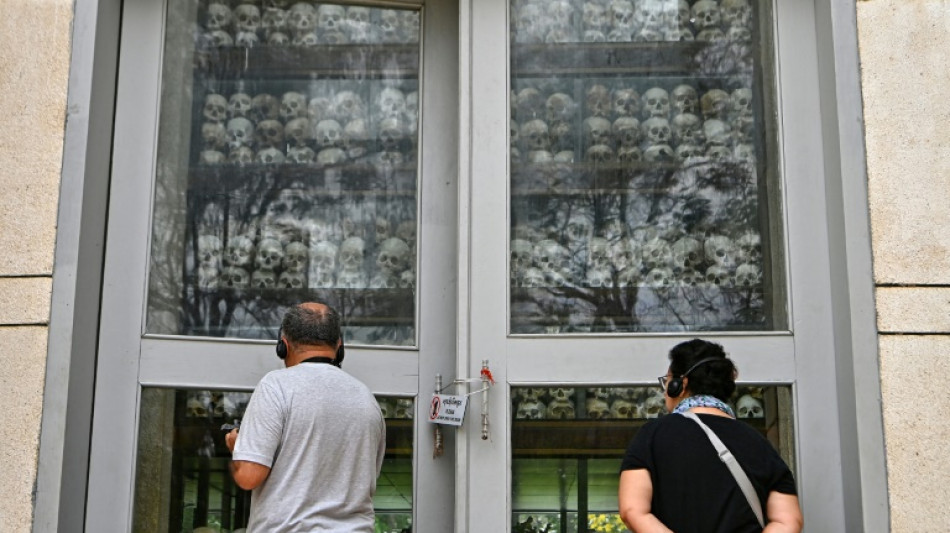
To remember victims, a Cambodian opposition party asked for authorities' permission to hold a memorial at Choeung Ek -- the most notorious of the Khmer Rouge's "Killing Fields" -- in the capital Phnom Penh.
But the city refused to greenlight the event, citing issues of "public order" and safety, and warned that the group would be held legally responsible, according to a letter seen by AFP.
"Victims of the Khmer Rouge genocide should not be banned by any rule if they wish to memorialise this very difficult time in Cambodian history," said Youk Chhang, director of the Documentation Center of Cambodia (DC-Cam), which researches and records atrocities of that period.
City hall could not be immediately reached for comment.
Survivors were absent at the Choeung Ek wartime museum Thursday, though dozens of tourists visited the site and took pictures of the skulls displayed in glass cases.
Outside Choeung Ek, survivor Sum Rithy, 72, recalled the Khmer Rouge were initially given a cautious welcome by Phnom Penh's war-weary residents when they entered the city, their distinctive red-chequered scarves fluttering behind them.
But soon enough cadres began to evacuate the city of two million people at gunpoint, in one of the largest forced displacements in recent history.
"It was a day of nationwide bloodshed... the Khmer Rouge chased people away from homes everywhere," Sum Rithy said.
He said his father and three siblings were killed, while he was starved and jailed for two years on allegations that he was a member of the CIA.
There was "no happiness, no smiling, but there was only sadness and suffering", he told AFP. "I will never forget this."
- Tribunal -
The Khmer Rouge drove Cambodia -- once known as the "Pearl of Asia" for its music, culture and French colonial architecture -- back to "Year Zero" through an agrarian peasant revolution.
By the time the tyrannical rule of Pol Pot was ousted four years later, an estimated two million Cambodians had been killed by execution, starvation or overwork.
Only after the Khmer Rouge was forced out by Vietnamese soldiers in 1979 did the scale of its atrocities emerge, with the bones of thousands of victims -- including children -- uncovered at mass graves across the country.
Pol Pot died in 1998 without facing justice.
A special tribunal sponsored by the United Nations convicted three key Khmer Rouge figures before ceasing operations in 2022, but other former cadres continue to live freely.
Former prime minister Hun Sen -- an ex-cadre who ruled Cambodia for nearly four decades -- was against pursuing further cases at the tribunal, claiming it would plunge the country into instability.
Last month Cambodia enacted a law -- at the request of Hun Sen -- that forbids denying the Khmer Rouge's atrocities, but which rights advocates and academics warn could also be used to stifle legitimate dissent.
N.Esteves--PC