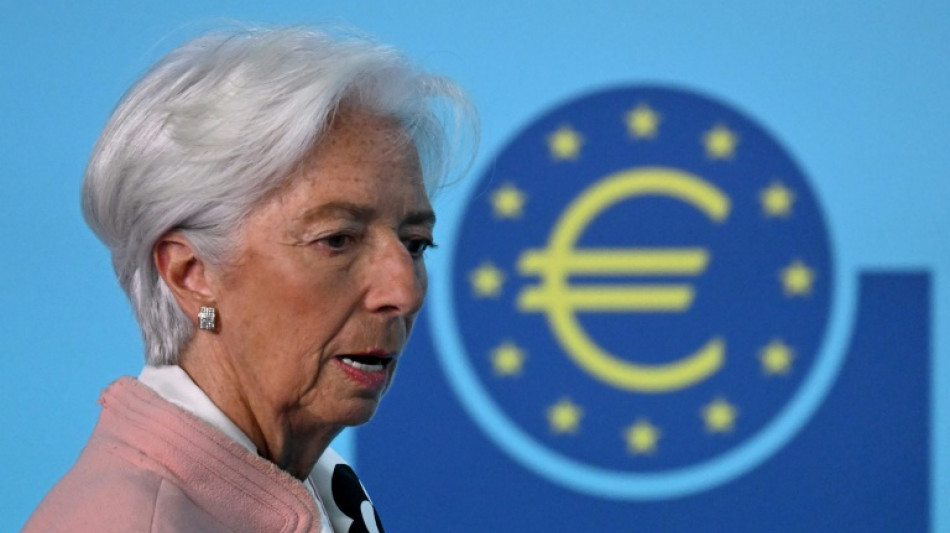
ECB cuts rates as Trump tariffs raise fears for eurozone growth / Photo: Kirill KUDRYAVTSEV - AFP

 South Korea volleyball team latest to be bussed to wrong Games venue

 Malaysia starts sending Myanmar migrants home

 8.3 mn refugees at risk due to 'severe' funding cuts: UN

 Stocks drop and oil rises as Hormuz hopes fade

 OpenAI cancels release of newest model due to safety concerns

 AI bosses head to White House as safety pressure builds

 Batista sacked as Costa Rica coach after six months

 Flooding, power cuts and evacuations as Hurricane Polo slams Mexico

 NFL Giants obtain QB McCarthy from Vikings

 Deal for evicted Spanish pensioner as PM seeks new housing law

 Clippers apologize, warn fans of 'challenges' after Leonard scandal

 Turkish comedian convicted for Erdogan 'insult' freed pending appeal

 Trump announces 'biggest' US steel plant in battleground Iowa

 Olise wonder strike gives Zidane's France win in Belgium
 US stocks fall, bond yields rise as Middle East war drags on

 Trump denies offering to sell arms to China's Xi

 Wemby ready for NBA Spurs to move rivals in climb to top

 Ukraine to postpone some spending amid delays in aid: PM

 Tuchel says Czech Republic game 'not yet a must-win'

 MaXhosa puts South Africa on the Paris fashion map

 Rose, Scott among 2027 World Golf Hall of Fame finalists

 Brunson says NBA champion Knicks can't get satisfaction

 France puts out largest wildfire since 1949
 Real Madrid's Perez summoned over Barcelona referee payments comments

 Oil takes off again, Wall Street dips after Trump rejects Iran truce offer

The European Central Bank cut interest rates again Thursday amid fears that US President Donald Trump's stop-start tariff announcements could threaten growth across the eurozone.
ECB policymakers decided to lower rates by a quarter-point, marking the central bank's sixth consecutive cut to borrowing costs for the single-currency area.
The decision brought the ECB's benchmark deposit rate down to 2.25 percent, the lowest it has been since the beginning of 2023.
Rate-setters have slowly lowered borrowing costs in the eurozone as inflation has drifted back towards the ECB's two-percent target.
But while inflation was headed in the right direction, "the outlook for growth has deteriorated owing to rising trade tensions", the ECB said in a statement.
The ECB had looked set to pause its cuts after its last meeting in March but the fears stirred up by Trump's whirlwind tariff policy look to have forced its hand.
Thursday's cut "came as little surprise", ING bank analyst Carsten Brzeski said.
Having sought a "very measured" approach to gradually bring rates down, the ECB now risked "falling behind the curve once again", Brzeski said.
- Tariff confusion -
Going into the meeting, ECB rate-setters will have had little idea what tariff rates would eventually apply to transatlantic trade -- and what impact they could have on growth.
Besides a basic 10 percent tariff rate on imports into the United States, Trump has also imposed 25 percent levies on the automotive, steel and aluminium sectors.
The US president spooked global markets with the unveiling of swingeing "Liberation Day" tariffs at the beginning of April, before promptly pausing higher duties for dozens of countries, including the EU, for 90 days.
The White House has also opened probes into chips and pharmaceuticals that could lead to more industry-specific tariffs that could impact the eurozone.
The ECB said it was facing "exceptional uncertainty" and would follow a "data-dependent and meeting-by-meeting" approach as it went forward.
The uncertainty was "likely to reduce confidence among households and firms", the central bank said, while market tensions would lead to tighter financing conditions.
In that context, another cut to relieve stress on households and businesses and support the economy seemed "straightforward", according to analysts at Italian lender UniCredit.
The ramifications of higher US tariffs would "outweigh the positive impulse" given by massive planned spending in the eurozone's biggest member, Germany, they said.
The incoming government in Berlin led by Friedrich Merz has lined up hundreds of billions of euros in extra cash for defence and infrastructure, providing a boost that could be felt across Europe.
- 'Always ready' -
But Germany's stimulus measures would only "kick in" in 2026, while the impact of Trump's shake-up of the global trading system would be felt almost immediately, the UniCredit analysts warned.
As for the prices of goods and services, US tariffs made a "further decline in inflation in the eurozone even more likely", said Robert Greil, a strategist at private bank Merck Finck.
Inflation among the 20 members of the eurozone has come down significantly from the double-digit highs seen in late 2022 and sat at 2.2 percent in March.
The single currency has gained in strength relative to the dollar, which should make imports cheaper going forward, while hefty US tariffs on China could see cheap goods diverted to Europe, Greil said.
Observers will listen carefully to ECB president Christine Lagarde's remarks after the rates announcement for a hint of how the ECB may respond going forward.
Lagarde last week signalled policymakers' willingness to support the eurozone in a more critical scenario, where Trump's tariff policy caused a threat to financial stability.
The ECB "is always ready to use the instruments that it has available", Lagarde said in Warsaw.
P.L.Madureira--PC