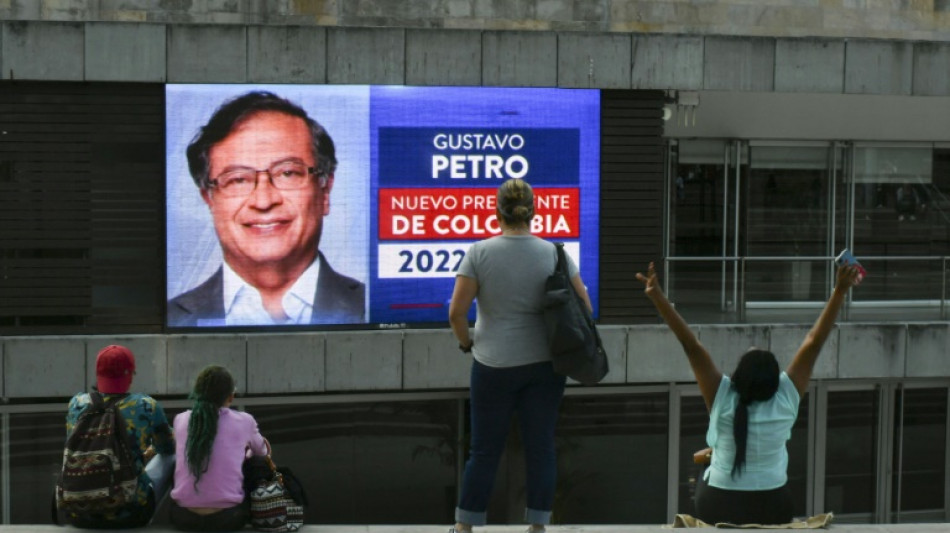
Gustavo Petro elected Colombia's first left-wing president / Photo: JOAQUIN SARMIENTO - AFP

 Vietnamese coffee farmers ride China's durian wave
 Venezuela says retains 'sovereignty' in US oil deal
 NASA's Roman telescope set to launch on cosmic mapping mission
 Data center backlash scrambles US midterm politics
 Emotional Federer inducted into tennis Hall of Fame
 Hovland takes solo lead as McIlroy surges at Tour Championship

 Djokovic 'prepared' for US Open bid for history
 Atletico down Sevilla to go top of La Liga

 US deports right-wing provocateur Milo Yiannopoulos

 Niger junta says it is back in control after soldiers' mutiny
 Erasmus calls Rennie barbs over Springbok scrumming 'nonsense'
 Lawrence's fifty leaves Pakistan facing record chase to level England series
 Netanyahu condemns settler attack in flashpoint West Bank village
 Munoz saves Iraola in Liverpool draw, big-spending Spurs lose again

 Newcastle condemn dismal Spurs to second successive defeat

 James Cleverly leaves shadow cabinet to seek London mayoralty
 Baladi Map app turns Lebanon’s local problems into a public record

 Thirty-seven Mumbai pilgrims return after Nepal flood disruption

 Ankle ligament tear ends Neeraj Chopra’s 2026 season
 Five college football games that could shape the 2026 season

 New finds strengthen case for Bethsaida at Sea of Galilee site

 Felony assaults on older New Yorkers rise sharply, police data show

 Three Texas Tech softball players hurt in jet ski collision

 Tambaram civic groups seek action on eight long-pending issues

 Cyberabad civic body demolishes 19 unauthorised structures
Ex-guerrilla Gustavo Petro was elected the first ever left-wing president of crisis-wracked Colombia on Sunday after beating millionaire businessman Rodolfo Hernandez in a tense and unpredictable runoff election.
With more than 99.5 percent of votes counted, Petro -- the 62-year-old former mayor of Bogota -- held an unassailable lead of more than three points with around 700,000 more votes than Hernandez, 77.
"Today is a celebration for the people. Let's celebrate the first popular victory," Petro wrote on Twitter.
Hernandez said he accepted the result in a Facebook live broadcast.
"I hope that Mr Gustavo Petro knows how to run the country and is faithful to his discourse against corruption," said the construction magnate.
Petro will succeed the deeply unpopular conservative Ivan Duque, who was barred by Colombia's constitution from standing for reelection, in a country saddled with widespread poverty, a surge in violence and other woes.
"May so much suffering be cushioned by the joy that today floods the heart of the Homeland. This victory is for God and for the People and their history. Today is the day of the streets and squares," added Petro.
In another moment of history, environmental activist and feminist Francia Marquez, 40, will become Colombia's first black woman vice-president.
Abstention was expected to be high among Colombia's 39 million voters amid fears a tight result could spark post-election violence.
To ensure security, some 320,000 police and military have been deployed.
The electoral observer mission said one of Petro's election monitors and a soldier were killed, both in the south.
Colombia is no stranger to political violence, with five presidential candidates having been murdered over the course of the 20th century.
Before the first round of this year's presidential election, several candidates received death threats.
- 'Dangerous' accusations of fraud -
When voting in Bogota, Petro, who comfortably topped last month's first round, urged his supporters to turn out as rumors swirled on social media of election irregularities.
"Today, undoubtedly we must defeat any attempt at fraud with massive participation," he said.
The national registrar, Alexander Vega, denounced such fears as "disinformation" while Hernandez, who voted in the northern city of Bucaramanga where he was mayor from 2016 to 2019, accused Petro of "creating an atmosphere of fraud."
"It's very dangerous for candidates to play with this idea (of fraud), it could easily erupt into post-election unrest," Elizabeth Dickinson, Colombia analyst at the International Crisis Group in Bogota, told AFP.
With the traditional political powers suffering a chastening first round defeat, a lot of early voters seemed undecided, not just about who to vote for but what the candidates represented.
Petro has been in politics for 30 years, while Hernandez is an unconventional outsider with little experience.
Valentina Rios, 19, who voted in Bogota said whoever won "at least it will be a change."
"For me, neither of them represents change," countered Alejandro Bueno, 20, an economics student in the capital, who hoped for "a peaceful transition to the next government."
Petro will have to deal with a country reeling economically from the coronavirus pandemic, a spike in drug-trafficking related violence and deep-rooted anger at the political establishment that spilled over into mass anti-government protests in April 2021.
Almost 40 percent of the country lives in poverty while 11 percent are unemployed.
Left-wing ideology is intrinsically linked in many Colombians' minds to the country's six-decade long multi-faceted conflict, leaving many to fear what a Petro presidency would represent.
Petro was a radical leftist urban guerrilla in the 1980s and spent almost two years in jail.
But his M-19 group made peace with the state in 1990 and formed a political party.
- Impact of Venezuela 'tragedy' -
"The worry comes from the experience of leftist governments in the region," Patricia Munoz, an expert at Pontifical Javerian University, told AFP.
Michael Shifter, from the Inter-American Dialogue think tank, said fears Colombia could turn into another authoritarian populist socialist state like neighboring Venezuela "borders on hysteria."
However, he said it's understandable since Colombia has been affected more than any other Latin American country by "the Venezuela tragedy and nightmare."
Until a few months ago, Hernandez was a virtual unknown outside of Bucaramanga.
He made the fight against corruption his main campaign pledge, although he is himself under investigation for graft.
He had vowed to "reduce the size of the state, end corruption and replace inept officials."
But his other policies were unconventional and he lacked a clear program.
Ferreira--PC