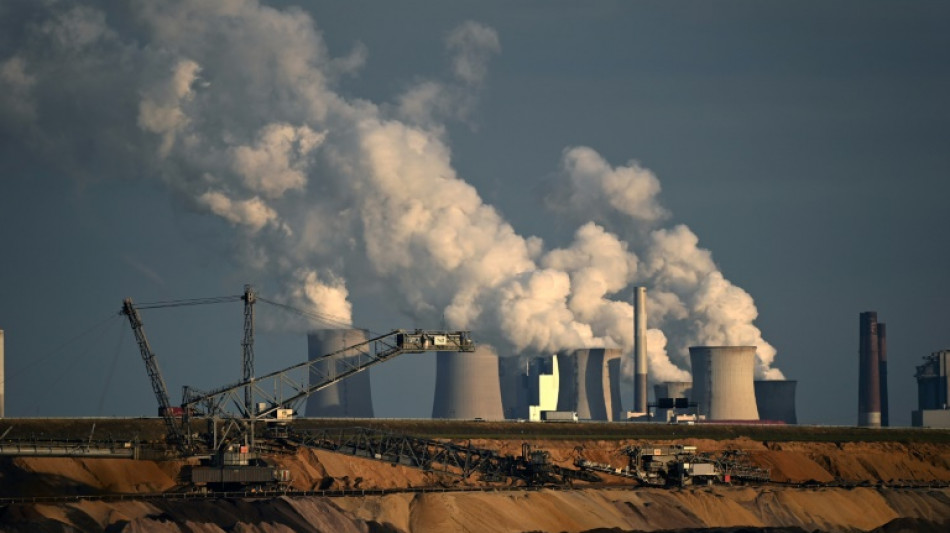
Dutch join Germany, Austria, in reverting to coal / Photo: Ina FASSBENDER - AFP/File

 Vietnamese coffee farmers ride China's durian wave
 Venezuela says retains 'sovereignty' in US oil deal
 NASA's Roman telescope set to launch on cosmic mapping mission

 Data center backlash scrambles US midterm politics
 Emotional Federer inducted into tennis Hall of Fame

 Hovland takes solo lead as McIlroy surges at Tour Championship
 Djokovic 'prepared' for US Open bid for history

 Atletico down Sevilla to go top of La Liga

 US deports right-wing provocateur Milo Yiannopoulos

 Niger junta says it is back in control after soldiers' mutiny

 Erasmus calls Rennie barbs over Springbok scrumming 'nonsense'

 Lawrence's fifty leaves Pakistan facing record chase to level England series
 Netanyahu condemns settler attack in flashpoint West Bank village
 Munoz saves Iraola in Liverpool draw, big-spending Spurs lose again

 Newcastle condemn dismal Spurs to second successive defeat

 James Cleverly leaves shadow cabinet to seek London mayoralty

 Baladi Map app turns Lebanon’s local problems into a public record
 Thirty-seven Mumbai pilgrims return after Nepal flood disruption

 Ankle ligament tear ends Neeraj Chopra’s 2026 season

 Five college football games that could shape the 2026 season

 New finds strengthen case for Bethsaida at Sea of Galilee site

 Felony assaults on older New Yorkers rise sharply, police data show

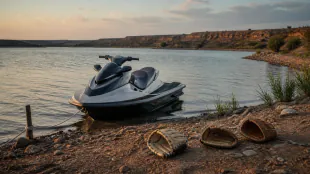 Three Texas Tech softball players hurt in jet ski collision

 Tambaram civic groups seek action on eight long-pending issues

 Cyberabad civic body demolishes 19 unauthorised structures
The Dutch joined Germany and Austria in reverting to coal power on Monday following an energy crisis provoked by Russia's invasion of Ukraine.
The Netherlands said it would lift all restrictions on power stations fired by the fossil fuel, which were previously limited to just over a third of output.
Berlin and Vienna made similar announcements on Sunday as Moscow, facing biting sanctions over Ukraine, cuts gas supplies to energy-starved Europe.
"The cabinet has decided to immediately withdraw the restriction on production for coal-fired power stations from 2002 to 2024," Dutch climate and energy minister Rob Jetten told journalists in The Hague.
The Dutch minister said his country had "prepared this decision with our European colleagues over the past few days".
Germany however said it still aimed to close its coal power plants by 2030, in light of the greater emissions of climate-changing CO2 from the fossil fuel.
"The 2030 coal exit date is not in doubt at all," economy ministry spokesman Stephan Gabriel Haufe said at a regular news conference.
The target was "more important than ever", he added.
- 'More countries being squeezed' -
Russia's invasion of its pro-Western neighbour has sent global prices for energy soaring and raised the prospect of shortages if supplies were to be cut off.
Russian energy giant Gazprom has already stopped deliveries to a number of European countries, including Poland, Bulgaria, Finland and the Netherlands.
Germany's reliance on Russian energy imports has made it particularly vulnerable as Moscow looks for leverage against the West.
The Dutch are less reliant, depending on Russia for around 15 percent of their gas supplies compared to the EU average of 40 percent. But they are still concerned.
"I want to emphasise that at the moment there's no acute gas shortage," Dutch minister Jetten said. "However, more countries are now being squeezed (by Russia). That worries us."
The Dutch government said it was also making an "urgent appeal" to companies and business to save as much energy as possible ahead of the winter.
Germany's decision to power up its coal power plants came after Gazprom cut deliveries to Germany via the Nord Stream gas pipeline last week.
The move, presented by Gazprom as a technical issue, has been criticised as "political" by Berlin.
German Economy Minister Robert Habeck, a Green party politician, described the decision to revert to coal as "bitter, but indispensable for reducing gas consumption".
- 'Unexpected situation' -
Austria's government meanwhile announced Sunday that it would reopen a mothballed coal power station because of power shortages arising from reduced deliveries of gas from Russia.
The authorities would work with the Verbund group, the country's main electricity supplier, to get the station in the southern city of Mellach back in action, said the Chancellery.
The European Commission noted Monday that "some of the existing coal capacities might be used longer than initially expected" because of the new energy landscape in Europe.
"We know that the energy mix and the plans of member states will adjust slightly because we are in an unexpected situation," Commission spokesman Tim McPhie said at a press briefing.
Germany, Europe's largest economy, has managed to reduce the share of its natural gas supplied by Russia from 55 percent before the invasion to 35 percent.
The government has also mandated the filling of gas reserves to 90 percent ahead of the European winter at the end of the year, to hedge against a further reduction in supply.
Germany's government, a coalition between the Social Democrats, Liberals and Greens, aims "ideally" to close all coal power plants by 2030.
Their agreement, reached at the end of last year, brought forward the previous government's aim to shut the plants by 2038.
burs-dk/jhe/jj
M.Carneiro--PC