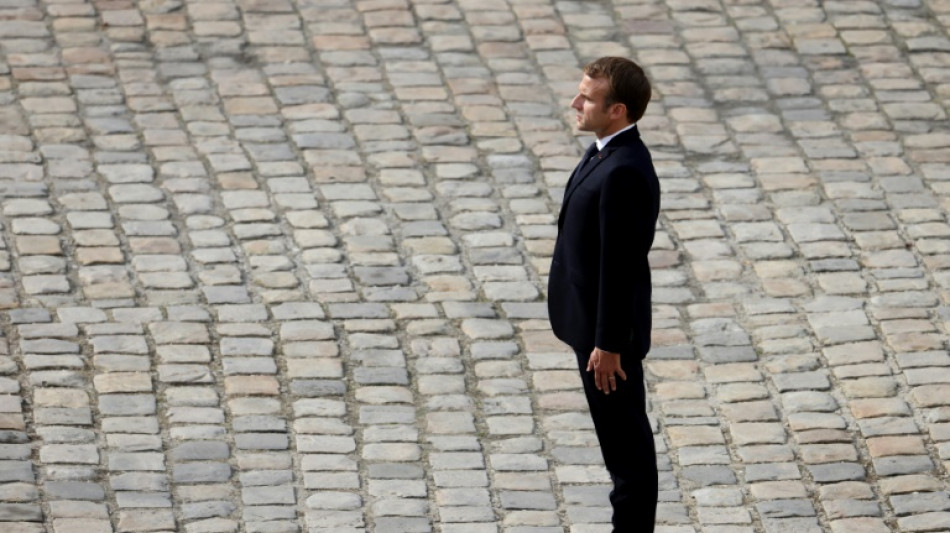
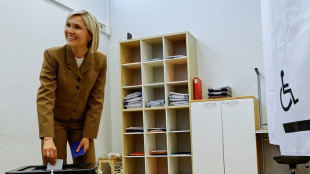
Move over, Jupiter: France's parliament takes centre stage / Photo: THOMAS COEX - AFP

 'No' camp seen winning Iceland's EU referendum

 Nepal flood survivors return to ruins to salvage memories
 Killing of Palestinian children and teens by Israel surges in West Bank

 Educators keep 9/11 memory alive for next generation, 25 years on
 Venezuelans view US oil deal with doubt, hope

 Gobena and Jepchirchir power to Sydney Marathon victories

 Iceland in suspense after close EU vote
 Wallabies hold on for victory in Argentina

 Juve notch second straight win, Fiorentina's centenary party falls flat

 Rybakina eases injury fears ahead of US Open

 Djokovic kicks off latest Grand Slam quest under US Open lights
 'Sorry' De Zerbi won't panic after Spurs shambles
 UN, Nepal warn of climate threat after deadly floods

 USTA boss says structure of new player council not yet set
 Tiny Elversberg stun Leverkusen on Bundesliga debut, Dortmund beat Hamburg
 Ankle ligament tear ends Neeraj Chopra’s 2026 season
 Police appeal for footage after life-threatening Stratford assault

 Family searches for Boston engineer missing after Nepal-Tibet floods

 Dolly Parton’s Imagination Library leaves global children’s reading legacy

 Five college football games that could shape the 2026 season

 New finds strengthen case for Bethsaida at Sea of Galilee site

 Felony assaults on older New Yorkers rise sharply, police data show

 Three Texas Tech softball players hurt in jet ski collision

 Tambaram civic groups seek action on eight long-pending issues

 Chennai councillors unite across parties to demand ward development funds

By design, France is usually governed by a president vested with extraordinary powers. But after Sunday's election, Emmanuel Macron finds himself at the mercy of a newly influential parliament.
It isn't meant to be this way: the 1958 constitution designed by the father of the modern nation, Charles de Gaulle, reduced the power of MPs, with subsequent changes amplifying this shift.
"The fifth republic was made for decisiveness," Frederic Fogacci, a historian and lecturer at Sciences Po university in Paris, recalling the origins of the current republic in the tumultuous post-war years.
For five years, Macron ruled as intended -- a leader with a strong majority that enabled him to push through changes, with only street demonstrations and the upper house Senate serving as resistance.
He once theorised that the French had a repressed longing for a king-like figure and he even namechecked the Roman god of gods, Jupiter, as inspiration -- earning him his nickname.
"Jupiter is over," political scientist Pascal Perrineau told the Parisien newspaper on Monday as the country digested the weekend's stunning results.
Only two months after being re-elected for a second term, Macron's allies are 45 seats short of a majority.
- Precedents -
Other presidents have had to contend with an opposition-dominated parliament, most recently right-winger Jacques Chirac, who served alongside a Socialist prime minister Lionel Jospin from 1997-2002.
Socialist President Francois Mitterrand also struggled through with a minority government from 1988-1991.
Even de Gaulle had slim majorities as president in the 1960s.
"He always had prime ministers who had to negotiate," Fogacci added.
But these rare periods when the president had his hands tied were meant to have been consigned to history by another constitutional change.
From 2002, the parliamentary elections were moved to just after the presidential ones, with the idea being that voters would hand the newly elected head of state a working majority afterwards.
In the 20 years since, the logic worked for Chirac, rightwinger Nicolas Sarkozy -- who was nicknamed the "hyper president" -- Socialist Francois Hollande and Macron in 2017.
- Silver lining? -
But French politics has changed rapidly and deeply since the turn of the century, with the traditional right-wing and left-wing parties disintegrating.
The newly elected parliament after Sunday's vote features three, rather than two, blocs: a hard-left alliance under Jean-Luc Melenchon, Macron's centrists and the far-right under Marine Le Pen.
Short of the required 289 seats for a majority, Macron's government will now need to either agree to a formal coalition tie-up, or negotiate each bill individually.
A smaller, fourth group of MPs -- the rump of the traditional right-wing party, the Republicans -- are likely to be crucial and are seen as the most likely allies.
The problem for Macron is that France's political culture is different to countries where coalitions are commonplace, such as Germany, said Jean-Daniel Levy from the Harris Interactive polling group.
"We have a culture based on conflict rather than finding agreements for the common good," he told AFP. "It would be rather surprising if this changed in the new parliament."
Jean Garrigues, a political historian, sees neither Melenchon, nor Le Pen as likely to compromise as heads of "two radical parties which do not have a culture of government, or negotiation".
But he sees a possible silver lining.
Turnout for parliamentary elections has been falling for 20 years and hit a near-record low on Sunday because many voters view the national assembly as a simple rubber-stamp forum.
"The only positive aspect could be a renewal of parliamentary life which could serve to re-legitimise parliament in the eyes of the electorate," Garrigues told AFP.
And the idea of re-electing Macron, then depriving him of a majority, was simply the continuation of a long-term trend.
Despite his parliamentary woes, the 44-year-old head of state retains sweeping and exclusive powers over foreign and defence policy.
"All of our history has been about balancing the principle of authority and the idea of counter-powers," he said. "Since the Revolution, it's been like that. It's a sort of French schizophrenia."
A.Santos--PC