UN air service slashes fleet by nearly a quarter / Photo: FANNY NOARO-KABRÉ - AFP/File

 Alex Bodi and Prof. Dr Dieter Lazik sign a contract for ALPHA WHEY and BODI Energy Drink

 Swiss reject plan to toughen neutrality: projection
 UK police call in bomb disposal team near air force base

 Bangkok floods send thousands into shelters after days of rain

 Assefa just misses women's world record at Berlin Marathon

 Dramatic winners Zimbabwe to end five-year exile by tackling DR Congo

 Pope to meet victims of clerical sex abuse on France trip

 How young is too young as child prodigies win big at Asian Games

 UK Labour party meets buoyed by Burnham but eager for concrete plans

 Thousands protest ahead of Mexican president's report on missing students
 Bangkok floods force thousands into shelters

 AI startup urges optimism from Europe despite safety fears

 'Godlike, invincible': Japan hails 11-year-old Games history-maker

 Nepal's hydropower ambitions face climate reality check

 Power cuts, rubble: millions come home to find Sudan's capital unlivable

 Internationals keep Presidents Cup lead with late fightbacks

 Tuchel to 'keep pushing' England to reach Spain's level

 Alcaraz saves match points to keep Europe ahead in Laver Cup
 Spain success driven by hunger to improve, says De La Fuente

 Lyon collapse at Stade Francais to suffer first Top 14 loss
 Oyarzabal and Spain sink England again as Modric shines for Croatia

 Housing protesters camp in central Madrid after mass demonstration

 Louise Trotter expands her palette at Bottega Veneta

 Pope prays at Lourdes after huge Paris mass

 USA trims International lead after Presidents Cup four-balls

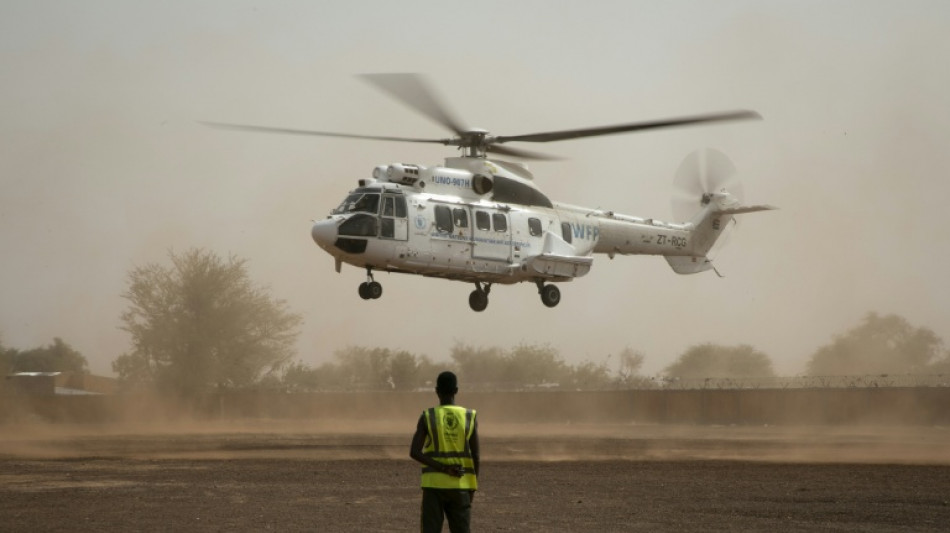
The UN's air service which flies humanitarian workers and cargo to hard-to-reach corners of the world has been forced to slash its global fleet by almost a quarter due to funding cuts, the World Food Programme (WFP) told AFP.
WFP, which manages the United Nations Humanitarian Air Service (UNHAS), received 45 percent of its funding from the United States last year and is one of the organisations most affected by President Donald Trump's foreign aid cuts.
Since January UNHAS "has been forced to cut its global fleet by over 22 percent due to a lack of funding — that's 17 fewer aircraft," a WFP official told AFP on condition on anonymity.
More than 600 aid organisations, including Doctors Without Borders, use UNHAS in 21 countries to ferry humanitarian workers and vital supplies to the world's most challenging regions.
"Without UNHAS flights, MSF will be forced to charter planes to many areas, which is extremely costly and diverts resources away from actual patient care," said Claire Waterhouse, MSF Southern Africa's head of operational support unit.
"Bearing the cost is not sustainable for MSF and may halt humanitarian operations in some contexts."
- South Sudan, Afghanistan -
The United States -- the world's top donor -- slashed foreign aid after Trump took office this year, causing havoc in the humanitarian sector with several organisations forced to slash staff, scale back or restructure.
Other major donor countries have also reduced their contributions.
Cuts have already affected countries like South Sudan, which faces a growing humanitarian crisis with almost a million people who arrived last year fleeing conflict in neighbouring Sudan.
"Weekly flight schedules were adjusted this year to remove five destinations from the 48 that were serviced in 2024. The flight frequency to 10 other destinations was also scaled down," the WFP representative said.
In Afghanistan, where one in every five people is hungry according to the UN, seats available with UNHAS dropped from 157 to 57 since the beginning of the year, the official added.
"This has not only reduced the capacity of aid workers to reach those most in need but also the capacity of UNHAS to react quickly to sudden changes in operational context such as security relocations or a surge in humanitarian needs."
- Human 'triage' -
Even after reducing air services, there is still a risk that more humanitarian operations could be grounded.
"Despite aggressive cost-saving measures, including reductions in the number and frequency of flights, UNHAS faces a $53 million funding shortfall through December," the WFP official said.
The data provided to AFP by the international organisation was what was available at the end of May, meaning the numbers could change if new sources of funding are found.
The Trump administration gutted the US Agency for International Development (USAID) shortly after taking office, eliminating 83 percent of its aid programmes.
The organisation was supporting 42 percent of all aid distributed globally.
In the wake of "the deepest funding cuts ever to hit the international humanitarian sector," the UN launched an appeal in June to prioritise aid for 114 million people "facing life-threatening needs across the world."
"We have been forced into a triage of human survival," said Under-Secretary-General for Humanitarian Affairs and Emergency Relief Coordinator Tom Fletcher.
"The math is cruel, and the consequences are heartbreaking. Too many people will not get the support they need, but we will save as many lives as we can with the resources we are given."
P.Mira--PC