-
 Thousands seek to thwart disputed N.Ireland flashpoint parade
-
How young is too young as child prodigies win big at Asian Games
-
 Swiss vote on what it means to be neutral
-
UK Labour party meets buoyed by Burnham but eager for concrete plans
-
 Pope to meet with victims of clerical sex abuse during France trip
-
Thousands protest ahead of Mexican president's report on missing students
-
 Iran stands firm on Hormuz plan after US rejection
-
Bangkok floods force thousands into shelters
-
 Madrid protest camp grows after eviction outrage
-
AI startup urges optimism from Europe despite safety fears

-
 Italy winemakers hail bumper harvest but cut output
-
'Godlike, invincible': Japan hails 11-year-old Games history-maker
-
 Kyiv shoppers feel the pinch from Russian strikes
-
Nepal's hydropower ambitions face climate reality check
-
 Japanese anime actor fights TikTok over AI voice cloning
-
Power cuts, rubble: millions come home to find Sudan's capital unlivable
-
 Curtain falls on the romance of India's single-screen cinemas
-
Internationals keep Presidents Cup lead with late fightbacks
-
 Smells like teen spirit as US thrash Peru 4-1
-
Tuchel to 'keep pushing' England to reach Spain's level
-
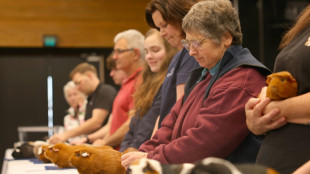 Cavy chaos: Hundreds attend New Zealand's biggest guinea pig show
-
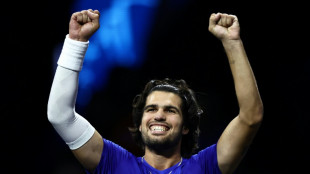
Alcaraz saves match points to keep Europe ahead in Laver Cup
-
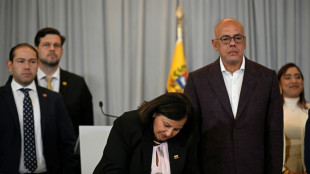 Venezuela releases more political prisoners after opposition talks
-
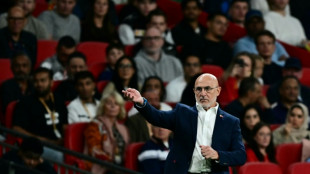
Spain success driven by hunger to improve, says De La Fuente
-
 England's best 'for a long time' despite Spain defeat, says Kane
-
Lyon collapse at Stade Francais to suffer first Top 14 loss
-
 Powerful storm pummels northeast US with rain, high winds
-
Oyarzabal and Spain sink England again as Modric shines for Croatia
-
 Filmmaker Mike Leigh wins top prize at Spain festival with 'last film'
-
Housing protesters camp in central Madrid after mass demonstration

-
 Spain beat England in Nations League to extend unbeaten run
-
Louise Trotter expands her palette at Bottega Veneta
-
 Ireland squad vote to play Israel tie despite Gaza unease
-
Pope prays at Lourdes after huge Paris mass
-
 Gutsy Vollering wins cycling road race world title
-
USA trims International lead after Presidents Cup four-balls
-
 Vollering wins cycling road race world title
-
Russia accuses Europe of blocking Ukraine talks, as strikes drag on
-
 Man City's meteoric rise clouded by dark shadow
-
'He said hello': Families pray with pope on Paris avenue

-
 Mbappe out for two weeks or more with knee injury say Real
-
Pope celebrates giant Paris mass, flies to Lourdes
-
 Lyon collapse away to Stade and suffer first Top 14 loss
-
Thousands march in Madrid over eviction of 87-year-old woman
-
 Russia accuses Europe of seeking to thwart Ukraine talks
-
England women back to winning ways with last-gasp defeat of New Zealand

-
 Man City chairman defiant over reported Premier League charges
-
Trump rejects Iran proposal for deal to reopen Hormuz
-
 Germany ready to 'walk through fire' for Klopp, says Tah
-
England's Cox says injured Buttler leaves 'big shoes to fill'
US, Japan, India, Australia pledge mineral cooperation on China jitters
The United States, Japan, India and Australia pledged Tuesday to work together to ensure a stable supply of critical minerals, as worries grow over China's dominance in resources vital to new technologies.
US Secretary of State Marco Rubio welcomed his counterparts from the so-called "Quad" to Washington in a shift of focus to Asia, after spending much of his first six months on the wars in Ukraine and the Middle East and on President Donald Trump's domestic priorities such as migration.
The four countries said in a joint statement that they were establishing the Quad Critical Minerals Initiative, aimed at "collaborating on securing and diversifying" supply chains.
They offered little detail but made clear the goal was to reduce reliance on China, which has used restrictions as leverage as the United States in turn curbs its access to semiconductors and as Trump threatens steep tariffs -- including on Quad countries.
"Reliance on any one country for processing and refining critical minerals and derivative goods production exposes our industries to economic coercion, price manipulation and supply chain disruptions," the statement said.
The ministers were careful not to mention China by name but voiced "serious concerns regarding dangerous and provocative actions" in the South China Sea and East China Sea that "threaten peace and stability in the region."
China holds major reserves of several key minerals including the vast majority of the world's graphite, which is crucial for electric vehicles.
In brief remarks alongside the other ministers, Rubio said he has "personally been very focused" on diversifying supply chains and wanted "real progress."
- US refocus on Asia -
The four-way partnership was first conceived by late Japanese prime minister Shinzo Abe, who saw an alliance of democracies surrounding China -- which has repeatedly alleged that the Quad is a way to contain it.
Rubio had welcomed the Quad foreign ministers on January 21 in his first meeting after Trump's inauguration, seen as a sign the new administration would prioritize engagement with like-minded countries to counter China.
But to the surprise of many, China has not topped the early agenda of Trump, who has spoken respectfully about his counterpart Xi Jinping and reached a truce with Beijing to avoid a wider trade war between the world's two largest economies.
Trump is expected to travel to India later this year for a Quad summit.
Both the Indian and Japanese foreign ministers said that they wanted the Quad to focus on a "free and open Indo-Pacific" -- a phrasing that is a veiled allusion to opposing Chinese dominance in Asia.
"It is essential that nations of the Indo-Pacific have the freedom of choice, so essential to make right decisions on development and security," Indian Foreign Minister Subrahmanyam Jaishankar said.
At Jaishankar's urging, the Quad condemned a May attack on the Indian side of Kashmir that killed mostly Hindu civilians and called for "the perpetrators, organizers and financiers of this reprehensible act to be brought to justice without any delay."
India in May launched air strikes in Pakistan, which it blamed for the attack. Pakistan denied responsibility and responded with its own attacks on the Indian military.
In a key concern for Japan, the Quad condemned North Korea for its "destabilizing launches" of missiles and insisted on its "complete denuclearization."
Trump, in one of the most startling moves of his first term, met with North Korea's reclusive leader Kim Jong Un, helping ease tensions but producing no lasting agreement.
Despite common ground on China, Quad members have differed on other hotspots, with the joint statement not mentioning Ukraine or Iran.
India has maintained its long relationship with Russia despite the invasion of Ukraine, while both India and Japan also have historically enjoyed cordial ties with Iran.
M.Carneiro--PC