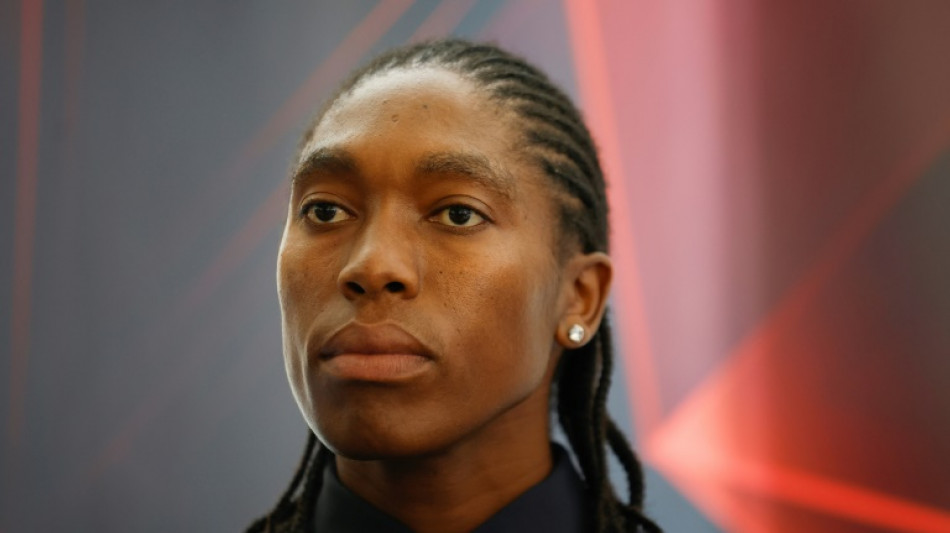
Europe court says S.African athlete's gender eligibility trial wasn't fair / Photo: Phill Magakoe - AFP/File

 AI startup urges optimism from Europe despite safety fears

 'Godlike, invincible': Japan hails 11-year-old Games history-maker

 Nepal's hydropower ambitions face climate reality check

 Power cuts, rubble: millions come home to find Sudan's capital unlivable

 Internationals keep Presidents Cup lead with late fightbacks

 Tuchel to 'keep pushing' England to reach Spain's level

 Alcaraz saves match points to keep Europe ahead in Laver Cup
 Spain success driven by hunger to improve, says De La Fuente
 Lyon collapse at Stade Francais to suffer first Top 14 loss

 Oyarzabal and Spain sink England again as Modric shines for Croatia
 Housing protesters camp in central Madrid after mass demonstration

 Louise Trotter expands her palette at Bottega Veneta
 Pope prays at Lourdes after huge Paris mass

 USA trims International lead after Presidents Cup four-balls

 Russia accuses Europe of blocking Ukraine talks, as strikes drag on

 'He said hello': Families pray with pope on Paris avenue

 Pope celebrates giant Paris mass, flies to Lourdes

 Thousands march in Madrid over eviction of 87-year-old woman
 England women back to winning ways with last-gasp defeat of New Zealand

 Trump rejects Iran proposal for deal to reopen Hormuz
 England's Cox says injured Buttler leaves 'big shoes to fill'

 Ruthless Perpignan upset sloppy Bordeaux-Begles

 Deadly abbey attack feeds anti-Ukrainian sentiment in Poland

 Antonelli says he drove 'safety-first' on his worst weekend of season
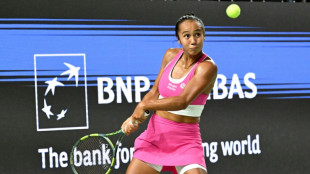 Fernandez fights back to reach Singapore Open final

A top European court ruled Thursday that the Swiss judiciary did not give double Olympic champion Caster Semenya a fair trial when she contested a rule forcing her to lower her testosterone levels to be able to compete as a woman.
However, the European Court of Human Rights (ECHR), in its final decision, said it could not determine whether or not the South African runner had suffered discrimination.
Its verdict comes after a row over the gender of an Algerian boxing champion engulfed the 2024 Paris Olympics, and as the International Olympic Committee mulls reintroducing contested gender testing.
Semenya, 34, is classed as having "differences in sexual development", but has always been legally identified as female.
She has been unable to compete in her favoured 800m category since 2018, after she refused to take drugs to reduce her testosterone levels under new rules from World Athletics, the governing body for track and field.
Semenya told journalists the ECHR's decision was a "positive outcome".
"We need to respect athletes, we need to put their rights first," said the athlete, who was Olympic 800m champion in 2012 and 2016 and world gold medallist in 2009, 2011 and 2017.
It was a reminder to leaders that "priorities lie in the protection of athletes," she added.
Semenya has embarked on a long legal marathon to contest the World Athletics rule.
The Lausanne-based Court of Arbitration for Sport ruled against her in 2019 and the decision was validated by the Swiss Federal Court in Lausanne in 2020.
It judged that a testosterone level comparable to that of men gave female athletes "an insurmountable advantage".
The ECHR said the Swiss court did not give the case a "rigorous judicial review that was commensurate with the seriousness of the personal rights at issue", and had therefore breached Semenya's right to a fair trial under the European Convention on Human Rights.
It ordered Switzerland to pay her 80,000 euros ($93,000) for expenses.
- 'Not far enough' -
A lower chamber at the ECHR in 2023 ruled that Semenya was the victim of discrimination by the Court of Arbitration for Sport -- even if it did not call into question the World Athletics rule, nor allow Semenya to return to competition without taking medication.
Swiss authorities, supported by World Athletics, appealed to the European court's 17-member Grand Chamber, leading to Thursday's ruling.
The Grand Chamber, however, said it could not rule on any discrimination as the alleged offence did not fall under Switzerland's jurisdiction.
Seema Patel, a sports law expert, said "the Grand Chamber didn't go far enough to recognise all violations in this case".
"But there is at least an alert to sport that convention rights must be respected," she said.
Antoine Duval, another legal scholar, said the ECHR had implied the World Athletics rule was disproportionate.
Its judgement "encourages intersex athletes affected by these rules to go before the Court of Arbitration for Sport and relaunch the debate", he said.
There are many types of "differences in sexual development", a group of rare conditions involving genes, hormones and reproductive organs.
Formerly known as intersexuality, they occur in approximately one in 1,000 to 4,500 births.
Semenya was born with the "46 XY" chromosome, rather than the XX chromosome most women have.
Before the 2009 world championships, where Semenya won the 800m gold aged just 18, she was forced to undergo gender testing. She was then put on medication to reduce testosterone levels.
But Semenya said she felt like a "human guinea pig" and vowed to never allow it again.
Testosterone is produced by men and women but men produce 20 times more of the sex hormone.
But how much the hormone boosts performance remains a matter of debate.
- 'Degrading' -
The International Olympic Committee is weighing reintroducing gender testing.
World Athletics and World Boxing have already adopted chromosomal testing -- generally a cheek swab to check for the Y chromosome.
World Aquatics in 2023 adopted a policy that foresees such testing.
Supporters say such screening simplifies access to women's competition, and UN rapporteur Reem Alsalem has said such tests are "reliable and non-invasive".
But Madeleine Pape, a sociologist of gender in sport, says there is a lack of research proving DSD athletes gain a "disproportionate advantage" over XX competitors.
Human Rights Watch has argued that World Athletics rule is "degrading and invasive", as well as "scientifically contested".
The gender debate reignited in June around Paris Olympic boxing champion Imane Khelif.
Donald Trump and Harry Potter author J.K. Rowling were among those who stoked a row over the Algerian's gender.
T.Vitorino--PC