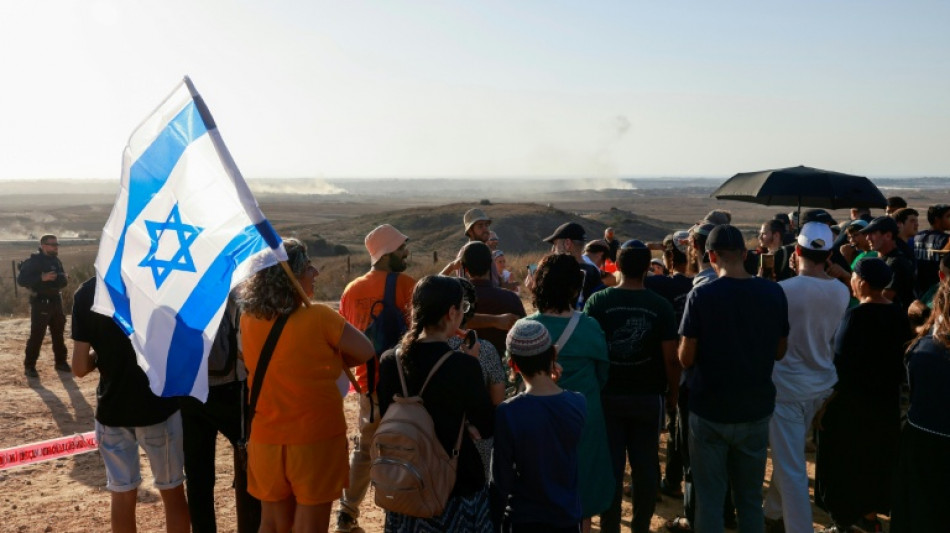
'Ours forever': would-be Israeli settlers march on Gaza / Photo: Menahem KAHANA - AFP

 Texas Sports Betting Status: No Legal Options Amid Legislative Push for 2027 Referendum

 Geri Halliwell-Horner Embraces Queen Camilla at Commonwealth Writing Competition

 Meta Quest 3 and 3S Gain Access to Over 150 3D Movies

 Sarah Bajada Shares Message on Pregnancy Loss

 ALIX LASERS shareholders remove Michael Sobitsch as managing director in view of the circumstances

 Euroseas Q3 Net Profit Falls to $91.4 Million Amid Fleet Reduction

Within sight of Gaza, the devastated Palestinian enclave ravaged by nearly 22 months of war, hundreds of Israeli settlers marched Wednesday to stake their claim to the battered territory.
Waving Israeli flags alongside the orange banners of Gush Katif -- a bloc of settlements dismantled in 2005 -- the marchers went from the town of Sderot to the Asaf Siboni observation point, overlooking the ruins of Beit Hanun.
Israel's withdrawal from Gaza 20 years ago ended 38 years of military presence. About 8,000 settlers were evacuated and 21 communities demolished.
But a vocal fringe never gave up the dream of return -- and now, amid war with Hamas and with hardliners in government, some believe the time is ripe.
Veterans of Gush Katif have been joined by a new generation of would-be settlers ready to move in if the army gets out of their way.
"As a movement, 1,000 families -- you see them today marching -- we are ready to move now, as things stand, and to live in tents," said 79-year-old Daniella Weiss, a former mayor of the West Bank settlement of Kedumim.
"We are ready with our children to move into the Gaza area right away, because we believe this is the way to bring quiet, peace, to put an end to Hamas," she told AFP.
"It's only when we hold on to the soil, to the grains of sand, that the army will raise a white flag," she said.
Far-right groups joined the protest, marching toward the border chanting: "Gaza, ours forever!" Loudspeakers blared: "The way to defeat Hamas is to take back our land."
- 'God and the government' -
Much of Gaza has been ruined by the Israeli offensive launched in response to the Hamas attacks of October 7, 2023, which left 1,200 dead and more than 250 taken hostage.
More than 60,000 Palestinians have been killed since, according to the Hamas-run territory's health ministry. International NGOs have accused Israel of forcibly displacing civilians and committing war crimes -- with some alleging genocide, a charge Israel fiercely rejects.
The official policy of Prime Minister Benjamin Netanyahu's government is that the Gaza operation was launched to destroy Hamas and rescue Israeli hostages -- not to restore settlements.
But the would-be settlers say they have been in talks with hardline members of the ruling coalition and believe there may be a political opening, despite the fact that reoccupation is deemed illegal under international law.
They were further buoyed this week when Finance Minister Bezalel Smotrich, in a speech at the Gush Katif museum, declared: "It's closer than ever. It's a realistic work plan.
"We didn't sacrifice all this to transfer Gaza from one Arab to another Arab. Gaza is an inseparable part of the land of Israel.
"I don't want to go back to Gush Katif -- it's too small. It needs to be much bigger. Gaza today allows us to think a little bigger."
The marchers heard him.
"I have faith in God and in the government," said Sharon Emouna, 58, who came from her settlement in the occupied West Bank to support the Gaza return movement.
"I'm just here in support, to say that the land of Israel is promised to the Jewish people and it's our right to settle there," she said.
And if any Palestinians want to remain in Gaza, Emouna added, they would benefit from living alongside the settlers.
On Wednesday, however, it was Israeli soldiers who blocked the final short walk to Gaza, across a parched landscape of low brush scorched by the summer sun.
A continuous stream of families approached the border, close enough to glimpse the apocalyptic silhouette of smashed Palestinian homes left by the fighting -- and, perhaps, what they hope will become home again.
J.V.Jacinto--PC