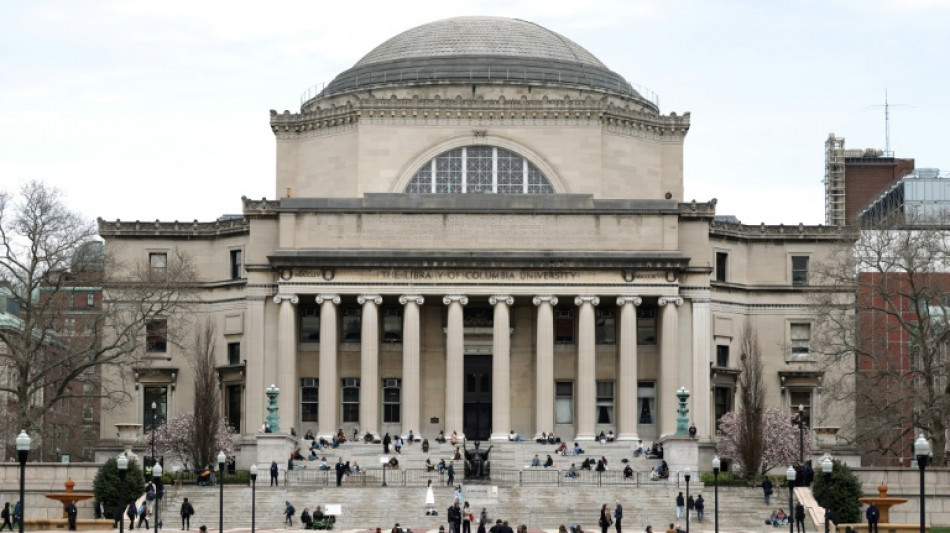
Academics warn Columbia University deal sets dangerous precedent / Photo: CHARLY TRIBALLEAU - AFP/File

 USA trims International lead after Presidents Cup four-balls

 Russia accuses Europe of blocking Ukraine talks, as strikes drag on

 'He said hello': Families pray with pope on Paris avenue

 Pope celebrates giant Paris mass, flies to Lourdes

 Thousands march in Madrid over eviction of 87-year-old woman
 England women back to winning ways with last-gasp defeat of New Zealand

 Trump rejects Iran proposal for deal to reopen Hormuz

 England's Cox says injured Buttler leaves 'big shoes to fill'

 Ruthless Perpignan upset sloppy Bordeaux-Begles
 Deadly abbey attack feeds anti-Ukrainian sentiment in Poland

 Antonelli says he drove 'safety-first' on his worst weekend of season

 Fernandez fights back to reach Singapore Open final

 Giant statue of Pope Leo XIV takes shape in Peru workshop

 Ukraine crush holders Italy to reach first BJK Cup final

 Pope celebrates giant Paris mass in landmark visit

 Germany selects Munich for Olympics host bid

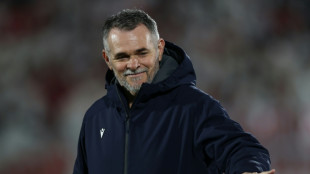 Sagnol sacked as Georgia boss after Nations League upset

 Man City could face 'drastic' sanctions after reported guilty verdict: ex-chairman

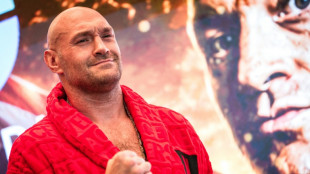 Furious Fury says row between rival promoters could scupper Joshua bout

 'Invincible' 223cm teen basketball player stars as China win bronze

 Tenth woman found dead in South Africa's string of killings

 Japan schoolboy, 11, wins gold while empty seats blight Asian Games

 Japan organisers 'not satisfied' as empty seats blight Asian Games

 Canals full, roads submerged as Bangkok declares flood disaster

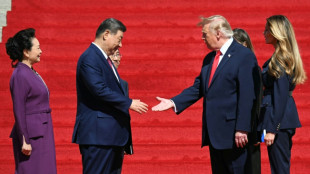 China, US to open AI 'communication channel' after summit

Columbia University's $200 million agreement with President Donald Trump's administration marks the end of a months-long showdown, but academics warn it is just the first round of a government "assault" on higher education.
Academics from Columbia and beyond have expressed concerns that the deal -- which makes broad-ranging concessions and increases government oversight -- will become the blueprint for how Trump brings other universities to heel.
The New York institution was the first to be targeted in Trump's war against elite universities, for what the US president claimed was its failure to tackle anti-Semitism on campus in the wake of pro-Palestinian protests.
It was stripped of hundreds of millions of dollars of federal funding and lost its ability to apply for new research grants. Labs saw vital funding frozen, and dozens of researchers were laid off.
But Columbia last week agreed to pay the government $200 million, and an additional $21 million to settle an investigation into anti-Semitism.
According to Ted Mitchell, president of the American Council on Education, the lack of due process -- with the government slashing funding before carrying out a formal investigation -- left Columbia in an "untenable position."
Columbia law professor David Pozen agreed, saying the "manner in which the deal was constructed has been unlawful and coercive from the start" and slamming the agreement as giving "legal form to an extortion scheme."
- Federal oversight -
The deal goes beyond addressing anti-Semitism and makes concessions on international student admissions, race and ethnicity considerations in admissions and single-sex spaces on campus, among other issues.
Columbia also agreed to appoint an independent monitor to implement the deal, share ethnicity admissions data with the government and crack down on campus protests.
Many of the provisions "represent significant incursions onto Columbia's autonomy," said Pozen.
"What's happened at Columbia is part of a broader authoritarian attack on civil society," he said, pointing to similar pressures on law firms and media organizations to fall in line.
According to the law professor, the deal "signals the emergence of a new regulatory regime in which the Trump administration will periodically and unpredictably shake down other schools and demand concessions from them."
In the coming weeks, Pozen said he expected the "administration will put a lot of pressure on Harvard and other schools to follow suit."
Harvard University has pushed back against the government, filing a lawsuit in a bid to reverse sweeping funding cuts.
But Steven Levitsky, a professor of government at Harvard, said that "in terms of academic freedom and in terms of democracy, the (Columbia) precedent is devastating."
- 'First round' -
Education Secretary Linda McMahon said she hoped the Columbia deal would be a "template for other universities around the country."
On Wednesday, McMahon announced a deal with Brown University to restore some federal funding and end ongoing investigations after the Ivy League school agreed to end race considerations in admissions and adopt a biological definition of gender.
Brown President Christina Paxson admitted "there are other aspects of the agreement that were not part of previous federal reviews of Brown policies" but were "priorities of the federal administration."
Harvard is reportedly considering forking out $500 million to settle, according to the New York Times.
Others have made smaller concessions to appease the government, with Trump's alma mater the University of Pennsylvania banning transgender women from competing in women's sports, and the University of Virginia's head resigning after scrutiny over its diversity programs.
Brendan Cantwell, a professor at Michigan State University who researches the history and governance of higher education, said government interference in universities "has not happened at scale like this, probably ever in American history."
While some university staff see striking an agreement as the quickest way to reopen the federal funding spigot, Cantwell warned that concessions such as sharing ethnicity data from admissions could be "weaponized" and provide fodder for future probes.
Levitsky agreed, saying: "Extortionists don't stop at the first concession. Extortionists come back for more."
"There's a very high likelihood that this is just the first round," he said.
Pozen noted that it will be harder for "major research universities to hold the line" compared to smaller colleges which are less reliant on federal funding.
But Levitsky still urged Harvard to stand its ground and "fight back," including in the courts.
"Fighting an authoritarian regime is costly, but that's what we have to do," he said. "This is an unprecedented assault, and universities need to work together."
G.Teles--PC