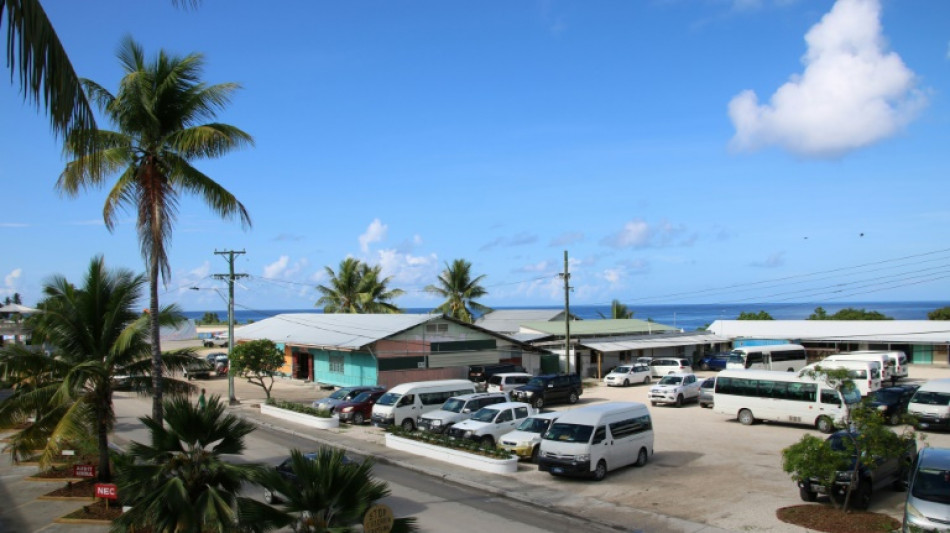
Pacific microstate sells first passports to fund climate action / Photo: Mike LEYRAL - AFP/File

 Man City chairman defiant over reported Premier League charges

 Germany ready to 'walk through fire' for Klopp, says Tah

 At least 16 killed in Russian and Ukrainian strikes

 Powerful storm pummels US Northeast
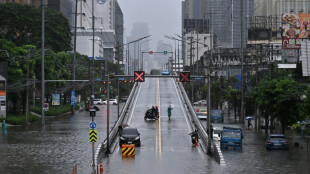
 Bangkok declares disaster after homes flooded, roads submerged by heavy rain

 Norris calls for errant Colapinto to be banned for causing Baku crash

 Russell finds himself again and prepares to heap pressure on Antonelli

 South Korea hold nerve to win Asian Games basketball gold

 Russell holds off Verstappen to claim imperious victory in Baku

 Russell holds off Verstappen to win Azerbaijan Grand Prix

 India's Kohli says 2027 ODI World Cup will be his last

 Huge crowds cheer Pope Leo along Champs-Elysees ahead of Paris mass

 Putellas wants to bring 'winning culture and mentality' to London City

 Rare Italian opera returns to Moscow after nearly 120-year hiatus

 Pope to celebrate giant Paris mass after 'peace' appeal

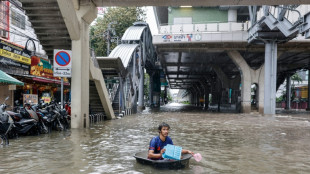 Homes flooded, roads submerged: Bangkok declares disaster over heavy rains

 Ahead of Paris mass, pope urges life together in 'dignity and peace'

 Austria 'ghetto' language classes leave children to repeat school
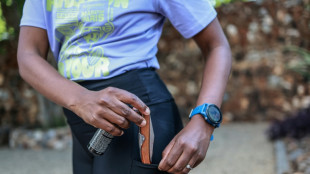 S.African women runners arm themselves after string of killings

 'I felt embarrassed': Japan eSports whizz-kid, 11, wins Games gold

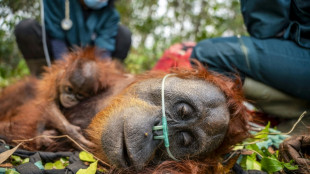 Indonesia fires threatens critically-endangered orangutan: IUCN

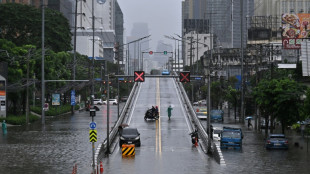 Bangkok declares flood disaster across city

 'World records not enough': North Korea weightlifters target Olympic gold rush

 Iran proposes Hormuz plan, Trump reportedly refuses
 El Nino rewrites the menu in the world's top restaurants

A remote Pacific nation has started selling passports to fund climate action, but is so far struggling to attract new citizens to the low-lying, largely barren island.
Pacific microstate Nauru, one of the world's smallest nations, has a novel plan to fund its fight against climate change by selling so-called "golden passports".
Selling for US$105,000 each, Nauru plans to drum up more than US$5 million in the first year of the "climate resilience citizenship" programme.
Almost six months after the scheme opened in February, Nauru has so far approved just six applications -- covering two families and four individuals.
Despite the slow start -- Nauru eventually hopes to sell 66 passports in the scheme's first year -- President David Adeang remained upbeat.
"We welcome our new citizens whose investment will assist Nauru to secure a sustainable and prosperous future for generations to come," he told AFP on Thursday.
Nauru believes the passport programme could eventually generate $43 million -– or about 500 successful applicants -- which would account for almost 20 percent of total government revenue.
But there are fears the scheme could be ripe for exploitation.
Edward Clark, who runs Nauru's climate passport programme, said one application has already been withdrawn after officials flagged "adverse findings" during background checks.
"The application would have been rejected had it not been withdrawn," he told AFP.
A previous Nauru attempt to sell passports ended in disaster.
In 2003, Nauru officials sold citizenship to Al-Qaeda members who were later arrested in Asia.
Among the first batch of climate passports approved was an unnamed German family of four living in Dubai, said Clark touting the "major milestone".
- 'Political volatility' -
"They were looking for a second citizenship to provide them with a Plan B given the current global political volatility."
The Nauru passport provides visa-free entry into 89 countries, including the United Kingdom, Ireland, United Arab Emirates and Hong Kong.
More than 60 different nations offer some form of migration for investment schemes, Australia's Lowy Institute has found.
Pacific nations such as Vanuatu, Samoa and Tonga have all dabbled in selling passports.
The island republic of Nauru sits on a small plateau of phosphate rock in the sparsely populated South Pacific.
With a total landmass of just 21 square kilometres (eight square miles), it is one of the world's smallest nations.
Unusually pure phosphate deposits -- a key ingredient in fertiliser -- once made Nauru one of the wealthiest places, per capita, on the planet.
But these supplies have long dried up, and researchers today estimate 80 percent of Nauru has been rendered uninhabitable by mining.
What little land Nauru has left is threatened by encroaching tides. Scientists have measured sea levels rising 1.5 times faster than global averages.
Nauru will eventually need to relocate 90 percent of its population as creeping seas start to eat away at its coastal fringe.
The first phase of this mass relocation is estimated to cost more than $60 million.
E.Raimundo--PC