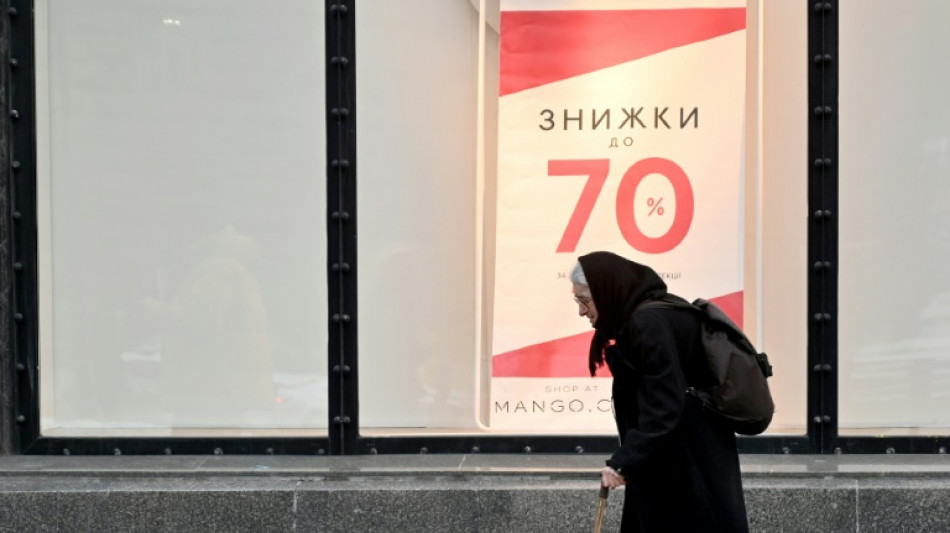
Invasion or not, Ukraine's economy is already paying price

 Trump's beef policies irk Texas ranchers, testing their loyalty

 Nvidia, OpenAI CEOs to attend Xi dinner at White House

 Anthropic picks Accenture for in-house AI safety evaluation

 Balogun returns as Monaco beat Lens to continue strong Ligue 1 start

 'Pause' on overt repression in Venezuela, but reforms still needed: HRW

 Global stocks mixed as yen falls despite Bank of Japan rate hike

 Cuba hit with seventh major blackout of the year

 Murray out with concussion so Wentz will start for Vikings

 UN chief 'deeply regrets' US visa refusal to Abbas for annual meeting

 England quick Carse to face no charges over alleged nightclub assault

 Mancini brings nine newcomers into the first squad of his Italy comeback

 Czechs level Davis Cup tie against USA as South Korea eye Finals

 New France boss Zidane confirms Mbappe as captain after naming first squad

 California governor signs order to explore AI 'kill switch'

 Head leads run spree as Australia win Zimbabwe ODI series

 In-form Raphinha wants to finish career at Barcelona

 Warren Buffett steps down as Berkshire Hathaway chairman

 Carrick confident Man Utd can 'work through' tough time

 Mbappe ends Nike partnership to join Swiss brand On

 Liverpool boss Iraola puts Bournemouth love affair on hold

 'A disaster' if Man City do not win says Maresca after flawless start

 Kerry James Marshall: American 'blackness' painter celebrated in Europe

 Spain coach De la Fuente offers 'full support' to people of Ceuta

 Russia seizes assets of Nestle, French firms over West's Ukraine support

 England can build on World Cup 'spirit', says Tuchel

In his open-plan office in the centre of Kyiv, tech executive Dmytro Voloshyn lists off the tricky questions he's dealt with over the last weeks as fears have soared over a possible Russian invasion.
What will happen if things escalate? What to do with foreign staff? What will happen if martial law is declared? What if the banking system collapses? What if the internet gets cut?
"We've basically had to prepare a contingency plan with answers to all of these questions," he told AFP, showing a chart on his laptop detailing different options for different scenarios.
Preply, the company co-founded by Voloshyn in 2013, bills itself as one of the main online platforms connecting language students to teachers across the world. It employs some 400 people in Kyiv and Barcelona.
With its sleek office design, plants creeping up the walls, cafe for employees, it looks like a Silicon Valley start-up and is considered one of the successes of Ukraine's high-tech sector.
But like the rest of the Ukrainian capital it is currently living a strange double life. Work is going on as normal, people are carrying on with everyday tasks, and nothing seems out of the ordinary.
At the same time -- as Western leaders warn about the threat from Moscow's troops massed on the border -- some people are bracing for the worst.
According to a survey by the European Business Association, which includes many multinationals operating in Ukraine, 40 percent of its members have already prepared emergency plans and 40 percent intend to do so.
"We have a plan, but we don't execute it because we are very confident the situation will stay as it is," Voloshyn, 34, says.
Voloshyn points out that Ukrainian businesses, like the broader population, have got used to living in a state of heightened alert since the Kremlin seized Crimea in 2014 and began fuelling a separatist conflict in the east that has killed over 13,000 people.
"We are not panicking because we know that this situation lasts for eight years already for us," he says.
"It was always that kind of tension here in Ukraine, and now it's more immediate and it escalates obviously, but we are not in a panic mode."
In fact, the crisis in 2014 spurred his company on. It pushed them to grow the business abroad as Ukraine's economy melted down and they sought to protect themselves from the turbulence.
- Weak currency, inflation -
The risk of a Russian invasion, which Moscow denies it is plotting, has not yet caused such catastrophic consequences as it did back then.
But it is already having a very real impact, freezing projects and scaring off some investors.
The central bank has lowered its growth forecast for 2022 to 3.4 percent from 3.8 percent.
It has also had to spend more than $1 billion since the beginning of the year to keep the local currency, the hryvnia, afloat as worried investors have moved money out of the country.
Despite that, the currency has still fallen to its lowest level in four years, fuelling inflation and undermining the purchasing power of households in one of Europe's poorest countries.
The situation has pushed President Volodymyr Zelensky to try to counter some of the more alarmist warnings coming from the West, insisting the priority was to stabilise the economy rather than stir "panic".
For Sofya Donets, an economist at investment firm Renaissance Capital, Ukraine is currently in a stronger position than in 2014 to withstand financial pressure.
It has more than doubled its reserves and is due an influx of Western assistance, with the European Union pledging a further 1.2 billion euros and talks ongoing to unlock new funds from the International Monetary Fund.
"However, this only works to smooth the effect of the prolonged turbulence, but not the full-scale military conflict," she said.
- 'Permanent threat' -
Currently unable to borrow on international markets, the Ukrainian state remains dependant on its international donors.
The government complains the country is suffering from a geopolitical situation beyond its control despite economic "fundamentals" that it insists are solid.
"We have been living since 2014 in a state of permanent threat from Russia, and now this is becoming news to the world," Finance Minister Sergiy Marchenko said in an interview with the Ekonomichna Pravda website.
"Tension cannot increase permanently," he insisted in a bid to reassure.
In the meantime, companies like Voloshyn's are getting ready.
But even if the worst does not happen, economists warn that the spike in tensions further dents the county's longer-term prospects.
"The risk premium for doing business in Ukraine has certainly increased," Lilit Gevorgyan, an economist at IHS Markit.
"This risk perception will not significantly come down unless tangible progress is made between Ukraine and Russia to solve the conflict. Chances of the latter are slim."
T.Batista--PC
