New Danish museum recounts refugees' personal plight / Photo: James Brooks - AFP

 Former Peru minister last-minute contender for UN labour agency helm

 Messi legacy will 'live forever', says Beckham
 'Literally tasting the smoke': Malaysians suffer as haze worsens

 Kyiv's defences, 'hybrid' threat from Moscow headline EU talks
 Oil extends gains, stocks mostly down as Trump issues fresh Iran warning
 ThinkMarkets Expands Weekend Trading Offering, Launches Weekend League Competition

 Tibet activists accuse China of downplaying floods
 Afghanistan war victims left 'without justice', UN says
 Iran president offers US olive branch before Putin meeting
 China-Nepal flood toll tops 1,000 as tunnel rescue offers last hope
 Japan to relax overtime regulation under workaholic PM
 Thwarted Niger mutiny exposes junta's Russia dependence
 Illegal mining ravages S.Africa's economic hub
 Nepal's wall of missing offers last hope after Himalayan flood

 US to press G20 on light-touch AI regulation

 2 die in Grand Canyon flash flood, only 1 person unaccounted for
 US Army Secretary Driscoll submits resignation: White House
 Oil extends gains, stocks drop as Trump issues fresh Iran warning
 Tsitsipas says Kyrgios's positive cocaine test 'kind of expected'
 In Japan's mountains, a different way to manage bears
 Middle East war a boon for UAE defence giant with global ambitions
 Former gang member found guilty of murdering Tupac Shakur

 Top-seeded Zverev opens US Open campaign
 US regulator, 22 states accuse Amazon of 'manipulating' ad auctions: lawsuit

 TRON Founder Justin Sun Shares Outlook on Bitcoin, Stablecoins and Global Finance at Bitcoin Asia 2026

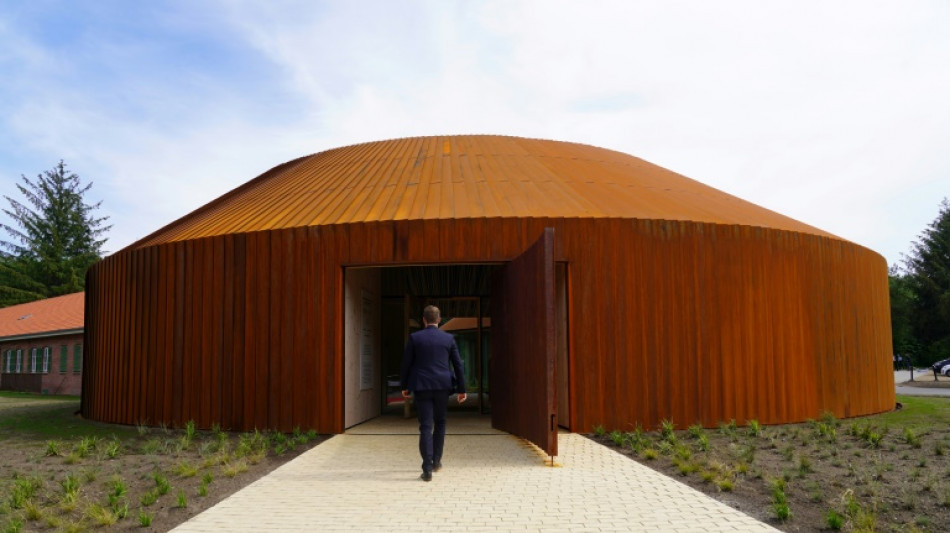
Built on the site of a camp for German World War II refugees, a new Danish museum opening Wednesday shines fresh light on personal stories of forced migration, past and present.
The new FLUGT ("flee" in Danish) Refugee Museum of Denmark, in the small town of Oksbol on Jutland's west coast near the German border, focuses primarily on German refugees, as well as others who have come to Denmark over the years.
Exhibits include personal items -- from a tent to a teddy bear -- that tell the intimate stories of people who have fled war and oppression in Afghanistan, Bosnia, Chile, Germany, Hungary, Iran, Lebanon, Russia, Syria and Vietnam, among others.
"We want to tell the story that is behind these numbers, there are actual people," museum director Claus Kjeld Jensen told AFP ahead of Wednesday's opening.
But for some, the museum's open philosophy contrasts with Denmark's approach to refugees, with successive right and left-wing governments pursuing one of Europe's toughest immigration policies.
- 'More relevant than ever' -
As World War II drew to a bloody close, roughly 250,000 Germans fled to Denmark as the Russian Red Army approached.
Around 35,000 of them found their way to the refugee camp in Oksbol, instantly making the site Denmark's fifth largest city by population size.
The camp, in operation from 1945 to 1949, had schools, a theatre and a workshop, all behind barbed wire.
Nowadays, little of the camp remains, aside from two former hospital buildings and a cemetery, hidden amid a thick, green forest.
"We have got this part of world history actually taking place right here where we're standing. But then there is an actual situation today," Kjeld Jensen said.
"We have far more refugees worldwide than we had by the end of World War II. So, I suppose the issue is far more relevant today than it has ever been."
Denmark's Queen Margrethe II attended the museum's official inauguration on June 25 with Germany's Vice Chancellor Robert Habeck. The German state contributed around 1.5 million euros ($1.58 million) to the 16-million-euro project.
"None of us would have thought it would be so sadly current to talk about refugees and fleeing," the 82-year-old monarch said.
- Fresh movement -
In 2021, the total number of people forced to flee their homes due to conflicts, violence, fear of persecution and human rights violations was 89.3 million, according to the UNHCR, the United Nations' refugee agency.
Russia's invasion of Ukraine sparked fresh movement across Europe, with more than six million refugees fleeing across the borders, according to the UNHCR.
The new museum was designed by world-renowned Danish architect Bjarke Ingels, who recently finished Google's new Silicon Valley headquarters and is set to design a new US museum about slavery in Fort Worth, Texas.
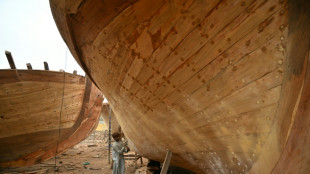
Ingels' design links the two surviving hospital buildings with a new, circular rusty steel-clad construction. Indoors, towering timber frames stretch into the sky, creating a large, open foyer, from which visitors explore the exhibits.
"When you come here from the outside, you see this kind of closed undulating wall of corten steel," explained Ingels.
"But then, when you move inside, you realise that there is this oasis or sanctuary that opens up towards the forest, which in a way is what the fugitives hopefully found here -- a sanctuary from the war and a glimpse of a brighter future."
- Fortress Denmark -
In mid-2020, Denmark became the first European Union country to re-examine the asylum cases of several hundred Syrians from Damascus, judging it safe for them to return. It also plans to open asylum centres outside Europe where applicants would be sent to live.
In 2021, only 2,099 people sought asylum in Denmark.
UNHCR representative Henrik Nordentoft admitted there were "challenges" with Denmark's refugee policies.
"These are very politically-driven and we hope, of course, that there will be a way of changing that," he said.
The museum's inauguration was attended by 82-year-old Jorg Baden, who fled Germany for Denmark in 1945 at the age of five, as well as more recent arrivals, including a 16-year-old who fled Syria in 2015 and a group of Ukrainian classical musicians who arrived earlier this year.
It's a reminder, as Baden put it, that "Flugt is not only a topic of the past, it reaches into our lives today."
P.Queiroz--PC