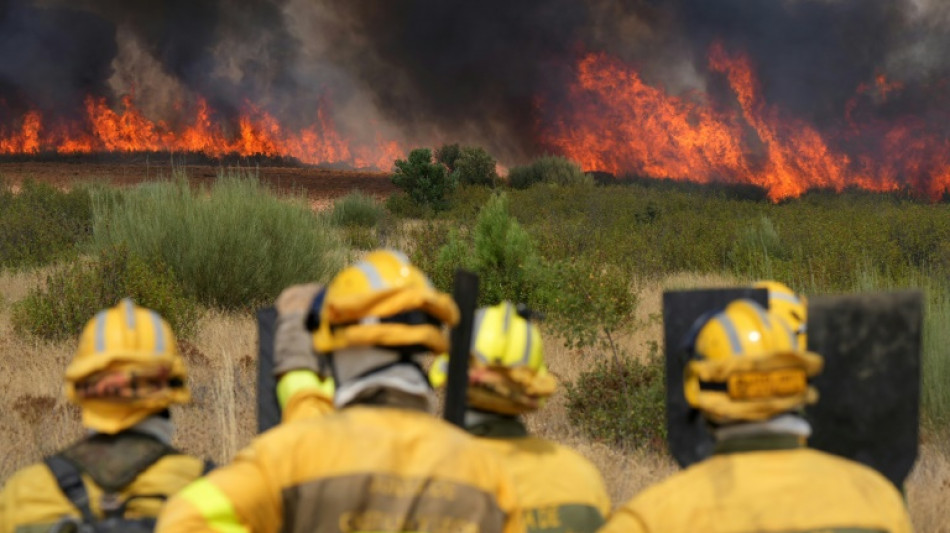
Spanish PM says 'difficult hours' left in wildfire fight / Photo: CESAR MANSO - AFP

 Geri Halliwell-Horner Embraces Queen Camilla at Commonwealth Writing Competition

 Meta Quest 3 and 3S Gain Access to Over 150 3D Movies

 Sarah Bajada Shares Message on Pregnancy Loss

 ALIX LASERS shareholders remove Michael Sobitsch as managing director in view of the circumstances

 Euroseas Q3 Net Profit Falls to $91.4 Million Amid Fleet Reduction

 Daily Horoscope November 20, 2026: Astrological Predictions for All Signs

 West Midlands Shoppers Urged to Guard Against Black Friday Scams

Spain still faces "difficult hours" ahead in its fight against wildfires that have ravaged a record area of land, Prime Minister Pedro Sanchez warned Tuesday, despite the onset of cooler weather.
The country has faced 16 days of scorching heat, which the public health agency announced Tuesday could be linked to as many as 1,149 excess deaths -- mostly over-65s and those already suffering from illnesses.
The most intense heat, when temperatures surpassed 40C in many regions of Spain, has now passed but Sanchez urged people to "exercise extreme caution", adding: "Critical moments remain, difficult hours remain."
Global warming is driving longer, more intense, and more frequent heatwaves around the world.
By lowering humidity in the air, vegetation, and soil, and reducing the threshold at which materials ignite, heatwaves turn vegetation into highly flammable fuel and make wildfires even harder to control.
While the phenomenon has fuelled fires across southern Europe this summer, Spain has been hit particularly hard -- finally getting some respite on Tuesday.
Cooler, more humid conditions gave firefighters an edge in the west of the country, but officials warned it would still take weeks to put the fires out completely.
"The evolution is favourable in all the fires," said Alfonso Fernandez Manueco of Castile and Leon's regional government, before adding that the situation could change.
The region had faced "unprecedented, extraordinary" weather conditions, he said, with high temperatures and strong winds.
Extremadura regional official Abel Bautista told Spanish public television they were now focused on stabilising the fires, adding: "We are very far from that."
- 'Fire from everywhere' -
Some 373,000 hectares have been scorched in Spain this year, according to the European Forest Fire Information System.
That marks the country's worst fire season since records began in 2006, surpassing 2022, when 306,000 hectares were consumed by flames.
The fires -- along with those affecting neighbouring Portugal -- have released smoke and greenhouse gases over the Iberian Peninsula at levels not seen since the start of these records in 2003, according to the EU's Copernicus Climate Change Service.
Dozens of villages have been evacuated, roads closed and the train service between Madrid and Galicia remains suspended because of the wildfires.
"We had to run away because the fire was coming in from everywhere -- everywhere -- above us, below us, all around," Isidoro, 83, told AFP in the Ourense province of Galicia.
Four people have been killed by the fires in Spain and two more in Portugal.
Officials in Spain said many fires were sparked by lightning during dry storms, though arson is suspected in some cases.
The interior ministry said 32 people have been arrested and 188 investigations had been launched.
Sanchez was visiting Extremadura on Tuesday, his second to the affected areas in recent days, and once again called for a "state pact to confront the climate emergency".
"Every year the climate emergency worsens," he said.
L.Carrico--PC