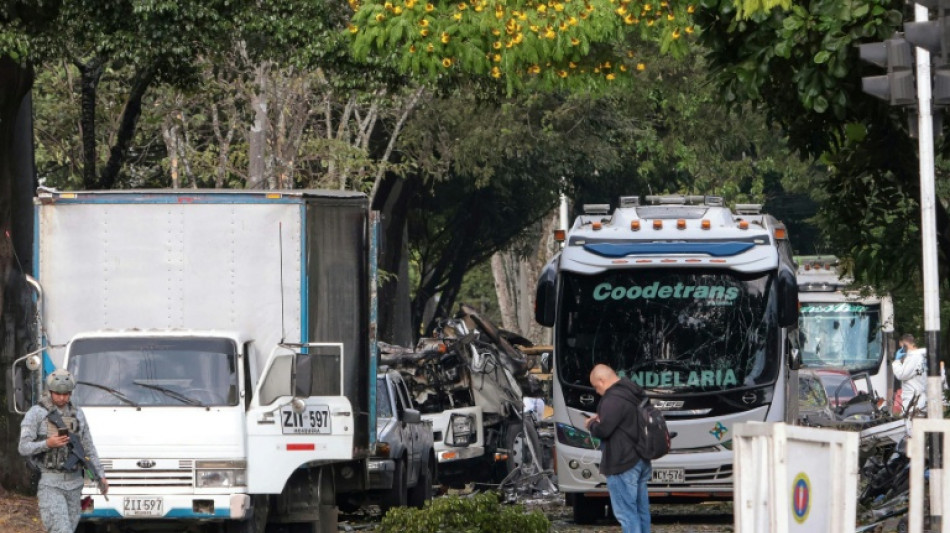
Five dead as 'thunderous' bomb attack hits Colombian city / Photo: STRINGER - AFP

 2027 Toyota Sienna Gets Sixth-Gen Hybrid System, More Power, and Trim Changes

 Burnham Government Announces Neighbourhood Support Teams to Reduce Hospital Admissions

 KFF Health News Readers Weigh In on Healthcare Policy, Ethics, and Workforce Shortages

 16-Year-Old Founder Targets 'Cost Per Kill' With AI Missile Startup
 Elon Musk Promises Steering-Wheel-Free Tesla Model Y Amid Cybercab Sales Launch

 Tosca's 2026 Sustainability Report Makes the Case for Packaging as Critical Supply Chain Infrastructure

 Eisai's Dayvigo Shows Year-Long Efficacy Without Tolerance Ahead of Korean Launch
Colombian authorities said five people were killed and dozens more injured when a truck bomb tore through a busy street in the city of Cali on Thursday, deepening the country's most serious security crisis in decades.
Police said the explosion targeted a military aviation school in the city's north -- a fresh challenge to Colombia's fragile peace process ahead of 2026 elections.
"There was a thunderous sound of something exploding near the air base," 65-year-old eyewitness Hector Fabio Bolanos told AFP.
"There were so many injured people," he said. "Many houses were damaged in front of the base."
Cali mayor Alejandro Eder said preliminary reports were that at least five people were killed and 36 people injured.
Fearing further explosions, he announced a temporary ban on large trucks entering the city and a US$10,000 reward for information.
Several buildings and a local school were evacuated.
Cali is Colombia's third-largest city, home to more than two million people, famed for its vibrant salsa-infused nightlife and cartel-tainted past.
Eyewitness Alexis Atizabal, 40, said civilians appeared to be among the victims.
"There were fatalities among people passing by on the avenue," he said.
It was not immediately clear who was responsible for the blast, but Eder blamed it on "narcoterrorists."
Many of Colombia's armed groups -- once based on leftist or right-wing ideologies -- are now de facto drug cartels, funding themselves through the lucrative cocaine trade.
In June, leftist guerrillas claimed responsibility for a wave of 24 coordinated bomb and gun attacks near Cali that killed seven people.
The group, the Central General Staff (EMC), rejected a 2016 peace deal and has upped operations ahead of next year's vote.
As yet, the group has not claimed responsibility for Thursday's blast.
- 'Most painful days' -
Left-wing guerrillas, right-wing paramilitaries and murderous cartels still control pockets of Colombia, but the country has enjoyed a decade or more of relative calm.
The 2016 peace deal saw the main rebel group, the FARC, disarm and demobilize after a six-decade-long insurgency.
But there has been a recent surge in violence that experts say demonstrates armed groups are regaining strength and the ability to carry out coordinated, complex attacks.
Former top security officials have voiced concern that the Colombian intelligence services have lost a step and are no longer able to detect and foil plots.
In a seemingly unrelated attack on Thursday, eight people were killed in clashes between guerrillas and police in the northwest of the country.
The police officers had been eradicating coca crops near the city of Medellin when a drone was used to down a helicopter.
Colombians are fearful of a return to the violence of the 1980s and 1990s, when cartel attacks, guerrilla violence and political assassinations were commonplace.
The latest attacks heaped pressure on the government of President Gustavo Petro, whose conciliatory approach to armed groups has been blamed for the uptick in violence.
In response to Thursday's attacks, Petro said dissident guerrillas loyal to warlord Ivan Mordisco, another group known as the "Segunda Marquetalia" and the country's largest cartel the Clan del Golfo would be declared "terrorist organizations".
Petro is constitutionally barred from running again in next year's elections.
Earlier this month, Colombia buried 39-year-old conservative presidential candidate Miguel Uribe, who was shot in June while campaigning in the capital Bogota.
Uribe's own mother, journalist Diana Turbay, was killed in a botched 1991 police operation to free her from cocaine kingpin Pablo Escobar's Medellin cartel.
F.Cardoso--PC