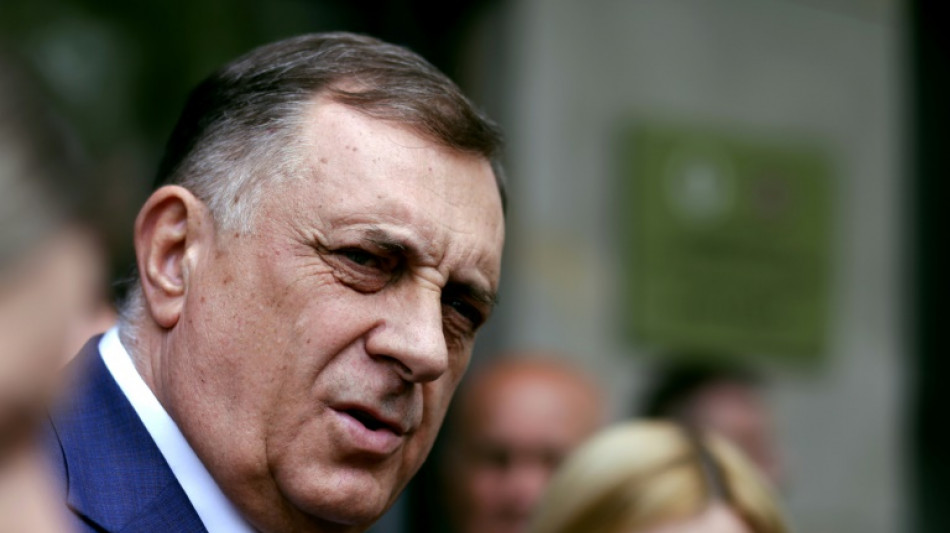
Bosnia's Serb statelet calls referendum on verdict against leader / Photo: STRINGER - AFP/File

 2027 Toyota Sienna Gets Sixth-Gen Hybrid System, More Power, and Trim Changes

 Burnham Government Announces Neighbourhood Support Teams to Reduce Hospital Admissions

 KFF Health News Readers Weigh In on Healthcare Policy, Ethics, and Workforce Shortages

 16-Year-Old Founder Targets 'Cost Per Kill' With AI Missile Startup

 Elon Musk Promises Steering-Wheel-Free Tesla Model Y Amid Cybercab Sales Launch

 Tosca's 2026 Sustainability Report Makes the Case for Packaging as Critical Supply Chain Infrastructure

 Eisai's Dayvigo Shows Year-Long Efficacy Without Tolerance Ahead of Korean Launch
Bosnia's Serb statelet, whose President Milorad Dodik is defying a ban on him holding office, will stage a referendum on October 25 on the federal court verdict against him.
Lawmakers in the Republika Srpska's (RS) regional parliament late Friday voted for the referendum as the political crisis around Dodik worsened, with his prime minister resigning on Monday, triggering a government reshuffle.
Dodik, 66, was convicted in February by a Bosnian federal court of undermining the fragile functioning of the Balkan country by flouting decisions by the international envoy enforcing a peace deal that ended Bosnia's 1992-1995 war.
Dodik avoided a one-year prison sentence by paying a 19,000-euro ($22,000) fine, but an appeals court upheld a ruling that he be removed from the RS presidency and banned from political office for six years.
The regional leader, who has been in his post for seven years, has vowed to block elections in the Republika Srpska and to hold a series of referendums.
The one voted for late Friday was the first of those.
The question to appear on the October ballot, Bosnian Serb lawmakers decided, was: "Do you accept the decisions of the unelected foreigner (international envoy Christian Schmidt) and the unconstitutional verdict of the Bosnia-Herzegovina Court against the President of the RS, as well as the decision of the Bosnian Electoral Commission to revoke the mandate of the President of the RS, Milorad Dodik?"
Of the 65 lawmakers present in the RS parliament, 50 voted in favour. Opposition lawmakers in the chamber refused to cast a vote.
"I won't get in your way... but you're walking on a minefield," warned one opposition member of parliament, Nebojsa Vukanovic, a fierce critic of Dodik.
- Dodik seeks massive backing -
Dodik has said he expects the Serbian population of the Republika Srpska to massively vote "no" to the referendum question. He has also threatened to hold a later referendum on independence for the Serbian entity.
The nationalist Bosnian Serb leader has been in power since 2006. He blames Schmidt, a former German minister who has been the international envoy for Bosnia since 2021, for his ordered ouster.
The RS parliament late Friday also adopted a number of "conclusions", including one rejecting Schmidt's authority, another demanding that Dodik continue as the statelet's president, and one rejecting elections to choose a successor to him.
With the federal ban on Dodik holding office, Bosnia's electoral commission is expected to call early elections for the RS presidency, which must be held within 90 days.
The outgoing RS prime minister, Radovan Viskovic, did not explain why he was resigning, in a Monday press conference held in the regional capital, Banja Luka.
He stated only that a new government would be formed, and that "I leave my successor a stable Republika Srpska".
Viskovic was accused along with Dodik of undermining Bosnia's constitutional order after the RS parliament voted to bar federal police and the judiciary from operating in the Serb entity.
Both have also been sanctioned by the United States for threatening the 1995 Dayton Peace Agreement and undermining Bosnia and Herzegovina's sovereignty.
Bosnia has been split between Serbian and Bosnian-Croat political units since the end of the 1990s war, in which tens of thousands died. The country is held together by weak central institutions.
B.Godinho--PC