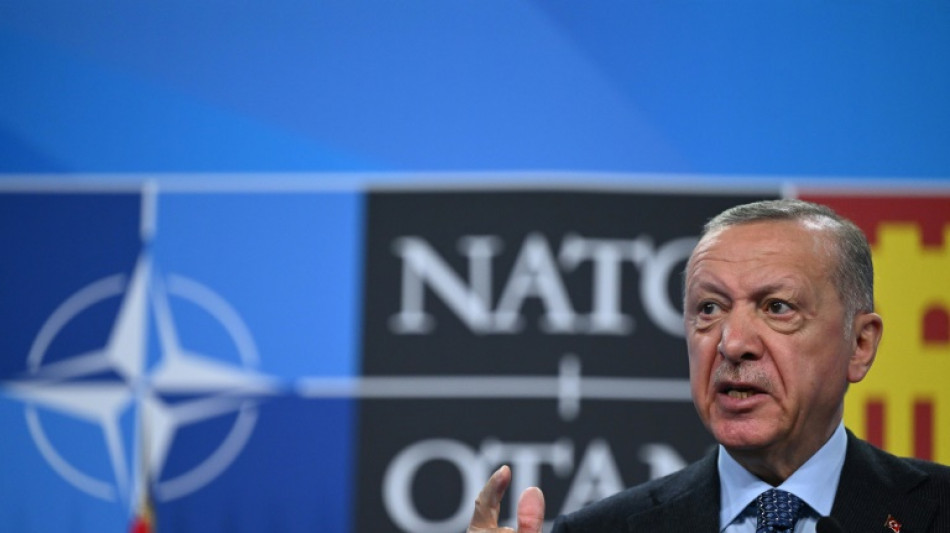
Erdogan warns Turkey may still block Nordic NATO drive / Photo: GABRIEL BOUYS - AFP

 Hilton Phoenix Resort to Open Emberance Restaurant Inspired by Sonoran Desert
 Canva Craft vs ChatGPT: Head-to-Head AI Image Generation Test

 TikTok Security Chief Advises SMBs on Free Cybersecurity Protections
 UCLA Stays Unbeaten With Ty Dieffenbach's Heroic Return Against Illinois

 Marco Rubio Praises Daughter Daniella’s Speech at Federalist Society Convention

Turkish President Recep Tayyip Erdogan on Thursday told Sweden and Finland that he could still block their drives to join NATO if they fail to implement a new accession deal with Ankara.
Erdogan issued his blunt warning at the end of a NATO summit at which the US-led alliance formally invited the Nordic countries to join the 30-nation bloc.
The two nations dropped their history of military non-alignment and announced plans to join NATO in response to Russia's invasion of Ukraine.
Their bids were headed for swift approval until Erdogan voiced concerns in May.
He accused the two of providing a haven for outlawed Kurdish militants and promoting "terrorism".
Erdogan also demanded they lift arms embargoes imposed in response to Turkey's 2019 military incursion into Syria.
A 10-point memorandum signed by the three sides on the sidelines of the NATO summit on Tuesday appeared to address many of Erdogan's concerns.
Erdogan lifted his objections and then held a warm meeting with US President Joe Biden that was followed by a promise of new warplane sales to Turkey.
Yet Erdogan told reporters at an impromptu press conference held as the summit ended that the memorandum did not mean Turkey would automatically approve the two countries' membership.
New countries' applications must be approved by all members and ratified by their respective parliaments.
Erdogan warned Sweden and Finland's future behaviour would decide whether he forwarded their application to the Turkish parliament.
"If they fulfil their duties, we will send it to the parliament. If they are not fulfilled, it is out of the question," he said.
One Western diplomatic source in the hallways of the NATO summit accused Erdogan of engaging in "blackmail".
- '73 terrorists' -
Erdogan delivered his message one day after Turkey said it would seek the extradition of 12 suspects from Finland and 21 from Sweden.
The 33 were all accused of being either outlawed Kurdish militants or members of a group led by a US-based preacher Turkey blames for a failed 2016 coup.
But Erdogan appeared to up the ante on Thursday by noting that Sweden had "promised" Turkey to extradite "73 terrorists".
He did not explain when Sweden issued this promise or provide other details.
Officials in Stockholm said they did not understand Erdogan's reference but stressed that Sweden strictly adhered to the rule of law.
"In Sweden, Swedish law is applied by independent courts," Justice Minister Morgan Johansson said in a statement to AFP.
"Swedish citizens are not extradited. Non-Swedish citizens can be extradited at the request of other countries, but only if it is compatible with Swedish law and the European Convention," Johansson said.
Finnish President Sauli Niinisto said on Wednesday that Erdogan appeared to be referring to cases that had already been processed by officials and the courts.
"I would guess that all of these cases have been solved in Finland. There are decisions made, and those decisions are partly made by our courts," Niinisto told reporters in Madrid.
"I see no reason to take them up again."
Most of Turkey's demands and past negotiations have involved Sweden because of its more robust ties with the Kurdish diaspora.
Sweden keeps no official ethnicity statistics but is believed to have 100,000 Kurds living in the nation of 10 million people.
The Brookings Institution warned that Turkey's "loose and often aggressive framing" of the term "terrorist" could lead to problems in the months to come.
"The complication arises from a definition of terrorism in Turkish law that goes beyond criminalising participation in violent acts and infringes on basic freedom of speech," the US-based institute said in a report.
R.J.Fidalgo--PC