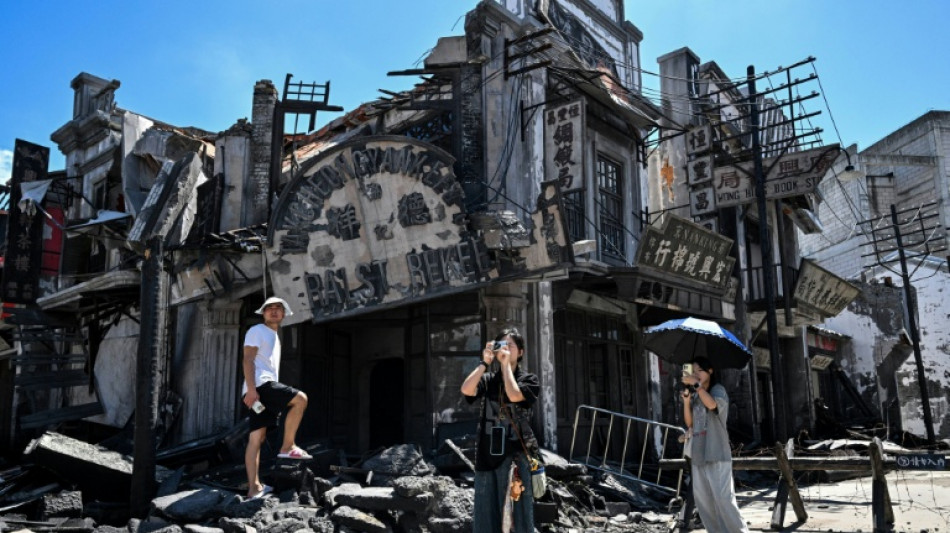
Nanjing massacre film set becomes China school holiday hotspot / Photo: Hector RETAMAL - AFP

 Japanese 11-year-old wins Asian Games eSports gold

 TikTok agrees to teen limits in US settlement following Meta

 Venezuela's oil cradle pins hopes on US energy deals

 US, China buy time with trade truce as pressure builds

 'Leo, Leo': Young Catholics give pope rockstar welcome in France

 Lula bans sports betting days ahead of Brazil's election

 Guatemala ensures survival of vulnerable 'fossil' fish

 Mancini finds positives in Italy loss, accepts fans' jeers

 Alcaraz helps Europe into Laver Cup lead

 Six missing after building collapses in historic Athens district

 Mbappe scores but suffers knee injury as Zidane gets debut France win

 Mancini's Italy return spoiled by Belgium defeat

 Rodri confident in Man City innocence despite reported charges

 Jay-Z rape accuser says she made 'false accusations'
 Senegal draw first match under Vieira and Nigeria survive scare
 Trump, Xi end summit long on pomp, but short on progress

 Russia not preparing for conflict with Europe, Putin says

 Trump's photo of Xi greeting carries signs of AI

 Six missing after building blast in historic Athens district

 Millions in US northeast brace for powerful storm
 Assefa seeks 'better than my best' at Berlin marathon

 US court refuses to overturn Pentagon ban on Anthropic

 Verstappen and Norris blame slow cars as Mercedes tops qualifying

 Crowds cheer pope in Paris after AI 'paradise of machines' warning

 Teen swimmer makes Games history as Thai, Chinese sprinters win gold

The sound of machine gun fire rattled around collapsed buildings as schoolchildren eagerly explored the ravaged streets of 1930s Nanjing, delighted to be visiting the set of a Chinese blockbuster about a historic massacre.
Slickly produced and star-studded, "Dead to Rights" is set in Nanjing, then China's capital, during six weeks of mass murder, rape and looting by the Japanese army in 1937 that killed tens if not hundreds of thousands.
In keeping with other films about the slaughter, "Dead to Rights" does not shy away from portraying the atrocities, but that hasn't deterred viewers. It has topped the Chinese box office since late July.
Its set at a suburban Shanghai film park is now open to the public, and was thronged with enthusiastic fans -- many of them young children -- when AFP visited this week.
An enormous, bullet-ridden mural of China's former leader, Chiang Kai-shek, stared down from a bombed-out building as visitors poured in, taking selfies and livestreaming excitedly.
Beneath the levity, the film had provoked strong emotions.
"It's a deep pain that comes from within, a feeling of profound hatred," said a woman surnamed He, describing her feelings towards Japan.
"History is something that can't be erased in the heart, no matter what happens in the future."
One man told AFP he had travelled almost 2,000 kilometres from northern Ningxia with his five-year-old son, who had watched the film.
Another young boy holding a Chinese flag struck a triumphant pose on a charred mound of rubble and broken glass, as his parents snapped pictures of him against the blue summer sky.
- 'Stoking fires'? -
The film's plot revolves around a group of Nanjing residents hiding in a photo studio, who are forced to develop Japanese photograph "souvenirs" of war crimes.
A South China Morning Post review called the movie "thunderously powerful" but said some violent scenes were "as though engineered to stoke the fires of anti-Japanese sentiment".
"Dead to Rights" is one of several summer releases about the war with Japan, which killed millions of Chinese, and which many feel Tokyo has never properly atoned for.
The country is gearing up for a major military parade next week to mark 80 years since Japan's defeat and World War II's end.
The "Dead to Rights" poster reads: "No Chinese person will ever forget."
"I don't think (films like this) represent hatred. It's because we need to restore history," said 37-year-old visitor Jiang Xiang.
The death toll of the massacre -- the Chinese put it at 300,000 -- remains a source of debate, and some Japanese arch-conservatives have denied it took place at all, despite overwhelming international evidence.
Jiang said awareness of China's suffering should be passed down the generations -- to teach that "we need to rely on ourselves, keep growing stronger".
- 'Understand history' -
In the on-set photo studio, a visitor's book was completely full of comments both patriotic and profane.
"Japan is the stupidest country in the world," read one in a childish scrawl.
Almost all of the parents AFP met said their children had watched the movie, with one mother from Nanjing saying their school had encouraged it.
China has no film rating system, and it is not uncommon for children to watch content that might be considered overly violent elsewhere.
"Look, that's where the head was hanging (in the film)!" a child giggled to a friend as they passed a wooden post.
Tourist He said war films "teach children how our ancestors fought for us".
The aim was to help "the children understand history -- not to make them hate or anything".
Middleschooler Li Xinyi said she found the Japanese "dislikeable" but cautioned against bitterness.
"Even though they did many cruel things to us, we still need to respect them, because now we must focus on peace."
Ferreira--PC