Disinformation a major factor in Brazil election debate / Photo: EVARISTO SA - AFP/File

 Kaepernick says NFL 'blackballing me' decade after protest

 Atletico loan David from Juve, send Lemar to Elche

 Chelsea 'keeper Sanchez makes deadline-day move to Como

 Kroenke to buy baseball's Los Angeles Angels: statement
 US defends Trump's Venezuela oil deal

 OpenAI to launch new model with 'stronger safeguards' after hack
 Fans mourn 'bittersweet' final Ariana Grande gig in London
 Norway's King Haakon VIII swears allegiance to constitution

 Syria site infrastructure 'consistent with nuclear reactor': IAEA
 Juventus sign Woltemade, Sarr on loan from Premier League
 US strikes Iran in latest tit-for-tat attacks
 China's Xi arrives in Egypt as US sanctions threat looms over Iran links

 Car bomb at Colombian police station kills one, injures 11
 Rain delays start of play on US Open

 Man City agree blockbuster deal to sign Chelsea star Fernandez: reports
 Alkemya Metacore Secures $50M via Tokenised Equity to Scale Nickel Energy and Security Tech

 Man City chase Fernandez, Arsenal sell Jesus on deadline day
 EU says Russian 'hybrid attacks' won't halt aid to Ukraine
 Explosives used in sabotage attack on German power lines
 Nepali families hold symbolic funerals for missing after floods

 Newcastle sign Lille forward Fernandez-Pardo

 Even at Elysee, phones are handed in, Macron tells French pupils

 Chelsea agree to sign Atalanta's Ahanor, with Palace loan for this season

 Chelsea sign Atalanta's Ahanor and loan him to Palace
 UK chalks up hottest summer on record for second year running
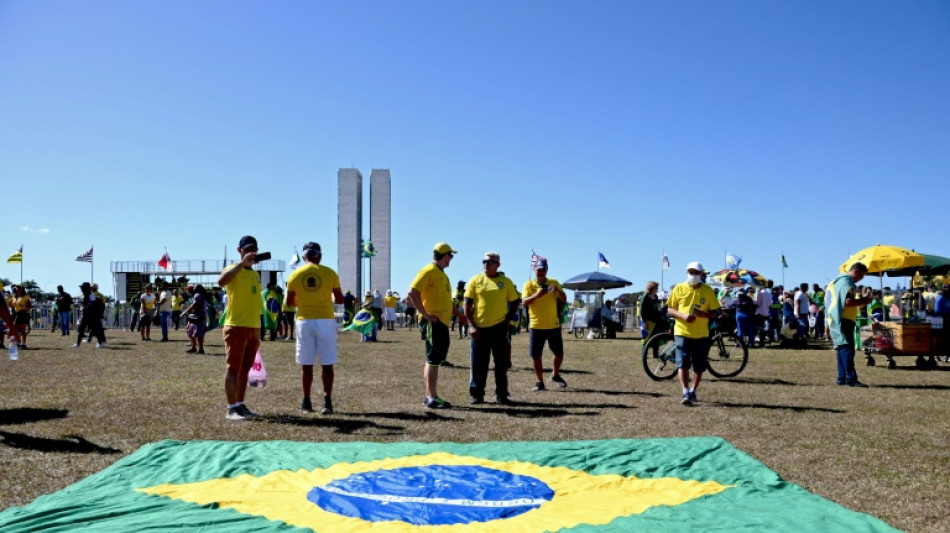
Three months out from the Brazilian presidential election, disinformation about the two main candidates, President Jair Bolsonaro and ex-leader Luiz Inacio Lula da Silva, is having a major impact.
The sheer volume of fake news, creation of new social media platforms and ever more complex content has made it even more difficult to verify information.
The amount of content fact checked by AFP increased by more than fourfold between January and June.
Those producing election fake news first cut their teeth on a very different subject: the coronavirus.
"The election content has taken over the space" previously dominated by the Covid-19 pandemic, said Sergio Ludtke, the coordinator of the Comprova information verification collective made up of 42 media outlets, including AFP.
"The pandemic was probably a period of testing for these groups" producing fake news, he added, saying that it subsequently became "a political event."
And as October's election approaches, verification is becoming "much more complicated" than it was four years ago.
Covid disinformation took on "a new form that permeated politics, the economy, science," said Joyce Souza, a specialist in digital communication at the University of Sao Paulo.
From posts casting doubt on the safety of vaccines, the main form of viral disinformation now revolves around distrust in the electoral system, whether that be opinion polls or electronic voting.
Electronic voting was originally implemented throughout the country in the 2000 elections to combat fraud, but Bolsonaro is not a fan and has cast doubt over the method, calling for paper votes and public counting.
- 'Generating doubt' -
The last elections in 2018 featured large amounts of false and misleading information, especially on WhatsApp. But they were easier to identify.
"What we see now is content that is not necessarily false in itself, but which leads to misleading interpretations," said Ludtke.
It is what happened in May in a tweet that questioned an opinion poll for "only" sampling 1,000 people.
That number was true but the suggestion that it was insufficient was inaccurate.
Experts told AFP it was enough to make a projection as long as the sample group accurately represented the population's diversity.
"One of the strategies of the complex scenario of disinformation is to generate doubt in the social media user, mixing things so much that (the user) doesn't know who to trust," said Pollyana Ferrari, a specialist in communication who coordinates fact checking at the PUC Catholic university.
Such strategies also play on emotions, said Souza, distorting even more the facts and facilitating rapid transmission.
Since the 2018 elections, social media platforms such as Telegram, TikTok and Kwai, which allow the rapid publishing and manipulation of visual content, have gained in popularity.
- 'Vector of disinformation' -
The latest polls last week had Lula in the lead on 47 percent of voter intentions for the October 2 election, compared to Bolsonaro's 28 percent.
But some content targets those polls in a bid to reduce public faith in pollsters.
A video apparently showing Brazilian football fans chanting "Lula, thief!" in a full stadium started doing the rounds recently and was viewed more than 100,000 times on just one platform alongside the question: "Is this the opinion poll leader?"
But the audio had been changed using a tool on TikTok.
For Ferrari, TikTok symbolizes the face of disinformation -- one that is more dynamic and even humorous.
"Like a virus, the fake contaminates the hearing, distorts the vision, settles down in the mind and hides behind the humor of the meme," she said.
In being "inoffensive, it becomes a vector of disinformation."
The supreme electoral tribunal said in a recent document that "false or out of context information affects value judgements, making people decide on the basis of erroneous preconceptions."
Souza believes this content "destroys rational debate in society and makes hate prevail over the public debate."
The problem is that sophisticated disinformation lasts, said Ludtke, and "probably remains in some sectors of society."
V.Dantas--PC