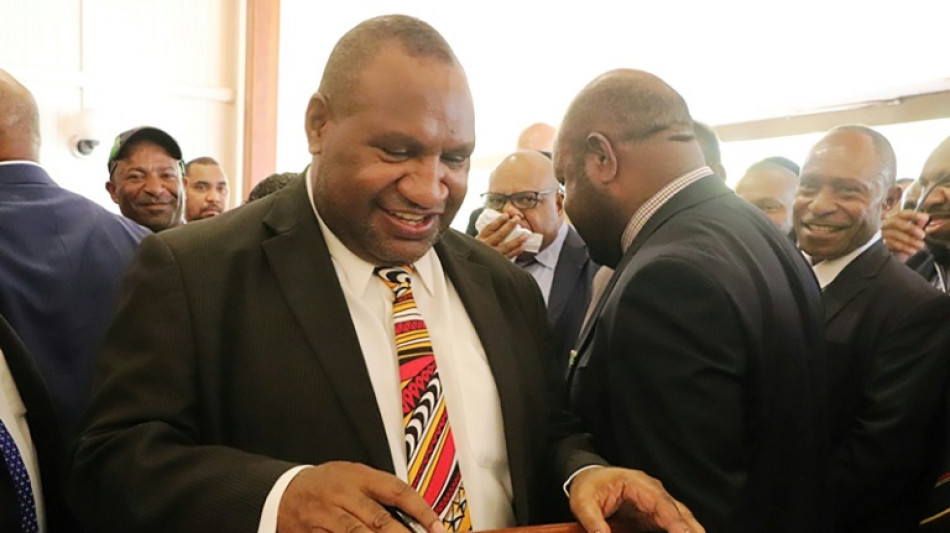
PNG votes in heavily guarded elections / Photo: GORETHY KENNETH - AFP/File

 Egypt and Vietnam Explore Manufacturing and Technology Transfer Partnerships

 Hilton Phoenix Resort to Open Emberance Restaurant Inspired by Sonoran Desert

 Canva Craft vs ChatGPT: Head-to-Head AI Image Generation Test

 TikTok Security Chief Advises SMBs on Free Cybersecurity Protections
 UCLA Stays Unbeaten With Ty Dieffenbach's Heroic Return Against Illinois

 Marco Rubio Praises Daughter Daniella’s Speech at Federalist Society Convention

Voters head to the polls Monday in heavily guarded elections across Papua New Guinea, where millions live in poverty despite vast mineral and energy riches.
About 10,000 police, army and corrections services personnel have been mobilised for the vote in the Pacific island nation, which has a history of corruption and election-related killings.
Australia has sent more than 130 troops with transport aircraft to help secure the challenging and lengthy voting process.
In the run-up to the elections in the rugged, largely forested country of nine million, Prime Minister James Marape called for people to be "free to vote safely".
Election rivalries can quickly spill over into bloodshed in Papua New Guinea, especially in the remote and mountainous highlands provinces.
During the last vote in 2017, Australian National University monitors documented more than 200 election-related killings and widespread "serious irregularities".
This year, 15 election-related deaths have already been recorded, according to Papua New Guinea police.
In the highlands province of Enga, a candidate was charged with shooting and killing the supporter of a political rival on June 26, police told local media.
Marape conceded in an end-of-campaign message that there was still "rampant corruption in all strata of public service" and a lack of development despite the country's "God-given" resources.
"I admit there is much more to be done for our country," said the prime minister, who leads the Pangu party.
He faces a stiff challenge from his predecessor Peter O'Neill, who resigned as leader three years ago under pressure over endemic corruption and a perceived failure to spread mining wealth to the people.
O'Neill, of the People's National Congress party, has vowed to attract private investment and revive the resources industry.
The country boasts large deposits of gas, oil, gold and copper -- as well as forestry and agricultural products.
- 'Very violent' -
Voting is scheduled to take up to 18 days and an outcome is not expected to be clear until August.
Analysts say the new leader will have to cobble together a coalition government in the male-dominated 118-seat parliament, which has had no women members since the last election in 2017.
"Elections are always messy and chaotic and they can get very violent," said Jessica Collins, Pacific researcher at the independent Sydney-based Lowy Institute think tank.
In an ethnically diverse country with more than 800 languages, analysts say voters are less interested in national issues than the material benefits candidates can bring home to local communities.
"People want to know what their candidate is going to do for them and for the village: the real, hard currency stuff," Collins said.
Further complicating the process, the electoral roll is not up to date, said Pacific analyst Henry Ivarature at the Australian National University.
"So the whole integrity of this election is already under question," he said.
The government that emerges from the elections will face significant challenges.
Nearly 40 percent of the population lives below the international poverty line, according to a 2020 report by the World Bank.
The resources- and agriculture-dependent economy posted a "weak recovery" last year, the Asian Development Bank said -- after being battered by the Covid-19 pandemic, with only about three percent of the total population fully vaccinated.
Marape, who has promised to make Papua New Guinea the "richest black Christian nation", told voters his government has started to take back the country's wealth for the people.
J.Oliveira--PC