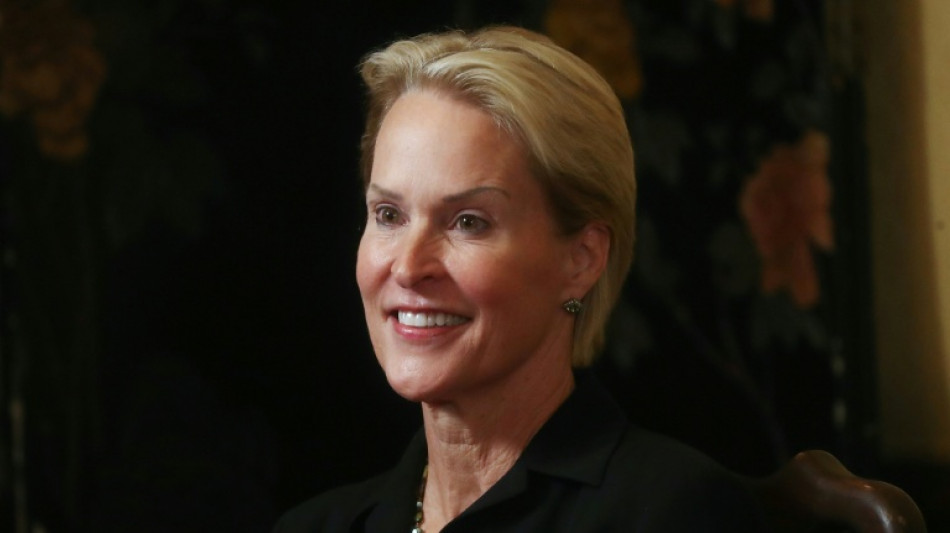
Not all 'A's: Unconventional paths that led to Nobels / Photo: MARIO TAMA - GETTY IMAGES NORTH AMERICA/AFP

 Welcome aboard the Costa Serena, the Asian Games floating hotel
 Asian markets mixed after recent oil surge
 Cash for nature protection: hotelier's offer to Principe islanders
 US miner KoBold bets on AI to gain edge in DR Congo mineral hunt

 Internet disrupted in Ethiopia as conflict rages
 Asian markets mixed after oil gains
 'Genius' Ohashi bids for third Asian Games gold after world record

 India's 'Tree Father' plants for a greener future
 Hopping mad: New health warning stirs up Belgian brewers
 Canadian capital to rename 'Trump Ave'
 Pope heads to France on first state visit in 18 years
 Bacteria suspected in deaths of hundreds of baby whales off Argentina
 US 'must choose' whether to end war: Iran president to Fox News
 UN approves resolution on dealing with rising sea levels
 Yalcouye makes dream debut as Ivory Coast beat Ghana in AFCON qualifier
 Chicago's White Sox and Cubs book MLB playoff berths

 Last-gasp Gakpo strike snatches Dutch draw to sour Klopp debut

 Global stocks mostly fall as oil prices and bond yields rise

 Israel's Netanyahu denounces enemies, allies in fiery UN speech
 Hollywood stars among arrests in NY anti-Netanyahu protest

 Losing start in AFCON qualifying for 78-year-old coach Le Roy

 Italy bans burqas in schools, caps numbers of foreign students per class
 Israel policies threaten 'life and existence' of Palestinians, Abbas says

 Paolini steers Italy past China in BJK
 Zidane admits emotion on eve of first game as France coach
Some Nobel laureates were straight-A students from the get-go. But others AFP spoke to recounted how they cut class, got expelled, and had doubts about their future.
Perhaps the most illustrious Nobel Prize winner, Albert Einstein, was once a mediocre student at Zurich Polytechnic School, now ETH Zurich.
The young Einstein skipped classes, wanted to study physics exclusively, and finished second-last in his class in 1900.
After graduating, he was the only student not offered a research assistant position, according to the Swiss university's website.
Einstein went on to win the Nobel Prize in Physics in 1921.
Frances Arnold, who won the 2018 Nobel Prize in Chemistry, also cut classes after a turbulent start to her education in the United States during the 1960s and 1970s.
"I was disruptive. I was just bored and well beyond what the rest of the kids in the class were doing. And the teachers often gave me little projects decorating the classroom and things like that," she recalled in an interview with AFP.
At the age of 10, she was allowed to take high school courses such as geometry -- a challenge she appreciated at first.
But by the time she reached her teens, she wasn't enjoying school anymore to the point that she stopped going and was expelled.
"I guess I wasn't interested in what they had to teach us. Or if I was interested in it, I just learned it on my own from a textbook. So I managed to pass all my classes despite many absences, I would say."
Now aged 69, she acknowledges that hers is not a model to follow, but believes schools should show more flexibility.
"They don't have the wherewithal to do anything special for the kids who really would benefit," she lamented.
- Overcoming challenges -
David Card, the 2021 Nobel economics laureate, also had unconventional educational beginnings.
"There's almost nobody I've met... in an economics PhD programme that has a background like mine where they went to a rural school," he told AFP.
Born on a farm in Canada in the 1950s, he was enrolled in a small one-room schoolhouse, where one teacher taught around 30 students at different grade levels.
"The way the teacher did it was she would spend some time with each row, which was one of the grades. I actually paid attention to a couple of grades beyond mine for most of the material," he said.
"So you could kind of accelerate very quickly, very easily."
The system was less ideal for students who needed more individualised support, he acknowledged.
According to the Nobel Foundation, other laureates had to overcome major academic challenges before going on to win the prestigious Nobel.
The first woman to win the economics prize, Elinor Ostrom, was turned down when she applied for a PhD in economics; 2009 medicine prize laureate Carol Greider struggled with dyslexia as a child; and 2015 chemistry prize winner Tomas Lindahl failed chemistry in high school.
- Humble beginnings -
Arnold and Card both started working at a young age, which the two consider an important life experience.
In her teens, Arnold held odd jobs as a waitress, receptionist and taxi driver.
"You appreciate more what the university education can give to you, in terms of getting a job you actually might want to have for the rest of your life."
"It also teaches you how to organise your time."
Similarly, Card juggled school and farm life very early on.
"I don't think there was that much homework back then in my schools. So there was lots of time," he recalled.
"I helped my father. I learned to drive a tractor when I was about 11. Every morning I got up at 5:00 am and helped him milk the cows and then I would have a shower and go to school."
Both prizewinners also studied other subjects before discovering their respective passions.
Arnold pursued studies in mechanical engineering and aeronautics before turning to chemistry.
"I wasn't sure what I wanted to do with my life. I went into mechanical engineering because it had the fewest requirements for engineering," she admitted.
And Card initially studied physics before switching to economics.
Despite their unconventional paths, both ultimately found their way to brilliance.
Nogueira--PC