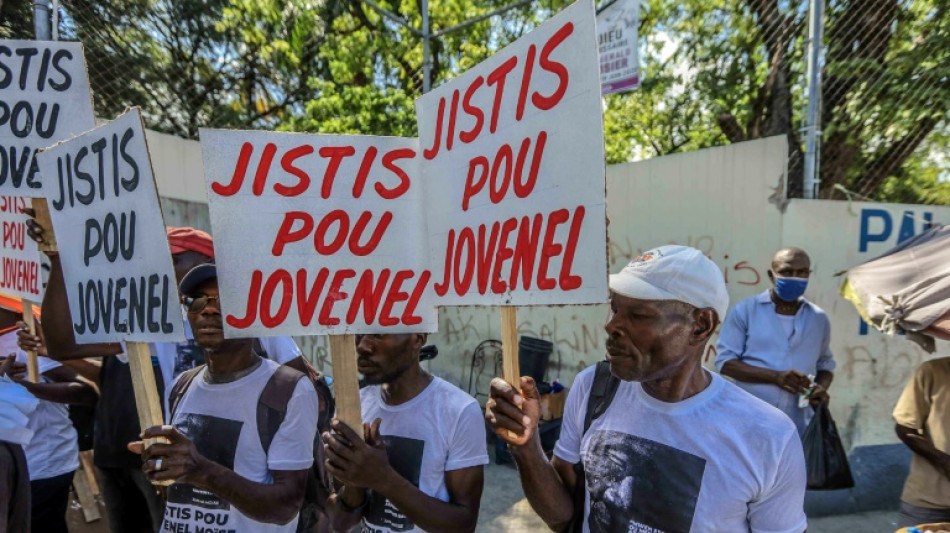
One year after Haiti's president assassinated, investigation stalls / Photo: Richard PIERRIN - AFP/File

 Google Smart Glasses Privacy: Bystander Face Removal Limits

 Egypt and Vietnam Explore Manufacturing and Technology Transfer Partnerships

 Hilton Phoenix Resort to Open Emberance Restaurant Inspired by Sonoran Desert

 Canva Craft vs ChatGPT: Head-to-Head AI Image Generation Test

 TikTok Security Chief Advises SMBs on Free Cybersecurity Protections
 UCLA Stays Unbeaten With Ty Dieffenbach's Heroic Return Against Illinois

 Marco Rubio Praises Daughter Daniella’s Speech at Federalist Society Convention
One year after Haitian president Jovenel Moise was shot to death at his home in Port-au-Prince, no suspected mastermind or motive has yet been identified, with the investigation stalling amid a crumbling political environment.
Moise was assassinated in the early hours of July 7, 2021, when a commando group entered the president's private home and shot him 12 times, killing him.
The same day, Haitian police mobilized exceptionally quickly to arrest about 20 people, including 18 former Colombian soldiers presumed to be hired as mercenaries.
But that initial speed has since been followed by a crawling legal process in Haiti and the United States.
The sluggishness has only worsened in recent weeks as the prosecutor's offices in the Haitian capital have for the last month been invaded by one of the many gangs plaguing the country, whole sections of which are controlled by the often violent criminal bands.
The inquiry's delays have also further complicated Haiti's existing political crisis.
The Caribbean island nation's presidency has been vacant since Moise's death, with no date set for a vote to fill the office.
No fewer than five successive judges have been in charge of the case, but none of them have issued any charges for the 40 people currently imprisoned in connection with it.
Prime Minister Ariel Henry, who was named to his post just two days before Moise's death, is suspected of speaking with one of the prime suspects via telephone just hours after the attack -- a line of investigation which he calls a "distraction."
Parliament has not functioned properly in two years, as Moise had not organized elections since he himself took office in 2017. And without a head of state to appoint judges, the country's judicial system has also flagged.
- Suspects charged in US -
With confidence in their own government all but gone, many Haitians have instead placed their hopes in the hands of the American judicial system.
Three suspects have been charged in Miami, Florida, where Haitian police also say the plot originated. Those suspects are: Colombian Mario Palacios, who is believed to be one of the five armed men who ultimately gained access to the room where Moise was killed, Colombian-Haitian citizen Rodolphe Jaar and former Haitian senator John Joel Joseph.
A fourth man was arrested at an airport in Istanbul in November, though Turkish courts rejected Haiti's extradition request for him just this week.
Despite the case's progress in the United States, a judge in April ruled to seal the evidence, citing two of the suspects' previous involvement as informants for the US Drug Enforcement Agency and the FBI.
A Haitian judicial source, speaking on condition of anonymity, lamented the US move, telling AFP: "A whole section of this story will remain unknown."
C.Cassis--PC