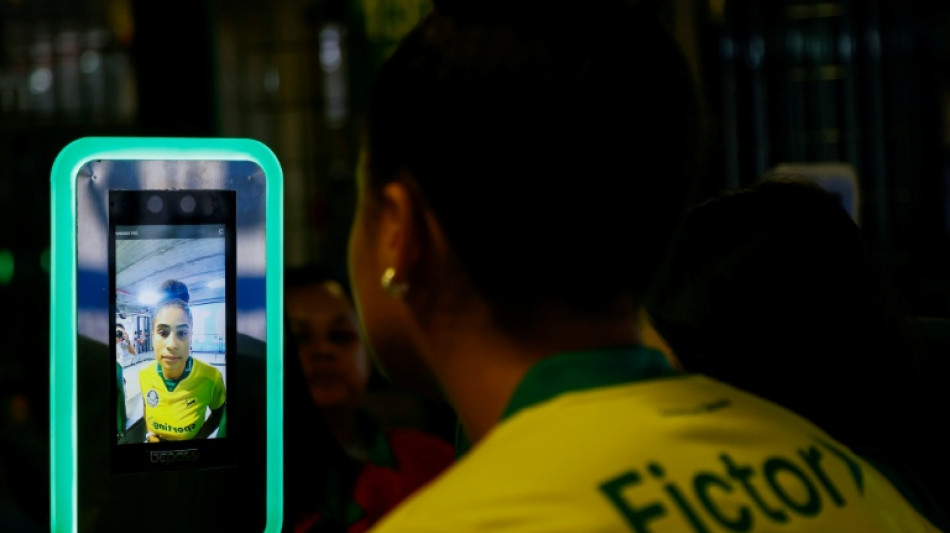
To beat football violence, Brazilian clubs scan every fan / Photo: Miguel SCHINCARIOL - AFP

 Bacteria suspected in deaths of hundreds of baby whales off Argentina

 US 'must choose' whether to end war: Iran president to Fox News

 UN approves resolution on dealing with rising sea levels

 Yalcouye makes dream debut as Ivory Coast beat Ghana in AFCON qualifier

 Chicago's White Sox and Cubs book MLB playoff berths

 Last-gasp Gakpo strike snatches Dutch draw to sour Klopp debut

 Global stocks mostly fall as oil prices and bond yields rise

 Israel's Netanyahu denounces enemies, allies in fiery UN speech

 Hollywood stars among arrests in NY anti-Netanyahu protest

 Losing start in AFCON qualifying for 78-year-old coach Le Roy

 Italy bans burqas in schools, caps numbers of foreign students per class
 Israel policies threaten 'life and existence' of Palestinians, Abbas says

 Paolini steers Italy past China in BJK

 Zidane admits emotion on eve of first game as France coach

 Breetzke and Maharaj sink Australia in first one-day international

 Zelensky broke confidentiality with North Korea POWs disclosure: South's president

 Former Liverpool star Carroll reveals he was sexually assaulted

 Dominican Republic calls for Haiti force to be strengthened

 Dolly Parton's nephew ordered to stay away from estate staff, properties

 Early exit for Philippine darling Eala at Singapore Open

 Hurricane Polo triggers huge waves in coastal Mexican city

 What happens if the US bans diesel exports

 Macklemore hits back with 'Free Palestine Tour' after Sheeran split

 Met Opera to give New Yorkers free tickets in affordability push

 Top ECB official to resign to take up IMF role

It was yet another tragedy linked to hooliganism in South American football: A young woman died after shards from a glass bottle thrown during a fight between fans sliced her throat.
This time, the culprit was arrested within hours thanks to a facial recognition system implemented in Brazilian stadiums in recent years.
Since July, the use of biometric controls, using fingerprints or facial recognition, have been required by law to boost security in stadiums with over 20,000 seats.
The young fan killed in 2023, Gabriela Anelli, was a fervent supporter of Palmeiras, one of Brazil's leading football clubs, and it was her team who were the first to fully roll out the security measure.
"We know exactly who is in each seat," Oswaldo Basile, the club's internal audit manager, told AFP.
"We can establish accountability if there are problems."
Palmeiras fans no longer need a ticket. They simply take a selfie on their phone and provide personal information on an app before going to the stadium.
Brazil has pioneered the technology in South America, but major teams like Argentina's River Plate are also adopting it.
To catch the fan who lobbed the deadly bottle at Anelli, Palmeiras used cameras to determine when it happened and to compare the faces of fans entering the stadium against people appearing on street videos capturing the incident.
- 500 Chilean fans blocked -
Facial recognition has been tested in European soccer stadiums, however data protection laws limit its use.
Some English Premier League clubs, and United States basketball, baseball and American football teams have implemented biometric identification, but its use remains controversial.
Brazilian clubs are required by law to protect personal data.
Tironi Paz Ortiz, CEO of Imply, a biometric systems company that works with teams in several South American countries, told AFP the law requiring the use of the technology represents "a major step forward" in the prevention of violence.
In May, the biometrics system at a stadium in northern Fortaleza blocked some 500 ticket purchase attempts by banned Chilean fans ahead of a match in the Copa Libertadores -- South America's top club football tournament.
The match between Fortaleza and the Chilean team Colo Colo in Santiago the previous month was suspended after a stampede left two teenage boys dead.
- Netting wanted criminals -
The technology has done more than filter football hooligans, it has allowed police to nab wanted criminals who enter stadiums.
Palmeiras have a deal with Sao Paulo police that has led to the arrest of more than 200 unsuspecting fugitives, including drug traffickers and murderers, who came to enjoy a game.
Lucas Lagonegro, a fan wearing a Palmeiras jersey, told AFP he feels "safer" entering the club's stadium.
"There are more children, more women, more families," said the 32-year-old lawyer.
The Beira-Rio stadium in southern Porto Alegre has had video surveillance cameras since hosting matches during the 2014 World Cup.
"But it was difficult to identify the perpetrators of offenses" before the implementation of facial recognition, said Andre Dalto, vice-president of the Internacional club which plays there.
Colombian sociologist German Gomez, who wrote a book about football fan groups and hooliganism, told AFP that biometric systems "can be useful as long as the other components of security -- police and the justice system -- are effective."
F.Cardoso--PC