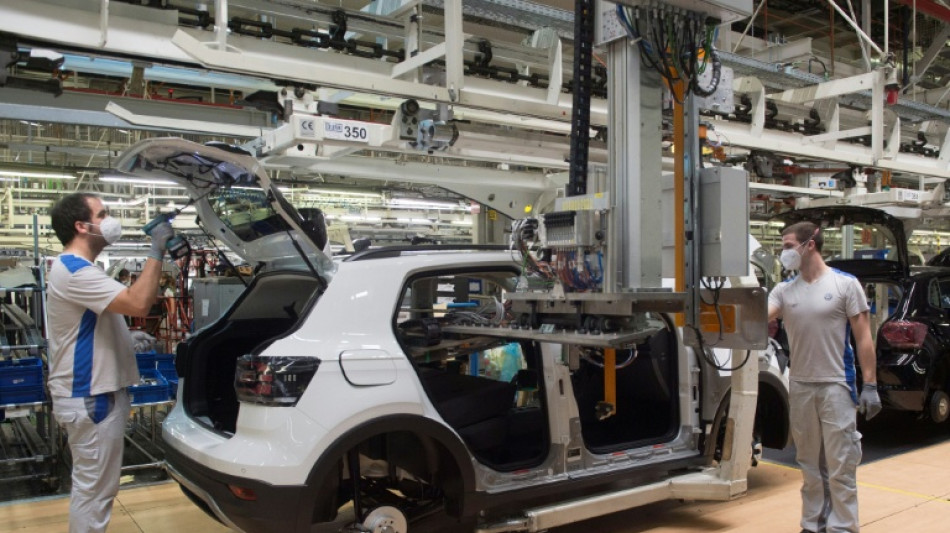
Nexperia, the new crisis looming for Europe's carmakers / Photo: ANDER GILLENEA - AFP

 UN approves resolution on dealing with rising sea levels

 Yalcouye makes dream debut as Ivory Coast beat Ghana in AFCON qualifier

 Chicago's White Sox and Cubs book MLB playoff berths

 Last-gasp Gakpo strike snatches Dutch draw to sour Klopp debut

 Global stocks mostly fall as oil prices and bond yields rise

 Israel's Netanyahu denounces enemies, allies in fiery UN speech

 Hollywood stars among arrests in NY anti-Netanyahu protest

 Losing start in AFCON qualifying for 78-year-old coach Le Roy
 Italy bans burqas in schools, caps numbers of foreign students per class

 Israel policies threaten 'life and existence' of Palestinians, Abbas says

 Paolini steers Italy past China in BJK

 Zidane admits emotion on eve of first game as France coach

 Breetzke and Maharaj sink Australia in first one-day international

 Zelensky broke confidentiality with North Korea POWs disclosure: South's president

 Former Liverpool star Carroll reveals he was sexually assaulted

 Dominican Republic calls for Haiti force to be strengthened

 Dolly Parton's nephew ordered to stay away from estate staff, properties

 Early exit for Philippine darling Eala at Singapore Open

 Hurricane Polo triggers huge waves in coastal Mexican city
 What happens if the US bans diesel exports
 Macklemore hits back with 'Free Palestine Tour' after Sheeran split
 Met Opera to give New Yorkers free tickets in affordability push

 Top ECB official to resign to take up IMF role

 Xi and Trump call for peace in lavish White House state visit

 Five up-and-coming players looking to make mark in Nations League

European automakers already buffeted by US tariffs and a rocky shift toward electric vehicles now face a new threat: a shortage of key semiconductors supplied by Chinese-owned Nexperia.
Beijing is locked in a standoff with Dutch officials who invoked a Cold War-era law in September to effectively take over the company, whose factories are in Europe.
Carmakers as well as parts suppliers have already warned of shortages that would force stoppages at production lines across the Continent.
Who is Nexperia?
The company produces relatively simple technologies such as diodes, voltage regulators and transistors that are nonetheless crucial, as vehicles increasingly rely on electronics.
The chips are mainly found in cars but also in a wide range of industrial components as well as consumer and mobile electronics like refrigerators.
It makes them in Europe before sending them to China for finishing, and are then re-exported back to European clients.
Based in the Netherlands and once part of electronics giant Philips, it was bought by Wingtech Technology of China in 2018.
But in September, the Dutch government took the unusual step of taking over the company, citing its "Goods Availability Law" of 1952 to ensure essential items.
In response, China banned any re-exports of Nexperia chips to Europe, igniting fresh geopolitical tensions.
Why is the automotive sector vulnerable?
Nexperia supplies 49 percent of the electronic components used in the European automotive industry, according to German financial daily Handelsblatt.
The European auto lobby ACEA warned this month that production would be seriously hit.
"Without these chips, European automotive suppliers cannot build the parts and components needed to supply vehicle manufacturers and this therefore threatens production stoppages," the group said.
For Germany alone, analysts at Deutsche Bank forecast a production drop of 10 percent while warning of a 30-percent cut in a "worst-case scenario".
How are automakers responding?
German auto giant Volkswagen has warned that it cannot not rule out "short term" production stoppages, while emphasising that it is searching for alternative suppliers.
Nexperia does not supply it directly but some of its parts suppliers use its chips.
Bosch, for example, says it has not yet reduced employee shifts at its German sites "but we are preparing to do so at our Salzgitter site", a spokesman told AFP.
But French parts maker Valeo said it had "visibility for the coming weeks" with regards to "all its components".
It said it had found alternatives for "95 percent of the volumes" bought each year from Nexperia, but "they haven't yet been approved by our clients".
Other suppliers?
According to OPmobility, another French parts maker, Nexperia's chips, while widely used, are not "unique" in terms of technology and therefore "easily substitutable".
But suppliers have to get the new products approved by automakers, which cannot be done quickly.
"They're looking frantically for other suppliers but these firms cannot build production capacity overnight," said Ferdinand Dudenhoeffer, director of Germany's Center Automotive Research institute.
"In the worst case this situation could go on for 12 to 18 months," he told AFP.
He added however since the disruptions cause by global lockdowns during the Covid-19 pandemic, "we've learned to pay more attention, both among general management and purchasing teams".
In any case, Dudenhoeffer said, "100 percent protection against supply disruptions is impossible -- or in any case prohibitively expensive".
F.Moura--PC