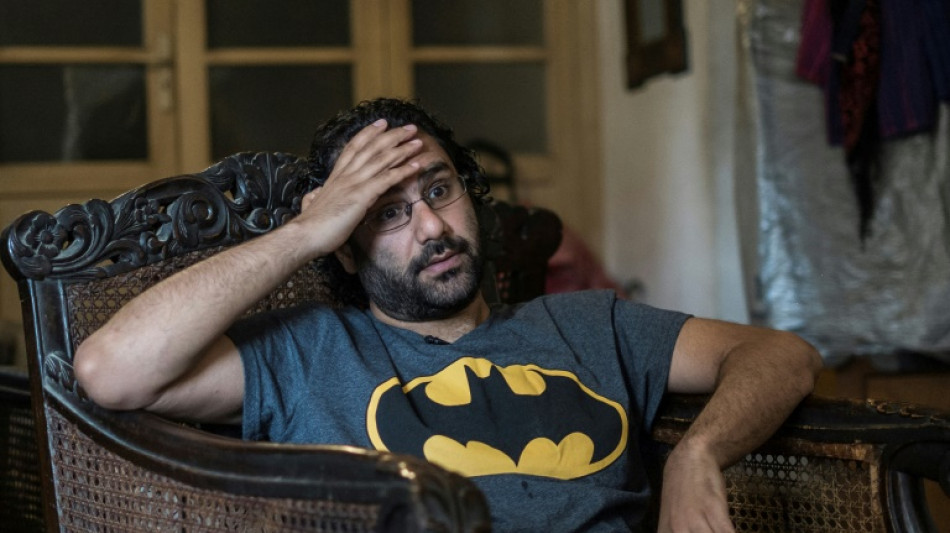
Alaa Abdel Fattah, Egypt's most famous dissident / Photo: Khaled DESOUKI - AFP/File

 Premiere Screenings of 'The 100th: Seeds of Aloha' Documentary Announced in California

 San Onofre Demolition Highlights California’s Nuclear Energy Void
 2026 Nickelodeon Kids' Choice Awards: Air Time, Channels, and Streaming Guide

 Kuwaitis Elected to Senior Leadership Roles at ALECSO

 BingX: Major Announcement of Far-Reaching Significance

 Tamil Nadu Commission Reviews Rs 1.14 Lakh Crore Investment MoUs, Seeks Subsidy Boost

 Sakeliga Challenges Icasa Over Telecoms BEE Ownership Rule

Egyptian dissident Alaa Abdel Fattah, long dubbed "an icon" of the 2011 revolution, has been in and out of jail for two decades, battling for the same freedoms under four regimes.
The 40-year old computer programmer and activist, now a British citizen, has been on hunger strike for 100 days, according to his family.
He holds a dubious honour, having been detained by every Egyptian government of the past two decades.
First imprisoned in 2006 under longtime autocrat Hosni Mubarak, Abdel Fattah was then detained under Mohammed Tantawi's military government, Islamist president Mohammed Morsi's divisive rule, and today under army field marshall-turned-president Abdel Fattah al-Sisi.
"Alaa was known for his commitment against military trials of civilians," Egyptian-Palestinian activist Ramy Shaath, himself a former political prisoner, told AFP.
Since Sisi came to power in 2013 "and the consolidation of military power, this opposition became unacceptable".
Abdel Fattah is currently serving a five-year prison sentence, handed down in December for "broadcasting false news", a common accusation levelled against dissidents.
Rights groups say Egypt is holding about 60,000 political prisoners, many facing brutal conditions and overcrowded cells.
Abdel Fattah's family has been vocal about not just the violations he has faced, "but all crimes against humanity he has witnessed during his imprisonment", his sister Mona Seif wrote in an April statement.
His continued imprisonment, Shaath told AFP, is because of his status as a symbol. "The regime wants to break him, in order to break the will of all Egyptians."
Born in 1981, Abdel Fattah is the son of preeminent human rights lawyer Ahmed Seif al-Din and mathematics professor Laila Soueif, whose sister is celebrated novelist Ahdaf Soueif.
His sisters Mona Seif and Sanaa Seif have for more than a decade both rallied international support for Abdel Fattah.
Sanaa Seif herself has been imprisoned twice since Sisi took power in 2013. She was most recently released in December from an 18-month prison sentence for "spreading false news".
- No 'end to this ordeal' -
In 2011, while Abdel Fattah was detained for "inciting violence", his son Khaled was born -- and named after Khaled Said, whose death by police brutality in 2010 helped spark the revolution.
In 2014, Abdel Fattah and Sanaa's father, who spent his last years in courtrooms trying to free them and other activists, died with both children incarcerated.
The hashtag #FreeAlaa has been a fixture of Egyptian social media since 2006.
Abdel Fattah and his family played a leading role in the January 2011 protests that toppled Mubarak, and his signature curls and scruffy beard would become a staple at every demonstration in the following years.
Abdel Fattah initially backed the overthrow of Islamist Morsi by then-defence minister Sisi in 2013.
He then became a leading critical voice against the crackdown that swiftly followed, as both Islamist and secular dissidents were killed or rounded up en masse.
In 2014, Abdel Fattah was sentenced to five years for protesting a 2013 law that banned all demonstrations except those authorised by police.
He was released in March 2019 to begin a five-year probation period, spending every night in a police station, but was arrested again in September that year in the wake of rare, small-scale anti-government protests.
"They (the authorities) are not dealing with us as humans, they are treating us solely as political animals who give them a lot of headaches," Abdel Fattah told AFP during his brief taste of freedom.
"They want me to be so oppressed that I am rendered invisible. I really don't see an end to this ordeal."
Abdel Fattah, who obtained British nationality in April through his London-born mother, has remained a prominent voice from behind bars.
In October, a British publishing house published a collection of his writings, "You Have Not Been Defeated."
Fuelled by his book, his family’s advocacy, and his hunger strike, politicians in London, Berlin and Brussels have been calling for his release.
A.S.Diogo--PC