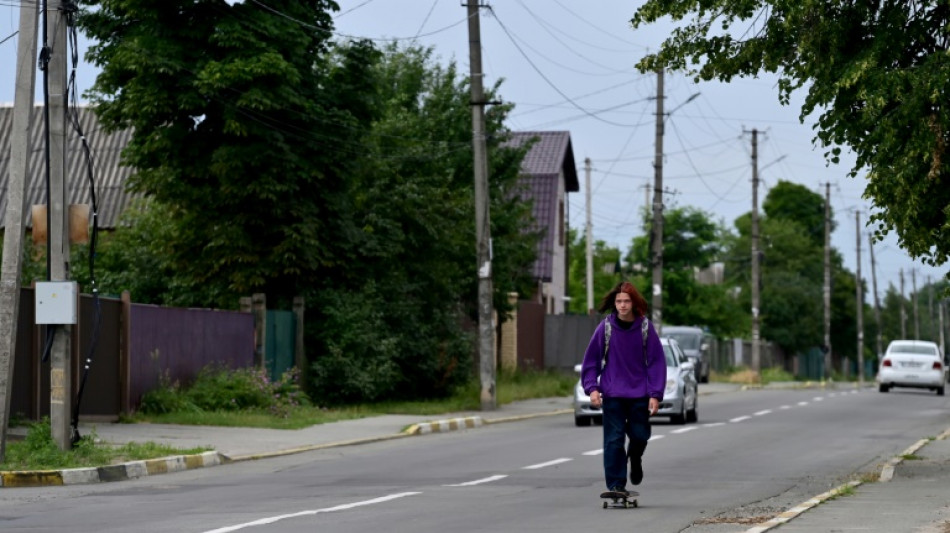
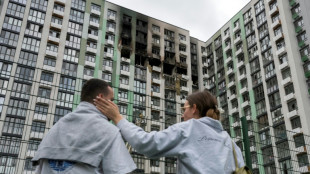
In Ukraine's Bucha, a reluctant return home and to normality / Photo: Miguel MEDINA - AFP/File

 Kyrgios gets month ban for cocaine, enters treatment programme
 Colombian judge bans strikes on guerrillas if minors are present

 Khachanov shocks ailing Auger-Aliassime, Swiatek and Osaka advance at US Open
 Lone juror blocking verdict in US mother's child murder trial: defense
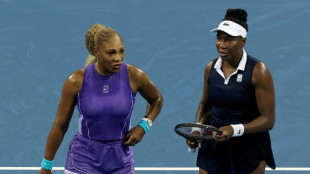 'Kinda chic' - Williams sisters set to launch US Open doubles bid

 Volkswagen says cutting 100,000 jobs by end of decade

 Russia slaps curfew on charity director over army criticism
 Ailing Auger-Aliassime upset by Khachanov at US Open

 Richarlison omitted from Tottenham's Premier League squad
 How El Nino is choking the Panama Canal

 Hamilton drives his Ferrari dream at Monza

 Senegal has an IMF loan, now what?

 Auger-Aliassime upset by Khachanov at US Open
 Hugging Face, the French start-up that became AI's warehouse
 World Cup winner Llorente retires from Spain team at 31
 Osaka squeezes into US Open third round

 Apple faces £2 bn lawsuit in UK over app privacy feature
 Former champ Swiatek eases into US Open third round

 DR Congo latest to promise moving Israel embassy to Jerusalem
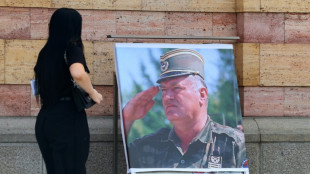 War criminal Mladic's body returns to Serbia with military honours

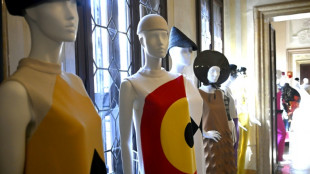 Pierre Cardin museum brings designer's futurist style to Venice

 Slovenian rookie Omrzel triumphs as Mas extends Vuelta lead
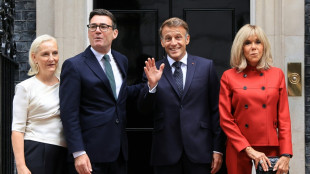 British, French leaders talk migrants, EU relations
 Heading for Ferrari's home race, Leclerc still dreams of world title

 Cafe at centre of Israel culture clash agrees to shut on Sabbath

In a large and upscale backyard in Bucha outside Ukraine's capital Kyiv, Maxim is having a quiet dinner with his wife and his neighbours.
But just three months ago, Russian soldiers were rummaging through his home and sleeping in his children's bedroom.
"In this atmosphere, I feel like nothing can happen and that life is normal," says the 36-year-old web designer, sitting around a table with his family.
"But we know there's a war and there's no place safe in Ukraine right now."
Together with his wife Anna and their two children they live in a newly built two-storey house, at the edge of Bucha, where young families from Kyiv come to exchange big-city life for a laid back suburban one.
"The Russian army slept in our house for a couple of nights, ate everything that we had in our fridge and they left this," he says showing a box of field military ration.
In February, Russian forces entered this suburb in the northwest of Kyiv during their attempt to encircle the Ukrainian capital.
They were pushed out a month later. With the liberation came shocking discoveries of atrocities committed against civilians, making Bucha a symbol of Russian brutality.
On April 2, AFP journalists found 20 bodies in civilian clothes lying along nearby Yablunska street.
On the same street three months later, children are walking around wearing headphones and men are returning home from work while others repair damage left by the fighting.
In front of an apartment block hit by artillery, stands a blonde woman with her eyes glued to the scars left on the building. She looks away to sigh.
- 'I won't live in little Russia' -
A few kilometres away from Yablunska street, Maxim's house suffered only minor damage. His wife Anna was in Turkey when the invasion started and after moved to Romania across the border with Ukraine.
Her next-door neighbour, 36-year-old pastry chef Nastya Glyieva, was also living as a refugee in Romania by that time.
To take her mind off the news, she worked as a volunteer in Filaret, a bus station in Bucharest which became a transit hub for Ukrainian refugees.
"The teacher of my 11-year-old daughter and her family were all killed. And I don't know how to tell her this," says Nastya.
"Almost everyday we hear loud bangs from unexploded devices being detonated by our army. When I first came back it made me shake but now it's normal for us," she says.
Her house in Bucha, bought a year ago and which was left unscathed during the fighting, is now also sheltering Dmitry Gliev, her husband's brother.
The 20-year-old cook lived for almost a month under Russian occupation in his small village close to Chernobyl, which has since come under the control of the Ukrainian army.
"On February 30, we had a complete occupation, there were more than 1,000 Russians in our village. We were told that it would not be long, but they stayed there for a month," says Dmitry.
"At the beginning I was very afraid, I put my mattress in the bathroom and I stayed there for three days... We made flour ourselves from wheat and then baked bread from it," he says.
Now he's in charge of the barbecue for the dinner hosted by Maxim and his family.
"If they had taken Kyiv, there would be no Ukraine, no freedom, no Ukrainian culture, just 'little Russia'. But I would never live in such a country," says Maxim.
F.Santana--PC