Return of centuries-old manuscripts key to France-Mexico talks / Photo: Ludovic MARIN - AFP

 What's behind the Pakistani strikes on Afghanistan?
 Hundreds protest for return of Nobel peace laureate Machado to Venezuela

 Aubameyang to miss two months for Deportivo after knee surgery

 Newsom says Trump presidency 'as we know it' ends in November

 Stocks fall as oil prices rise and bonds back under pressure

 Russell leads Mercedes 1-2 in Azerbaijan GP practice

 Ukrainian kills priest, wounds four at Polish abbey

 Sri Lanka captain Mendis hits century in 321-6 against England

 Oscar-winner Cotillard fears being moved by AI actor

 Agassi demands proper break for exhausted tennis stars

 Seixas 'crushes' teammates in training to draw Pogacar comparisons
 Trump welcomes Xi to White House, touting agreement on AI

 Stocks fall, oil prices rise as global bonds back under pressure
 UK man died putting women, children first in Mozambique jihadist siege: coroner

 Russell leads Mercedes 1-2 at Azerbaijan GP practice

 Alcaraz shrugs off pressure of packed calendar at 'joyful' Laver Cup

 Fury to face British rival Joshua in Cardiff on December 11

 Streamex Converts Interest Into Capital as GLDY Investment Strategy Secures $1M+ Institutional Allocation

 STARTRADER Named Best Fintech Forex Broker at Forex Expo Dubai 2026

 Japan swimmer Ohashi, 17, shrugs off Covid to smash world record

 Shin Ohashi: Junk food-loving teen and new world record-holder

 Greek PM urges 'courage' in talks with UK over Parthenon Marbles

 'I was drowning': Iran Nobel winner exposes pain of separation from children

 Israel's US envoy says son fighting for life

 Olympic champion Yulo completes gymnastics gold collection at Asian Games

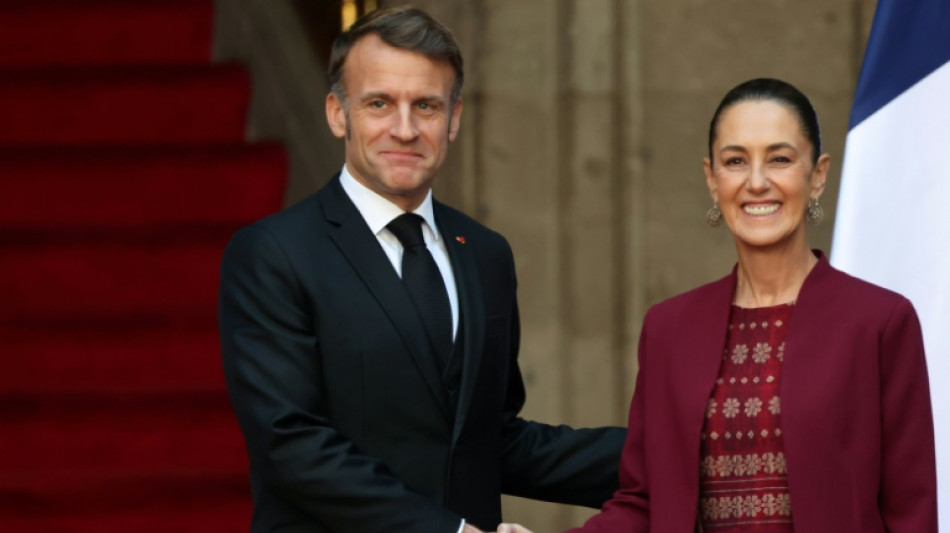
The return of two centuries-old manuscripts from France to Mexico will headline talks during French President Emmanuel Macron's visit to the Latin American country on Friday -- a request expected to meet headwinds.
At the heart of the discussions are two manuscripts illustrating Indigenous Mexica life: the Codex Borbonicus, kept at the library of French parliament's lower house, the National Assembly, and the Codex Azcatitlan, which is part of France's National Library collection.
"Our main interest is the return of these codices, which are very important to Mexico," said Mexican President Claudia Sheinbaum in October.
- What is a codex? -
Mexican manuscripts are generally referred to as codices by researchers, according to Olivier Jacquot, head of collections of the French National Library's manuscripts department.
These codices include both pictographic and alphabetical narrations of the history, rituals and beliefs of the people of present-day Mexico before and after the arrival of Spanish colonisers in the 16th century.
The Codex Borbonicus gets its name from the Palais Bourbon, the seat of the French parliament's lower house, where it has been preserved since the 19th century.
It represents the "divinatory and solar calendars" of the Mexica civilisation -- a dominant Indigenous population in pre-Hispanic Mexico -- according to the French culture ministry.
The Codex Azcatitlan narrates the history of the city of Mexico-Tenochtitlan "from the migration from the mythical Aztlan to the fall of the Mexica empire at the hands of the Spanish and their Indigenous allies in 1521", according to the Mexican government's Memorica site, a platform to preserve and share the country's heritage.
- How did they come to be in France? -
France's National Assembly library acquired the Codex Borbonicus in an 1826 auction, according to the institution.
However, the codex is believed to have been stolen from a library in Spain years earlier during the Napoleonic era.
The Codex Azcatitlan was donated to the National Library in 1898 by Augustine Goupil, widow of the Franco-Mexican collector Eugene Goupil, along with other manuscripts, Jacquot said.
They were gifted on the condition that the collection "always be preserved in its entirety in the Library", said Marie de Laubier, the National Library's collections director.
- Why is Mexico claiming them? -
Mexico has ramped up efforts to recover historical and cultural heritage outside the country since the administration of Sheinbaum's predecessor, Andres Manuel Lopez Obrador.
"The trafficking of cultural goods harms the people," Diego Prieto, director of Mexico's National Institute of Anthropology and History, said in May, announcing the repatriation of 16,200 cultural items since 2018 from various countries.
On Thursday, Sheinbaum advisor Jose Alfonso Suarez del Real said they plan to discuss with Macron the return of the Codex Azcatitlan as part of next year's celebrations of 200 years of French-Mexican relations.
This manuscript "is essential for understanding the development of what was Mexico-Tenochtitlan from its foundation until the early 17th century" and "of enormous interest to the Mexican people", Suarez del Real said.
In May, Suarez del Real said Mexico had been calling for the return of the Codex Borbonicus since the 19th century.
In 2024, the Indigenous Hnahnu people insisted on its return because it contains the "formulas" for the Mexica Fuego Nuevo (New Fire) ceremony, next to be held in 2027.
- What is France's response? -
Before Macron's visit to Mexico, the French presidency said the issue of the codices was "an important matter about which we have a very open dialogue with the Mexicans".
Relations were strained in 1982 when a Mexican lawyer, Jose Luis Castaneda, stole the Codex Tonalamatl from France's National Library and brought it back to Mexico, where it has remained.
Both the French National Assembly and National Library say their possession of the manuscripts is legal and defend the principle of "inalienability of public collections" in France.
Far-left lawmakers presented a bill in April to repeal this legal principle, but it is unlikely to succeed.
"The National Assembly's board is the only body competent to decide on (its) collections," its press office told AFP.
The preservation of the manuscripts, which can only be exhibited temporarily due to their fragility, is another argument against moving them.
P.Queiroz--PC