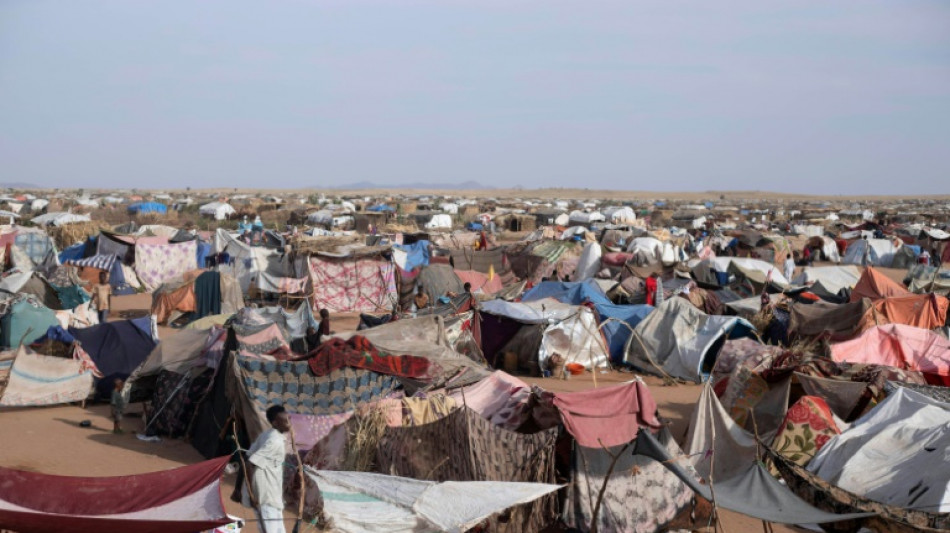
The Sudanese who told the world what happened in El-Fasher / Photo: - - AFP

 What's behind the Pakistani strikes on Afghanistan?
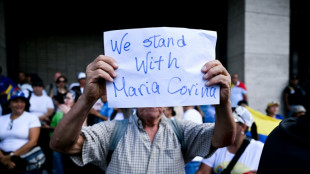 Hundreds protest for return of Nobel peace laureate Machado to Venezuela
 Aubameyang to miss two months for Deportivo after knee surgery

 Newsom says Trump presidency 'as we know it' ends in November
 Stocks fall as oil prices rise and bonds back under pressure
 Russell leads Mercedes 1-2 in Azerbaijan GP practice

 Ukrainian kills priest, wounds four at Polish abbey
 Sri Lanka captain Mendis hits century in 321-6 against England
 Oscar-winner Cotillard fears being moved by AI actor
 Agassi demands proper break for exhausted tennis stars

 Seixas 'crushes' teammates in training to draw Pogacar comparisons
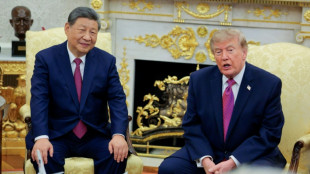
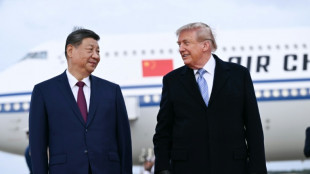 Trump welcomes Xi to White House, touting agreement on AI
 Stocks fall, oil prices rise as global bonds back under pressure
 UK man died putting women, children first in Mozambique jihadist siege: coroner

 Russell leads Mercedes 1-2 at Azerbaijan GP practice
 Alcaraz shrugs off pressure of packed calendar at 'joyful' Laver Cup

 Fury to face British rival Joshua in Cardiff on December 11

 Streamex Converts Interest Into Capital as GLDY Investment Strategy Secures $1M+ Institutional Allocation

 STARTRADER Named Best Fintech Forex Broker at Forex Expo Dubai 2026
 Japan swimmer Ohashi, 17, shrugs off Covid to smash world record
 Shin Ohashi: Junk food-loving teen and new world record-holder
 Greek PM urges 'courage' in talks with UK over Parthenon Marbles
 'I was drowning': Iran Nobel winner exposes pain of separation from children

 Israel's US envoy says son fighting for life

 Olympic champion Yulo completes gymnastics gold collection at Asian Games
"Sixteen killed." "Seven killed." "Thirty-one killed." "People are eating cowhide to survive." "The bombs are getting closer." "They're shooting people trying to run away."
These were the grim updates shared with AFP's veteran Sudan correspondent Abdelmoneim Abu Idris Ali by people trapped in the 18-month-long siege of El-Fasher, a city overrun by the paramilitary Rapid Support Forces (RSF) two weeks ago.
Throughout the siege and ensuing battle, it was thanks to ordinary civilians that AFP and other news organisations were able to form a picture of what was happening there.
They were Dr Omar Selik, Dr Adam Ibrahim Ismail, Sheikh Moussa and activist Mohamed Issa -- men who relayed vital information from a city mostly cut off from communications.
They have all since been killed.
Until their deaths they played a crucial but, for security reasons, anonymous role in documenting Sudan's two-year war between the army and the RSF.
Ismail, a young physician, was detained by RSF fighters on October 26 as he tried to flee the city.
He was shot dead the following day.
Until his last moments, Ismail had been treating "the wounded and the sick" at the Saudi Hospital, El-Fasher's last functioning medical facility, according to the Sudanese Doctors' Union.
AFP's Abu Idris Ali learned of Ismail's death through that statement, having spoken to him only days earlier.
"His voice was weary," Abu Idris Ali recalled from Port Sudan.
"Every time we ended a call, he said goodbye as if it might be the last time."
- 'War machine' -
In September, Abu Idris Ali had already lost three other local sources -- people who answered his calls and questions whenever communications allowed.
They were killed in a drone strike on a mosque in El-Fasher on September 16, which killed at least 75 people.
"Their voices painted a picture of El-Fasher," he said.
"Through them, I heard the groans of the wounded, the sorrow of the bereaved, the pain of those crushed under the war machine."
Before the war broke out in April 2023, AFP journalists criss-crossed the vast country, regularly visiting far-flung areas of Darfur.
It was there that Abu Idris Ali first met Sheikh Moussa, who opened the door to his modest hut in 2006, beginning a two-decade-long friendship.
Though he never met the tireless Dr Selik or the fiery 28-year-old Mohamed Issa, Abu Idris Ali said, "their voices ring in my ear every day."
Dr Selik, a kind-hearted medic who acted as a key source for journalists worldwide, witnessed the collapse of El-Fasher's health system before his own demise.
Hospitals were shelled, shuttered, or emptied of supplies, yet he continued to work tirelessly.
"He always tried to hide the tinge of sadness in his voice when he gave me toll figures," Abu Idris Ali recalled.
"He spoke like he was talking to a patient's family, breaking the news of the death of a loved one."
Fearful for his own family, he sent them to safety while staying behind to save lives.
Since his death, other doctors have taken up the mantle, but bombs fell daily, striking hospitals and killing medical staff.
- 'Another kind of grief' -
Only days before his death, activist Issa told AFP he had fled the famine-hit Abu Shouk displacement camp, overrun by the RSF.
At 28, after months of crossing frontlines to deliver food, water and medicine to trapped families, he was killed.
"Every time I asked him what was happening in the city, his voice would ring out boisterous: 'nothing bad inshallah, I'm a little far away but I'll go find out for you!'" Abu Idris Ali said.
"You couldn't stop him -- and off he went."
Sheikh Moussa had been uprooted from his South Darfur village 22 years ago by the Janjaweed militia, from which the RSF would end up descending.
He spent the rest of his life in refugee camps.
"Violence broke out over and over outside his door, yet his laugh never faded," Abu Idris Ali recalled.
When bombs rained down on El-Fasher, Sheikh Moussa "would speak endlessly of the pain his people were facing, but if you ever asked him how he was, he would only ever say: al-hamdulillah, thank God".
"Every phone call, I could see him, always sitting cross-legged in the shade outside his door, always in a blindingly white jalabiya robe and matching prayer cap, always smiling despite the horrors around him."
Sheikh Moussa never made it home to his village, between El-Fasher and Nyala, the South Darfur state capital.
"Many of those 75 people gathered in that mosque had run for their lives just days before, but an RSF drone showed them there was no fleeing death," Abu Idris said.
"Every death is a tragedy, one we are accustomed to reporting. Yet it is another kind of grief when it is someone you have broken bread with, someone whose voice you heard every day."
M.Gameiro--PC