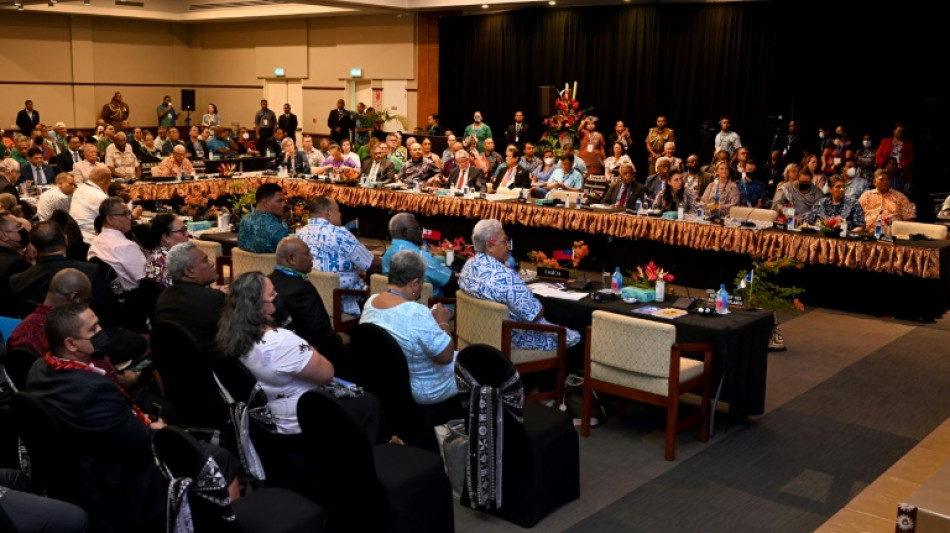
Pacific leaders struggle to keep focus on climate at key summit / Photo: William WEST - AFP

 Premiere Screenings of 'The 100th: Seeds of Aloha' Documentary Announced in California

 San Onofre Demolition Highlights California’s Nuclear Energy Void

 2026 Nickelodeon Kids' Choice Awards: Air Time, Channels, and Streaming Guide

 Kuwaitis Elected to Senior Leadership Roles at ALECSO

 BingX: Major Announcement of Far-Reaching Significance

 Tamil Nadu Commission Reviews Rs 1.14 Lakh Crore Investment MoUs, Seeks Subsidy Boost

 Sakeliga Challenges Icasa Over Telecoms BEE Ownership Rule

US-China rivalry and divisions over regional leadership threatened to overshadow a landmark summit of island leaders that got under way Tuesday in the Fijian capital, Suva.
This year's Pacific Islands Forum is the most important meeting in years, coming after a Covid-enforced hiatus and as low-lying tropical isles run out of time for climate action.
But instead of a singular focus on the threat posed by rising sea levels and ever-more-powerful storms, China's bid to play a bigger regional security role looks set to dominate the agenda.
The Solomon Islands in April signed a highly contentious security agreement with China, upsetting decades-old alliances with the West.
And on the eve of the summit, Beijing-allied leaders in the tiny nation of Kiribati announced the country would be renouncing membership of the forum altogether, fracturing a region that puts a high value on unity and consensus.
- 'Breakdown in our connections' -
The remaining leaders gathered at Suva's luxurious Grand Pacific Hotel are expected to discuss a strategy to guide the Pacific through to 2050, keenly focused on the existential threat posed by climate change.
But Fiji president and chair of the Pacific Islands Forum, Voreqe Bainimarama, used his opening remarks to acknowledge the "breakdown in our connections" with the Micronesian nations, of which Kiribati is a part, that has occurred in recent years.
It had been hoped a carefully negotiated agreement with Micronesia would be enough to heal a schism that emerged when the region's chosen candidate to lead the forum was snubbed.
But Kiribati's exit sparked concerns about a fracturing of the Pacific's closely held unity, which gives the region of small island states heft in global climate negotiations.
Tuvaluan foreign minister Simon Kofe told AFP he was "surprised and saddened" by Kiribati's departure, but was optimistic the nation could be enticed to rejoin.
Last year, Kofe made headlines when he addressed the COP summit standing knee-deep in water to draw attention to the threat climate change poses to his low-lying nation, which may disappear below rising seas in the next 50 years.
Faced with such a threat, his top priorities at the summit are climate related, although he said he understood "how some members want to discuss the security issues".
Concerns about regional security -- brought to the fore by the Solomons-China pact -- "draw a bit of attention away from climate change", Kofe said.
- Security v climate -
The summit will be a key opportunity for Australia's newly-elected prime minister, Anthony Albanese, to improve relations with the Pacific, which soured under the previous conservative government.
Albanese, who will arrive in Suva on Wednesday, sought to knit the issues of climate and security together Tuesday ahead of his departure for the summit.
"Our neighbours in the Pacific understand that climate change is a national security issue," he told a press conference in Sydney.
F.Moura--PC