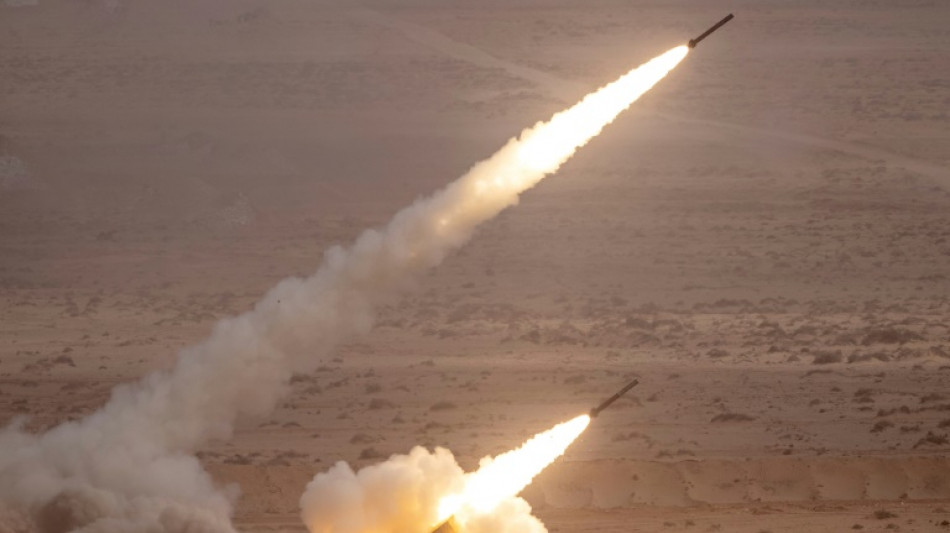
Himars precision rockets shift the balance in Ukraine: experts / Photo: FADEL SENNA - AFP

 US shows strong job growth in August in boon to Trump

 Alonso urges Chelsea to 'move forward' after Fernandez's exit

 US safety regulator probes Tesla's Cybercab

 Voting begins in crucial US midterm elections

 US shows strong job growth in August in boon to Trump ahead of midterms

 US diesel price hits new high on Iran war, squeezing voters

 Swiss far-right extremists go on trial amid protests

 Record European fires burn over 500,000 hectares over summer

 Former world triathlon champion Jonny Brownlee retires from professional running

 'No room for mistakes' scaling Everest in Venice documentary

 Rubio to visit Trump-friendly allies Colombia, Ecuador, Peru: State Dept

 Indonesia steps up wildfire fight that sparked hazardous haze

 Leclerc on top as Ferrari take 1-2 in Monza opening practice

 Malaysia declares haze emergency in Sarawak state on Borneo

 East German refinery adjusts to life without Russian oil

 Song Yadong looks to become China's first UFC champion after home victory

 India's Mandhana becomes top run-scorer in women's cricket

 IUX Announces Two New Podcast Series: IUX Market Trendline and The Market Journey

 Brussels Diamond League finals Day 2 - four events to watch

 Looming far-right win in Germany sparks security worries

 Tanker captain arrested over cargo ship sinking off Istanbul

 India hopes 'unique idea' will save athletes from cabin fever

 UK asserts 'unshakeable' Falklands commitment after Milei presses claim

 How a Dostoevsky novella took TikTok by storm

 Zverev goes the distance again to reach US Open third round

US-made precision rockets have given Ukraine forces a major battlefield boost since they were introduced in June, tilting the balance against the Russians and possibly forcing Moscow to pause its offensive, experts said.
Since mid-June, using the Himars missile systems, Ukraine has destroyed more than 20 major Russian ammunition depots and command posts that were previously too far behind the front lines to be reached by traditional artillery.
Videos posted on social media have shown spectacular prolonged eruptions at ammo dumps in Russian-controlled Lugansk, Nova Kakhovka, and elsewhere, attesting to the power and precision of the US missiles.
"The occupiers have already felt very well what modern artillery is. They will not have a safe rear anywhere on our land," Ukraine's President Volodymyr Zelensky said.
But experts also caution that the new weapons are no panacea, and that the country needs more weapons and radars systems to use in combination to defeat the Russians.
Christopher Dougherty, a defense analyst at the Center for New American Security in Washington, said the Himars success is as good as could have been hoped.
Still, he said, "The thing by itself, it's not a game changer."
- Precision advantage -
The M142 High Mobility Artillery Rocket System is an agile wheel-mounted launcher of 227 mm GPS-guided missiles with a range of around 80 kilometers (50 miles).
Unlike other multiple launch rocket systems that both sides have used in the war, Himars missiles can be directed precisely on targets, meaning they can be used sparingly and reliably.
The first four launchers, which can carry 6 rockets at a time, were delivered in June; now the Ukrainians have 12, with hundreds of rockets to use between them.
They have more advantages than precision. The rockets fly low enough and fast enough that Russian air defenses can't intercept them easily. Because the vehicles are so mobile, it is hard for the Russians to find and target them.
"Himars is changing the character of the fight in Ukraine. It is allowing the Ukrainians to target the Russians at greater distance and in areas that have been denied to them because of Russian air defense systems," Mick Ryan, a retired Australian general and military analyst, wrote this week on Twitter.
It's not only Himars; since June Ukraine has had powerful high-precision artillery from other allies, like France's Caesar howitzer, and last week the US announced it would be providing 1,000 new precision-guided artillery rounds.
Ryan said Ukraine is using them against Russian weak points: the tendency to store munitions close to railway depots and in towns relatively near the front.
While that raises the risk for Ukrainians of hitting population centers, the precision targeting helps to reduce civilian casualties.
Dougherty said he was surprised that the Russians didn't plan for the Himars.
"It's not like a secret that these things were going to show up," he said. "It's another instance in which the Russians have been really slow to adapt to what are, frankly, rather obvious battlefield issues."
- Russian truck shortage -
Eventually the Russians will adapt and disperse their supply depots, and move some much further away from the front lines, analysts said.
But that will make their battlefield logistics tougher.
"Each time you distribute anything, it takes more trucks to get to the same amount of stuff to the people who need it," said Dougherty.
On top of that, he said, the Russian military's truck fleet has been significantly diminished by the war.
Phillips O'Brien, professor of strategic studies at the University of St Andrews, Scotland, said the Himars are not an end to themselves, but part of broader strategy to damage Russian logistics and push back its air defenses.
Doing so would leave the frontline artillery that is the mainstay of the Russian offensive less protected from Ukraine air and ground forces.
- Longer range missiles? -
Kyiv is meanwhile pressuring Washington for ATACMS missiles which can be launched by the Himars and have a 300-kilometer range.
"At all levels, our authorities are negotiating with US representatives regarding the need to provide us with longer-range Himars missiles," Fedir Venislavskyi, a senior Ukrainian lawmaker, said on Wednesday.
So far the White House has refused, worried such weapons would be used by Ukraine against targets on Russian territory.
That, the administration of President Joe Biden fears, risks drawing the US and NATO directly into war with Russia.
Dougherty said the US really does not have many ATACMS in stock and production stopped years ago.
O'Brien said that, in addition to the Himars, Ukraine really needs more protection from Russia attacks from the air.
"Getting Ukraine more and better anti-air capabilities should be as high priority as getting it better-ranged weapons," O'Brien wrote on Twitter.
V.Dantas--PC