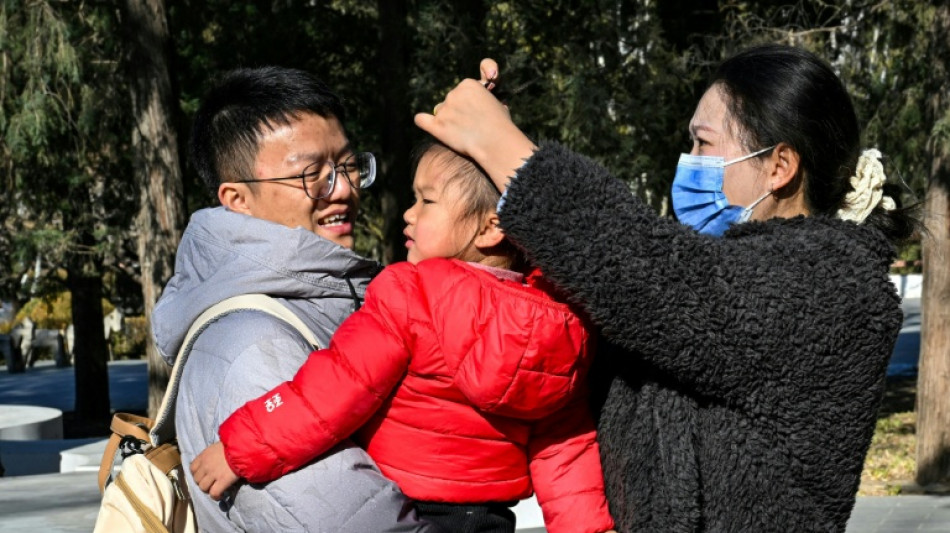
China's birth-rate push sputters as couples stay child-free / Photo: Adek BERRY - AFP

 Marchand 'stressed' about racing Japanese rivals at LA Olympics

 Mobile boat clinics bring healthcare to India's remote islands
 Former India paceman Zaheer Khan named Chennai coach in IPL

 Six-year-old Chinese girl sets world record with Rubik's Cube

 Swimming prodigy Yu, 13, says 'interviews way harder than racing'

 Star coaches make their bows as Nations League returns

 Rams bounce back as Giants reel from Dart injury

 In Bangladesh, Pakistan's Jinnah photo stirs anger

 Two New Zealand naval ships transit Taiwan Strait

 Zidane gets down to work as France start new era

 Inside the Venezuelan prison meant to 'drive you insane'

 UK king braces as memoir by Diana's brother goes on sale

 Akkodis and Hamburg Public Transport Association Showcase hvv mia at InnoTrans 2026, Demonstrating the Future of AI-Powered Mobility

 Macron says talks with Trump on Red Sea, Ukraine 'constructive'

 Green policies just good politics, says UK minister

 Bardot auction in Paris fetches nearly one million euros

 No timeline on Daniels injury return, says Commanders coach

 British Columbia sues OpenAI in US court over Canada school shooting

 French star Batum retires after 18-year NBA career

 Zidane leads first France training session

 Man shot by ICE agent in Texas detained with bullet inside him: lawyer

 California declares state of emergency ahead of El Nino

 South Africa arrests three more suspects, after nine women murdered

 Carse needs time away from England, says captain Brook

 NOWPayments Releases Cross-Chain Payout Data Revealing Key Performance Benchmarks Across TRON, BNB Chain, and Solana

Twenty-five-year-old Grace and her husband are set on staying child-free, resisting pressure from their parents and society to produce offspring, even as China strives to boost its flagging birth rate.
A decade since China scrapped its stringent one-child policy and implemented a two-child policy in January 2016, the nation is dealing with a looming demographic crisis.
The country's population has shrunk for three straight years, with the United Nations predicting it could fall from 1.4 billion today to 633 million by 2100.
There were just 9.54 million births in China in 2024 -- half the number than in 2016 -- and concerns about the shrinking and ageing population have been growing as couples choose to buck traditional Chinese norms.
More young people like Grace, who refers to herself and her husband as DINKs -- or "dual income no kids" -- have either sworn against having children at all or are putting it off for the next few years.
These couples' reasons run the gamut from high child-rearing costs to career concerns.
Grace, who asked to be identified by her English name over fears of repercussions, said she needed to have a decent income and "some savings" before starting a family.
Without these conditions, "I wouldn't even consider having kids", the content creator added.
The term "DINK" has gone viral on Chinese social media, including Xiaohongshu, where its hashtag has received more than 731 million views, sparking differing views on the subject.
"If I were to widely publicise the fact that I'm a DINK and talk about how comfortable my life is, there would definitely be many people who wouldn't be happy about it," Grace told AFP.
- Changing attitudes -
Chinese authorities have rolled out pronatalist incentives after ending its one-child policy -- which had been in place for more than three decades to address poverty and overpopulation.
Top leaders have pledged more childcare relief, including subsidies to parents to the tune of $500 per year for every child under the age of three, state media reported in July.
Beijing also slapped a value-added tax on condoms and other contraceptives in January.
But experts say China, which was overtaken by India as the world's most populous nation in 2023, still faces significant hurdles in boosting its birth rate.
"The number of people choosing not to marry or not to have children is increasing, and fertility intentions among the younger generation are weak," He Yafu, an independent Chinese demographer, told AFP.
Cultural constraints have limited the long-term effectiveness of China's pronatalist measures, said Pan Wang, an associate professor at Australia's University of New South Wales.
"The one-child policy fundamentally reshaped family norms and also people's lifestyles, because many people, especially the one-child generation, were used to and often prefer smaller family sizes," Wang told AFP.
The rising living costs in China and economic uncertainty also continue to deter childbearing, she added.
Beijing resident Wang Zibo, 29, said he and his wife have decided to wait for the "economy to stabilise" before they have children, even though he said he is in "quite good" financial standing.
"Looking at things in China right now, the main reason (why young couples are not having children) is still that the economy is somewhat weak," he told AFP.
China has struggled to maintain a strong economic recovery from the pandemic, while many employees work long hours under a gruelling "996" culture -- 9:00 am to 9:00 pm, six days a week.
"People have been excessively busy with work... for some, it's difficult even to find the time to think about (starting a family)," Wang said.
- No time, no money -
China in 2021 further relaxed its strict family planning controls, allowing couples to have three children -- something many couples, especially those living in cities, are reluctant to do.
Even having one child is a huge responsibility, Wang said, citing the example of a friend who had a baby shortly after he got married.
"He would constantly tell me... not only do you have no time and you spend all your money on the child, you kind of lose yourself in the process too."
Demographer He said if China's fertility rate of around 1.0 persists in the long term, the most obvious consequences will be a continued decline in population size and rapid population ageing.
"This will increase the future burden of elderly care, weaken China's overall national strength, and drag on economic development," he added.
A.Magalhes--PC