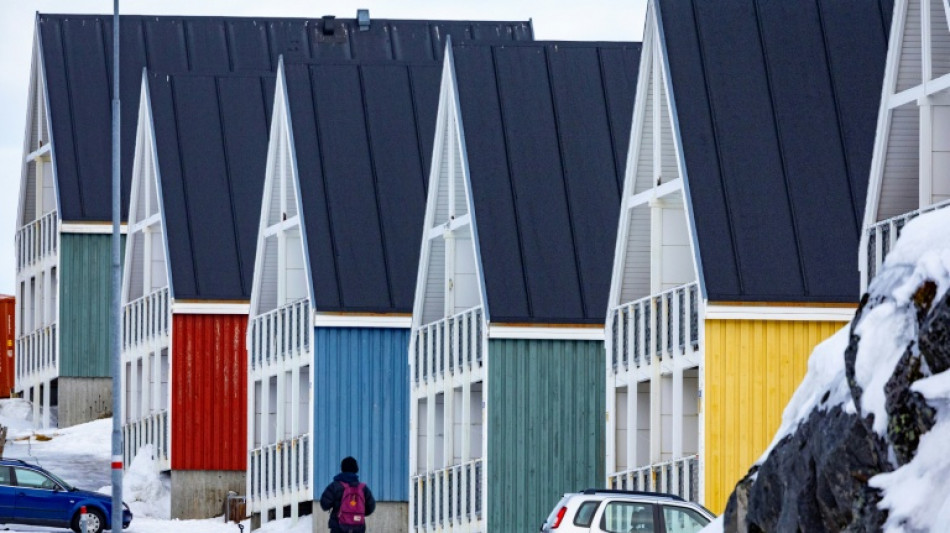
Dogsleds, China and independence: Facts on Greenland / Photo: Odd ANDERSEN - AFP/File

 Typhoon Dujuan leaves four dead in Japan, 45,000 houses without power

 G7 leaders condemn Houthi strikes on Saudi Arabia

 Google data centre sparks protests in Austria

 Shin Ohashi: Junk food-loving teen and Japan's next big swimming hope

 Stocks rise on AI buzz, drop in oil prices
 China's robot dancers limber up for America's Got Talent final

 Despite military might, Saudi struggles to crush the Houthis

 Trump to tout deals, defend Iran war in UN speech
 Sri Lanka to issue verdict in landmark Easter attack trial

 No green light to lift EU sanctions on Russian oligarchs, talks to resume

 UK agrees support for Saudi in struggle with Houthis: reports

 EU foreign policy chief calls for continued sanctions on Russia

 Flights scrapped, evacuations urged as Typhoon Dujuan wallops Japan

 Fonseca to take break from tennis

 A Cuban zoo, and its animals, in epic battle for survival

 Infantino proposes consulting federations to reform FIFA

 El Nino weather pattern enters record territory: scientist
 OpenAI calls for US to lead global effort on AI standards
 South African ostriches plucked alive for luxury fashion: report

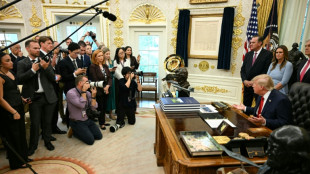 US networks halt Trump coverage in revolt over White House ban

 Paramount settles with US states to clear Warner Bros. mega-merger
 Climate crisis a job for world leaders, not just activists: UK FM

 US networks halt Trump coverage over White House ban
 French singer accuses Miley Cyrus of plagiarism

 EU fines Google 403 mn euros for location data breach

US President Donald Trump has stepped up his designs on taking over Denmark's autonomous territory Greenland, but questions abound about why he has taken an aggressive stance when the US already has extensive access to the Arctic island.
Trump has insisted the US needs Greenland for national security reasons.
What does Denmark's defence agreement with the US on Greenland say? What investments have Denmark made in Greenland? Do China and Russia pose a real threat? What does Greenland's independence movement say?
Here are answers to those four key questions.
- US military presence -
In 1941, at the height of World War II, occupied Denmark authorised the United States to build and operate military bases on Greenland, Denmark's then-colony in the Arctic, for as long as the conflict would last in a bid to protect the American continent.
By the end of the war, the US had 15 military bases in Greenland. Today there remains just one, the Pituffic air base on the northwestern coast, which US Vice President JD Vance visited in March.
Greenland's location is highly strategic, lying on the shortest route for missiles between Russia and the United States. It is therefore a crucial part of the US anti-missile shield.
Home to 57,000 people, Greenland "is an important part of the US national security protection," Marc Jacobsen, Arctic expert at the Royal Danish Defence College, told AFP.
"The United State may increase their military presence in Greenland, but that's already possible under the existing accord," he said.
Since 1951, a Danish agreement with the United States -- revised in 2004 -- gives the US military practically carte blanche to do what it wants on Greenlandic territory, as long as it informs Denmark and Greenland in advance.
"The Government of the United States will consult with and inform the Government of the Kingdom of Denmark, including the Home Rule Government of Greenland, prior to the implementation of any significant changes to United States military operations or facilities in Greenland," Article 3 of the accord states.
- Danish investments in security -
Trump has argued that Denmark has failed to ensure the security of Greenland, which measures 2.2 million square kilometres (849,424 square miles), or about a fifth of the size of the entire European continent.
In the past year, Copenhagen has beefed up its investments in Greenland. In 2025, it allocated 1.2 billion euros to security in the region, Danish Prime Minister Mette Frederiksen recalled on Monday.
And not just to buy dogsleds, contrary to what Trump claimed.
Yes, the Sirius patrol, tasked with defending a huge, largely uninhabited swathe of the island in the northeast measuring 972,000 km2, travels across the ice by dogsled. The patrol consists of 12 soldiers and some 70 dogs.
But to defend the entire territory, 81 percent of which is covered in ice, the Danish military has invested in five new Arctic vessels, an air radar alert system, as well as drones and sea patrol planes.
A subsea telecoms cable between Greenland and Denmark will also be built. Two cables already link the island to Iceland and Canada.
- Chinese and Russian presence -
A recent report by Denmark's military intelligence service said Russia, China and the United States were all vying to play "a greater role" in the Arctic.
Greenland has untapped rare earth deposits and could be a vital player as melting polar ice opens up new shipping routes.
In August 2025, two Chinese research vessels were observed operating in the Arctic, north of the US and Canada, about 1,000 kilometres (620 miles) north of Greenland.
"It's important that Donald Trump understands that there are not Russian and Chinese ships along the coast of Greenland," Jacobsen said.
China is also virtually absent from Greenland's economy.
The semi-public company Shenghe Resources is a majority shareholder in Australian mining group Energy Transition Minerals, which wants to develop a rare earths deposit in southern Greenland. That project is currently halted, however.
In addition, China was blocked from investing in new airports in Greenland.
"The Greenlandic government had shortlisted a big Chinese state-owned company for providing technical support for building new airports eight years ago, but Denmark and the US offered to finance the airports on the condition that the Chinese contractor was not selected," Jesper Willaing Zeuthen of the University of Aalborg told AFP.
- Road to independence -
Greenland's capital Nuuk and Copenhagen have repeatedly said that the territory is not for sale and that only Greenland can decide its future.
It is currently governed by a coalition that has no plans to seek independence from Denmark in the immediate future.
The Naleraq party, which wants swift independence and which came second in Greenland's legislative elections in March, is not in government.
While some of its members want to bypass Denmark and negotiate directly with the United States, the party's official stance is that "Naleraq does not want Greenlanders to become American. Just as we do not want to be Danish."
A year ago, 85 percent of Greenlanders said they opposed joining the United States, according to a poll published in the Danish and Greenlandic press.
L.Torres--PC